










Encompass targets 15% offline sales mix for both brands
Key highlights
- Encompass targets a 15% offline sales mix for Stoa Paris, up from 3%, over the next two to three years.
- Encompass targets Small Batch offline sales of 15%, up from about 5%, while D2C is expected to fall from 72% to 60%.
- Stoa Paris generated Rs 14.60 crore of H1 FY27 revenue, up 62% year on year, and was present in 65 offline stores.
- Consumer-brand revenue rose 148% to Rs 20.70 crore in H1 FY27 and accounted for 43% of group revenue.
powered by IRIS
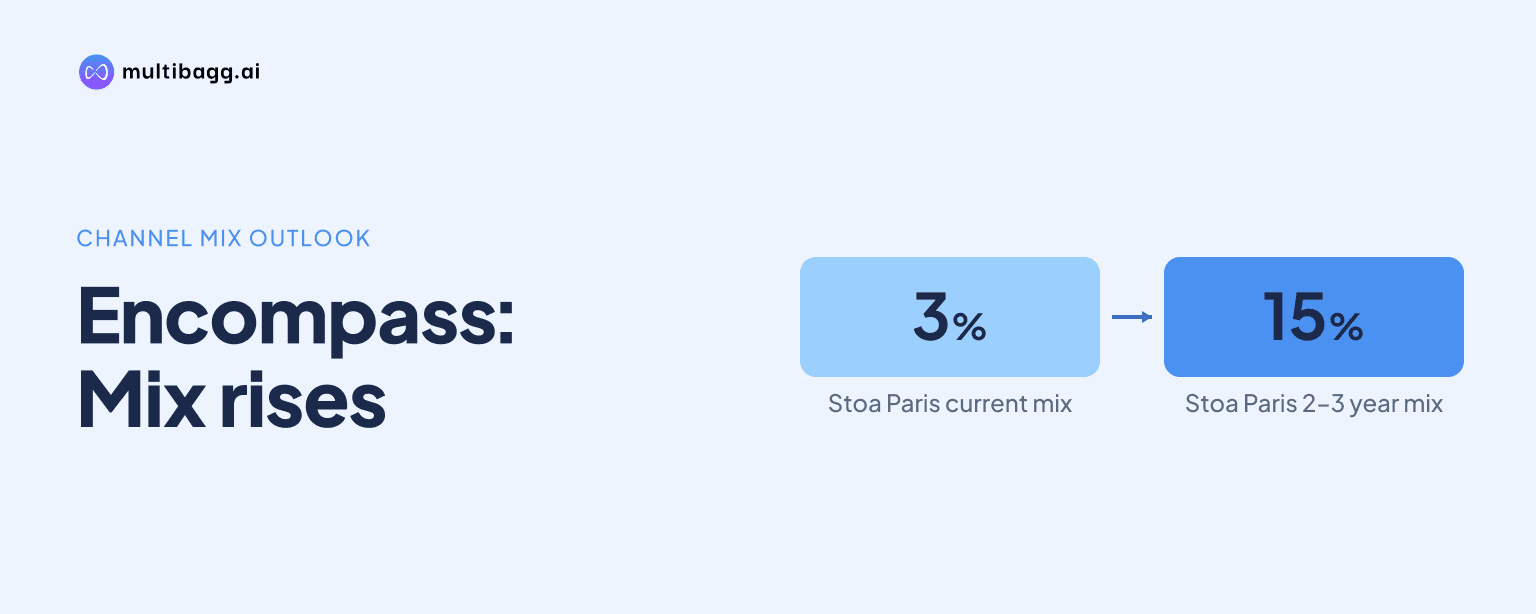
Encompass Design India Limited plans to raise offline retail to 15% of sales for both Stoa Paris and Small Batch within the next two to three years, from 3% and about 5%, respectively. The channel shift accompanies consumer-brand revenue growth of 148% year on year to Rs 20.70 crore in H1 FY27.
Know Encompass Design India inside out
Results, valuation, peers and who's buying, in one view.
How will Encompass change Stoa Paris’s channel mix?
Encompass expects Stoa Paris to reduce direct-to-consumer, or D2C, sales to 50% from 62% while raising offline retail to 15% from 3% over the next two to three years. Management said other marketplaces and quick commerce currently account for 34% of sales and should remain at about 35%, making offline retail the principal source of the planned rebalancing.
Stoa Paris had already established a physical base through 65 offline stores, including Reliance, Centro and Home Town, at the time of the November 19, 2026 earnings call. The premium home-furnishing brand expanded from 25 stock-keeping units, or SKUs, at its 2022 launch to more than 400 SKUs, providing a larger range for its marketplace, D2C, quick-commerce and store channels.
Management’s prepared remarks gave a separate, narrower snapshot for Stoa Paris, describing own D2C sales at about 60% and marketplaces beyond Amazon at about 9%. The subsequent question-and-answer disclosure used a broader category covering other marketplaces and quick commerce, so the table uses that like-for-like channel breakdown rather than combining differently defined figures.
What is Encompass targeting for Small Batch offline sales?
Encompass targets a 15% offline sales mix for Small Batch, up from about 5%, while its D2C share is expected to decline to 60% from 72% over the next two to three years. Management said the released share should move towards both offline retail and other marketplaces and quick commerce, but did not quantify a target for the latter channels.
Small Batch currently derives 23% of sales from other marketplaces and quick commerce, compared with Stoa Paris’s 34%, indicating the two brands start from different digital-channel mixes. Management said the number of potential stores and retail doors for Small Batch is significant, underpinning its plan to increase physical distribution for its food products.
Small Batch reported H1 FY27 revenue of Rs 6.10 crore, up 199% year on year, compared with Stoa Paris revenue of Rs 14.60 crore, up 62%. Its 74.6% gross margin and 54.8% contribution margin were higher than Stoa Paris’s 68.3% gross margin and 41.3% contribution margin during the same half-year.
Why is Encompass expanding offline retail and marketplaces?
Encompass is broadening its channels to create what management called a more resilient and scalable business as consumer brands become a larger share of the group. Management identified distribution, product innovation and brand awareness as the means to scale its brands, with offline retail, marketplaces and quick commerce supplementing sales through proprietary D2C channels.
Consumer-brand revenue increased 148% year on year to Rs 20.70 crore in H1 FY27 and represented 43% of group revenue, compared with approximately 30% a year earlier. Segment earnings before interest, tax, depreciation and amortisation, or EBITDA, rose to Rs 9.40 crore from Rs 3.80 crore, producing a 45.3% margin and contributing more than 60% of group EBITDA.
The group’s reported revenue from operations rose 69% to Rs 47.50 crore in H1 FY27, while EBITDA increased 74% to Rs 15.50 crore. Management expects consumer brands to contribute close to 60% of H2 FY27 revenue and more than half of full-year FY27 revenue, compared with their 43% contribution in the first half.
Got a follow-up? Ask IRIS
What could offline expansion mean for Encompass working capital?
Encompass said a higher offline mix may extend receivable days to about 70 on the outside, because D2C, marketplace and offline channels operate on different terms. Debtor days stood at 57 at the end of H1 FY27, while management later described the current level as around 60 days, making receivables a disclosed execution consideration as retail distribution increases.
Inventory rose to Rs 23.30 crore at the end of H1 FY27 from Rs 16.30 crore at the end of FY26. Management attributed the increase to higher business volumes, additional designs and SKUs, channel expansion, early-year international volatility and preparation for the festival season; it said about four months of inventory is reasonable for products whose demand can rise during campaigns and sales events.
Cash and bank balances were Rs 45.20 crore against total borrowings of Rs 18.90 crore at the H1 FY27 end, yielding an approximate net cash position of Rs 26 crore. Management said it had reprioritised Rs 20 crore for working capital after its preference issue was short-closed, and identified tighter inventory planning, disciplined receivables management and working-capital alignment with growth as priorities.
How does the channel plan fit Encompass’s brand strategy?
Encompass is building a portfolio of three to five brands at a time, according to management, rather than a large number of individual brands. Stoa Paris and Small Batch are the two scaling brands, while QuirkLoom and Blisshome are sub-brands leveraging the Stoa Paris platform; the proposed acquisition of Ballr Apparels, owner of Bummer, is intended to add a third brand.
Management said brands have identified staff for distribution, production and logistics, while finance, treasury, human resources, warehousing, creative design and performance marketing are shared operating functions. Each category typically has 10 to 15 people, and management said it will add brands only when its platform can support a launch without excessive extra cost, team strain or working-capital pressure.
Management is not actively marketing Stoa Paris or Small Batch for sale. It said a future exit would depend on category-relevant scale, gross and contribution margins, steady growth, repeat customers, buyer interest and achievable value, and identified approximate annual recurring revenue, or ARR, of Rs 75 crore as a point where current brands could enter exit consideration.
Conclusion
Encompass’s channel plan shifts both core brands towards a larger offline presence without eliminating their D2C base. Stoa Paris is targeted to move from 3% to 15% offline sales while retaining 50% D2C sales, whereas Small Batch is targeted to move from about 5% to 15% offline sales and reduce D2C to 60%. The strategy is aligned with management’s expectation that consumer brands will become the majority of group revenue during FY27.
The next measures to watch are the H2 FY27 consumer-brand revenue mix, inventory and receivable days as physical retail expands. Management expects consolidated revenue growth of approximately 50% to 55% in FY27 and over 60% in FY28, with consumer brands accounting for close to 80% of group revenue in FY28; the disclosed plan leaves the pace of Small Batch marketplace expansion unquantified.