










Epigral Says Chlorine Pricing Has Reset to Around Zero
Key highlights
- Epigral said chlorine pricing was around zero in Q2 FY27 after historically being negative.
- Q2 FY27 ECU realisation was Rs 31,000 to Rs 32,000, while the current range was Rs 32,000 to Rs 33,000.
- Q2 FY27 revenue rose 28% year on year to Rs 752 crore, while EBITDA increased 3% to Rs 136 crore.
- Epigral expects renewable hybrid projects to supply 30% to 35% of total power demand within two to three years.
powered by IRIS
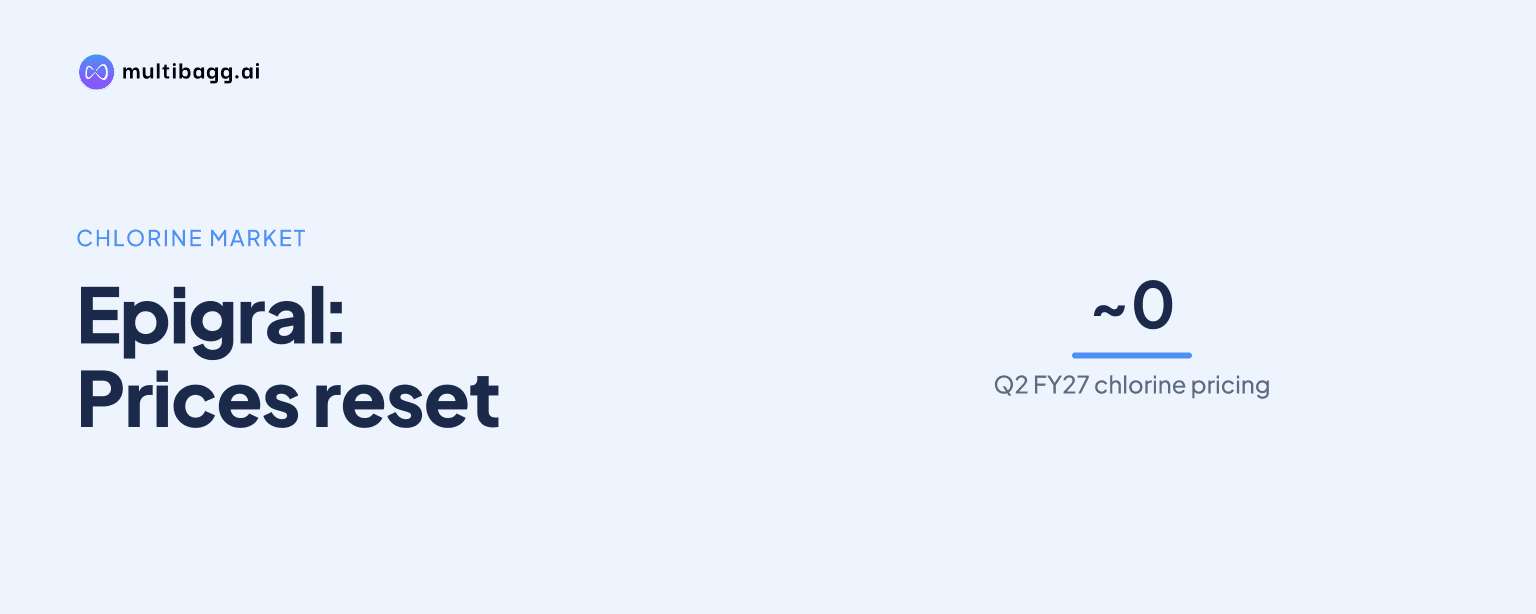
Epigral Limited said chlorine pricing was around zero in Q2 FY27 after historically entering negative territory, allowing chlor-alkali producers to recover more energy-cost inflation in the domestic chlorine market. Management put Q2 electrochemical-unit realisation at Rs 31,000 to Rs 32,000 and the current range at Rs 32,000 to Rs 33,000.
Know Epigral inside out
Results, valuation, peers and who's buying, in one view.
Why has Epigral said chlorine pricing has reset?
Epigral said chlorine has moved from a product that was sometimes priced negatively to one that management does not expect to return to the negative zone. Management described Q2 FY27 chlorine pricing as around zero, with a possible range of zero to minus Rs 1, and said the current level was around zero.
Chairman and Managing Director Maulik Patel described the change as a new environment for the chlor-alkali industry. Chlor-alkali production creates caustic soda and chlorine together, but Patel said caustic soda is globally priced while chlorine is priced in India. That distinction is central to Epigral’s view that cost recovery can now come more readily from chlorine.
The company’s Q2 FY27 financial outcome showed why this mechanism matters. Revenue increased 28% year on year to Rs 752 crore from Rs 589 crore, helped by higher volume and improved realisations, but earnings before interest, tax, depreciation and amortisation, or EBITDA, rose only 3% to Rs 136 crore from Rs 132 crore amid higher raw-material costs.
Why is chlorine a route for energy-cost recovery?
Epigral said chlorine pricing is easier to adjust for higher energy costs because it is determined in the domestic market, unlike caustic soda, whose price is globally influenced. Patel said global caustic soda prices had not moved as much as energy costs required in the prevailing environment, shifting the burden of cost recovery towards chlorine.
The cost pressure was especially relevant because most Indian chlor-alkali plants are coal-based, according to management. An analyst cited a 60% to 70% rise in coal prices over the previous three to four months, and Patel responded that gas prices had increased even more than coal prices in the current environment.
Epigral linked the pricing shift to demand as well as cost pass-through. Patel said new chlorine-derivative plants and demand had increased in the preceding six months, with further demand growth expected over the next six months. Management therefore attributed the move away from negative pricing to both added downstream chlorine consumption and higher energy costs.
How did chlor-alkali costs affect Epigral's Q2 FY27 earnings?
Epigral said higher coal and energy prices reduced chlor-alkali profitability and were the main reason for a sequential decline in operating profit during Q2 FY27. Investor Relations and Strategy executive Milind Kotecha gave that explanation when an analyst referred to a Rs 43 crore quarter-on-quarter fall in operating profit.
The reported margin comparison also showed greater pressure in the quarter than across the first half. Q2 FY27 EBITDA margin was 18%, while first-half FY27 EBITDA margin was 22%. First-half revenue increased 21% to Rs 1,461 crore from Rs 1,204 crore in H1 FY26, and EBITDA rose to Rs 315 crore from Rs 296 crore.
Profit after tax, or PAT, rose 26% year on year to Rs 64 crore in Q2 FY27 from Rs 51 crore. For H1 FY27, PAT rose to Rs 164 crore from Rs 131 crore and PAT margin was 11%, the same as H1 FY26. The results show that revenue growth and improved realisations coincided with input-cost pressure in the chlor-alkali business.
Got a follow-up? Ask IRIS
What are Epigral's current ECU and caustic soda expectations?
Epigral reported Q2 FY27 electrochemical-unit, or ECU, realisation of around Rs 31,000 to Rs 32,000. ECU represents the combined economics of caustic soda and chlorine from the chlor-alkali process. Management said the current ECU range had risen slightly to Rs 32,000 to Rs 33,000.
Patel said management believes global caustic soda prices could increase in Q3 and Q4 FY27 because Europe faces high energy costs during winter. He said caustic demand and the relevant global price index probably should begin rising in those quarters, but Epigral did not provide a specific caustic soda price target or margin forecast.
Epigral’s operating utilisation figures provide additional context for this exposure. In Q2 FY27, management said caustic soda capacity utilisation was around 75%, epichlorohydrin, or ECH, utilisation was around 75% to 80%, and hydrogen peroxide utilisation was around 95%. The company did not disclose product-specific margins for those operations.
How is Epigral reducing its energy exposure?
Epigral said it expects solar and wind hybrid projects to supply 30% to 35% of its total power demand within two to three years. Management said one hybrid project had already been commissioned and a second project had been announced, as part of a plan to reduce future energy costs.
The company said it would not need substantial direct capital expenditure for these projects. Instead, Epigral plans to invest 26% of the equity in a special purpose vehicle, or SPV, and provide a 20-year commitment. Management presented this structure as the model it intends to use to lower power-cost exposure.
The power plan comes alongside capacity additions that could broaden Epigral’s chlorine-linked downstream portfolio. Its chlorinated polyvinyl chloride, or CPVC, and ECH expansions were in trial runs in Q2 FY27 and were expected to be commissioned within a quarter. Derivatives and specialty products accounted for 57% of Q2 FY27 revenue.
How do downstream expansions use Epigral's chlorine integration?
Epigral said its in-house chlorine reaches its CPVC operations through a pipeline, rather than being handled through tonners. Management cited that arrangement when explaining its integrated manufacturing model and said it has the largest CPVC capacity in India, although it did not disclose the capacity figure on the call.
For ECH, management said capacity would double in Q3 FY27 and ramp-up would be gradual. It expects about 50% of eventual ECH production to be consumed internally and the other 50% to be sold in the market. The company is targeting commissioning of its epoxy resin plant by March 2028, with management expecting that project to support ECH consumption from FY29 onwards.
Epigral also said the pilot plants for its epoxy resin and formulations project and its multipurpose plant were ready, with customer approvals due to begin. Management estimated that its current and announced capital expenditure could support revenue of around Rs 5,000 crore to Rs 5,100 crore by FY31, based on current realisations and gradual capacity ramp-up.
Conclusion
Epigral’s main message is that chlorine’s move to around zero has changed the economics of chlor-alkali cost recovery. With caustic soda prices influenced by global markets, management sees domestically priced chlorine as the more responsive channel for passing through energy inflation, although Q2 FY27 still reflected pressure in 18% EBITDA margin and only 3% EBITDA growth.
The next developments to watch are management’s expectation of firmer caustic soda pricing in Q3 and Q4 FY27, commissioning of CPVC and ECH expansions within a quarter, and progress towards meeting 30% to 35% of power demand through renewable hybrid projects in two to three years. The March 2028 epoxy-resin commissioning target is also relevant to planned ECH captive consumption from FY29.