










Epigral Limited Q2 FY27 Revenue Rises 28%, Margin Falls
Key highlights
- Epigral reported Q2 FY27 revenue of ₹752 crore, up 28% year-on-year from ₹589 crore.
- EBITDA rose 3% to ₹136 crore, while EBITDA margin fell to 18% from 23%.
- Q2 FY27 profit after tax increased 26% to ₹64 crore from ₹51 crore.
- Derivatives & Specialty contributed 57% of Epigral's Q2 FY27 revenue.
powered by IRIS
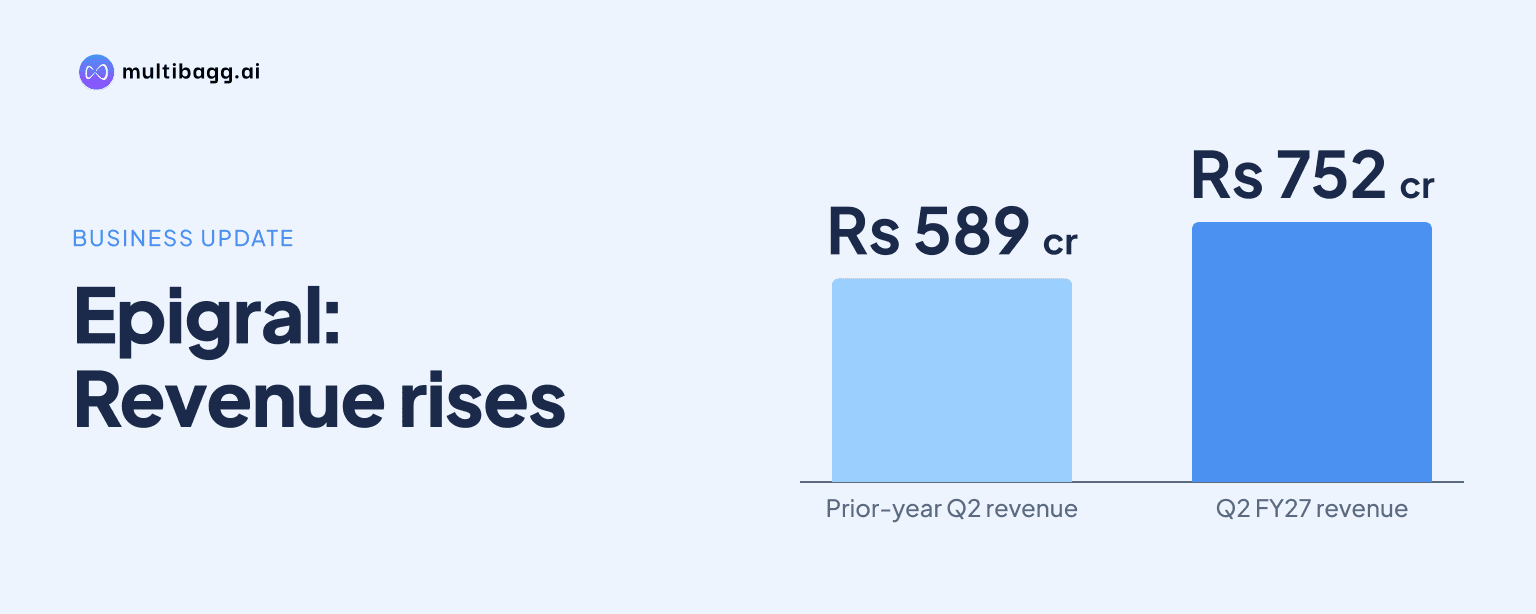
Epigral Limited reported Q2 FY27 revenue of ₹752 crore, up 28% year-on-year, but EBITDA increased only 3% to ₹136 crore as its margin declined to 18% from 23% amid higher raw-material costs. The result highlights the effect of cost pressures on profitability despite stronger volumes and improved realisations.
Know Epigral inside out
Results, valuation, peers and who's buying, in one view.
What did Epigral report for Q2 FY27?
Epigral reported revenue of ₹752 crore for the quarter ended September 30, 2026, compared with ₹589 crore in Q2 FY26. Management attributed the 28% year-on-year increase to volume growth and improved realisations across most products. The Derivatives & Specialty business accounted for 57% of quarterly revenue.
EBITDA rose to ₹136 crore from ₹132 crore a year earlier, representing growth of 3%. Net profit was ₹64 crore, compared with ₹51 crore in Q2 FY26, an increase of 26%. Separately reported standalone results showed revenue from operations of ₹745.99 crore and profit after tax of ₹64.42 crore. The company presentation used rounded figures of ₹752 crore revenue and ₹64 crore profit.
Why did Epigral's EBITDA margin decline?
Epigral said its Q2 FY27 EBITDA margin was affected by high raw-material costs. Management linked these costs to global uncertainty, which affected both raw-material and finished-goods prices. The margin fell to 18% even as revenue rose substantially, showing that the increase in operating costs was greater than the improvement in EBITDA.
Management also referred to higher energy prices and said the increased cost burden had shifted to the chlorine side of operations. It indicated that demand for chlorine derivatives and new plants had increased over the preceding six months, with further demand growth expected over the following six months. However, the company did not provide a quantified FY27 revenue, earnings, or margin forecast during the call.
How is Epigral's product mix and capacity plan developing?
Epigral said its Derivatives & Specialty segment contributed 57% of Q2 FY27 revenue. The contribution makes this business the larger part of the company's quarterly revenue mix and provides context for management's emphasis on volumes, product realisations, and demand for chlorine derivatives.
The company also indicated that CPVC and ECH capacity is due in Q3 FY27. During the earnings call, management said demand for ECH is growing in India and that export opportunities are also available. The disclosures did not specify the capacity size, commissioning date, capital expenditure, or expected revenue contribution from these projects.
Got a follow-up? Ask IRIS
What do the half-year figures show about the business?
For H1 FY27, Epigral reported revenue of ₹1,461 crore, up 21% year-on-year. EBITDA increased 7% to ₹315 crore, and the H1 EBITDA margin was 22%. Net profit for the first half rose 25% to ₹164 crore.
The H1 profit comparison requires context because the prior-year reported figure included an ₹81 crore deferred-tax benefit, according to the investor presentation summary. The reported first-half revenue and EBITDA growth indicate continued expansion in sales, while the Q2 margin decline shows that profitability was more pressured in the July-September period.
What does the result mean for investors and the chemicals sector?
The quarterly result shows a split between top-line growth and operating-profit growth. Revenue rose 28% and profit after tax rose 26%, but EBITDA growth was limited to 3% because of raw-material costs. For investors, the 18% EBITDA margin is a central operating metric because it was five percentage points lower than the year-earlier quarter.
Management described the chemical industry environment as complex, volatile and highly challenging, with headwinds expected to persist in upcoming quarters. At the same time, it maintained a positive long-term view on Indian chemical demand. The company has not issued a numerical FY27 outlook, so the available disclosures do not establish a specific growth, margin, or profit target for the full year.
Conclusion
Epigral's Q2 FY27 performance combined strong revenue growth with weaker operating leverage. Revenue reached ₹752 crore, while higher raw-material costs limited EBITDA growth and reduced the margin to 18%. The 57% revenue contribution from Derivatives & Specialty also underlines the importance of this business mix to the quarterly outcome.
Investors will watch the planned Q3 FY27 CPVC and ECH capacity additions, along with movements in raw-material and energy costs. Management has cited domestic ECH demand and export opportunities, but it has not disclosed quantified FY27 guidance or projected financial contributions from the new capacities.