










Epigral says existing capex can support Rs 5,100 crore FY31 revenue
Key highlights
- Epigral estimates Rs 5,000 crore to Rs 5,100 crore of revenue by FY31.
- Gross block could rise from about Rs 3,000 crore currently to Rs 4,100 crore to Rs 4,200 crore.
- The MPP and epoxy-resin projects carry about Rs 600 crore of capex.
- Epigral targets 30% to 35% of power demand from solar and wind hybrid sources within two to three years.
powered by IRIS
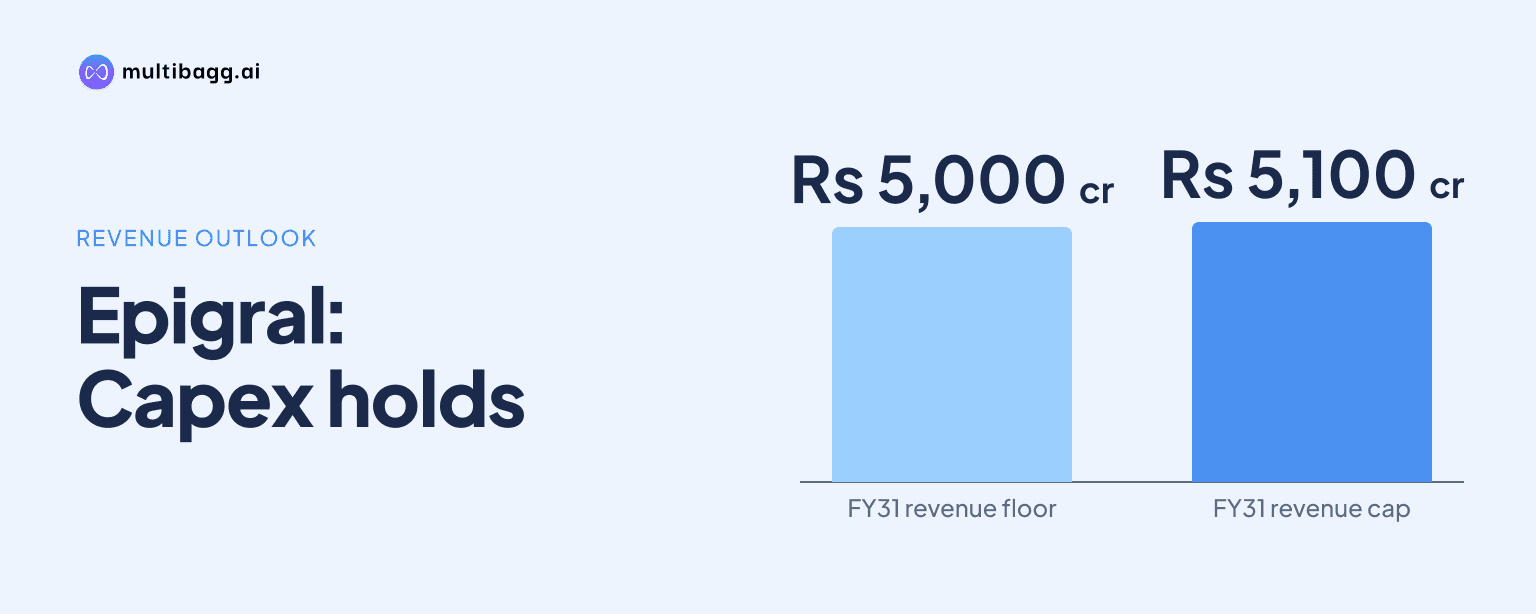
Epigral said its existing assets and committed CPVC, ECH, epoxy-resin and multipurpose-plant investments can support Rs 5,000 crore to Rs 5,100 crore of revenue by FY31. Management based that estimate on a projected Rs 4,100 crore to Rs 4,200 crore gross block, current realisations and a gradual ramp-up in capacity utilisation.
Know Epigral inside out
Results, valuation, peers and who's buying, in one view.
How does Epigral link its FY31 revenue target to capex?
Epigral links its FY31 revenue range to the gross block expected after projects already under way and announced are completed. Management said the current gross block is about Rs 3,000 crore, while CPVC and ECH projects due for commissioning in about a quarter would add roughly Rs 500 crore to Rs 600 crore. At optimum utilisation, it estimated that a gross block of around Rs 3,500 crore could generate revenue of about Rs 3,600 crore to Rs 3,700 crore.
The next investment layer is the epoxy-resin and multipurpose plant, or MPP, programme, for which management cited capex of around Rs 600 crore. That addition would lift the gross block to about Rs 4,100 crore to Rs 4,200 crore. Management said this asset base was sufficient to generate Rs 5,000 crore to Rs 5,100 crore of revenue by FY31, without identifying a further capex requirement in its response.
The Rs 5,000 crore to Rs 5,100 crore range is management's estimate rather than a declared revenue outcome. Management said it used current realisations and a gradual utilisation ramp-up for capacity commissioned this year and next year. The target therefore depends on both selling prices through FY31 and plants reaching the assumed utilisation levels.
Which projects underpin Epigral's FY31 revenue plan?
Epigral's plan rests on CPVC and ECH expansions being commissioned, followed by the MPP and epoxy-resin projects. Management said the earlier projects would take gross block from around Rs 3,000 crore to approximately Rs 3,500 crore, while the Rs 600 crore MPP and epoxy-resin programme would lift it to Rs 4,100 crore to Rs 4,200 crore.
The MPP is intended to support value-added chemistry beyond basic chlorotoluene sales. Management said chlorotoluene revenue could be close to Rs 100 crore in the current year, while the chlorotoluene business could contribute around Rs 300 crore at optimum utilisation. It said future value addition could increase that figure but did not assign a specific MPP revenue contribution within the FY31 bridge.
Epigral also expects ECH to supply an internal downstream operation as well as external customers. Management targeted commissioning of the epoxy-resin plant by March 2028 and said it could begin driving revenue from FY29. It estimated that about 50% of ECH output would be consumed captively, with the remaining 50% sold in the market after the epoxy-resin operation reaches the relevant stage.
Got a follow-up? Ask IRIS
When should Epigral's additional capacity start contributing?
Epigral said the CPVC and ECH projects would be commissioned in about a quarter, while the epoxy-resin plant is targeted for commissioning by March 2028. The earlier CPVC and ECH additions should therefore begin ramping before the epoxy-resin unit, and management said epoxy-resin revenue should start contributing from FY29 onwards.
The FY31 target allows for a phased ramp-up rather than immediate full production. Management said its Rs 5,000 crore to Rs 5,100 crore estimate incorporates gradual utilisation of capacity commissioned this year and next year. For ECH, it cited growing Indian demand and an export opportunity but did not provide a numerical utilisation timetable or export-sales target.
CPVC is another utilisation variable because demand growth and customer approvals affect volume absorption. Management said CPVC utilisation was around 60% to 65% at the time of the call and described demand growth at about 13% compound annual growth rate, or CAGR. It said additional industry supply could create uneven timing in a single year, but management expects demand to absorb capacity over three to four years.
What assumptions and constraints underlie Epigral's FY31 estimate?
Epigral's FY31 calculation assumes current realisations and progressive asset utilisation, not simply physical project commissioning. Management said CPVC realisations were around Rs 120 to Rs 125 per kilogram and had moved with raw-material prices. It also said customer approvals are required for both CPVC and ECH, with CPVC approvals taking longer because pipe testing forms part of the process.
Energy costs are a separate operating consideration. Management said one solar and wind hybrid project had been commissioned and a second announced. Over the next two to three years, it expects 30% to 35% of total power demand to be supplied by solar and wind hybrid sources, with Epigral investing 26% of the equity in a special-purpose vehicle, or SPV, and committing to a 20-year arrangement.
That renewable-power structure is distinct from the Rs 600 crore MPP and epoxy-resin capex included in the FY31 revenue discussion. Management said it does not expect substantial investment for the renewable projects, while annual maintenance capex is generally around 1.5% of gross block. It also said higher coal and energy prices reduced chlor-alkali profitability in the reported quarter, showing that revenue growth and earnings can be affected by different drivers.
Conclusion
Epigral's Rs 5,000 crore to Rs 5,100 crore FY31 revenue estimate is tied to a stated asset build-out: about Rs 3,000 crore of current gross block, roughly Rs 500 crore to Rs 600 crore from CPVC and ECH additions, and Rs 600 crore for the MPP and epoxy-resin programme. Management's bridge indicates that these assets, at current realisations and progressively higher utilisation, are intended to support the target without further capex being identified in the call.
The next points to watch are CPVC and ECH commissioning in about a quarter, the March 2028 epoxy-resin commissioning target and the expected FY29 start of epoxy-resin revenue. Management's plan for solar and wind hybrid sources to meet 30% to 35% of power demand within two to three years, alongside the pace of CPVC approvals, will also influence how capacity converts into sales and operating costs.