










Epigral targets Rs 300-350 crore chlorotoluene revenue at scale
Key highlights
- Epigral expects close to Rs 100 crore of chlorotoluene revenue in FY27.
- Epigral targets Rs 300-350 crore of chlorotoluene revenue at optimum utilisation.
- Derivatives and specialty products contributed 57% of Epigral's Q2 FY27 revenue.
- Epigral reported H1 FY27 revenue of Rs 1,461 crore, versus Rs 1,204 crore in H1 FY26.
powered by IRIS
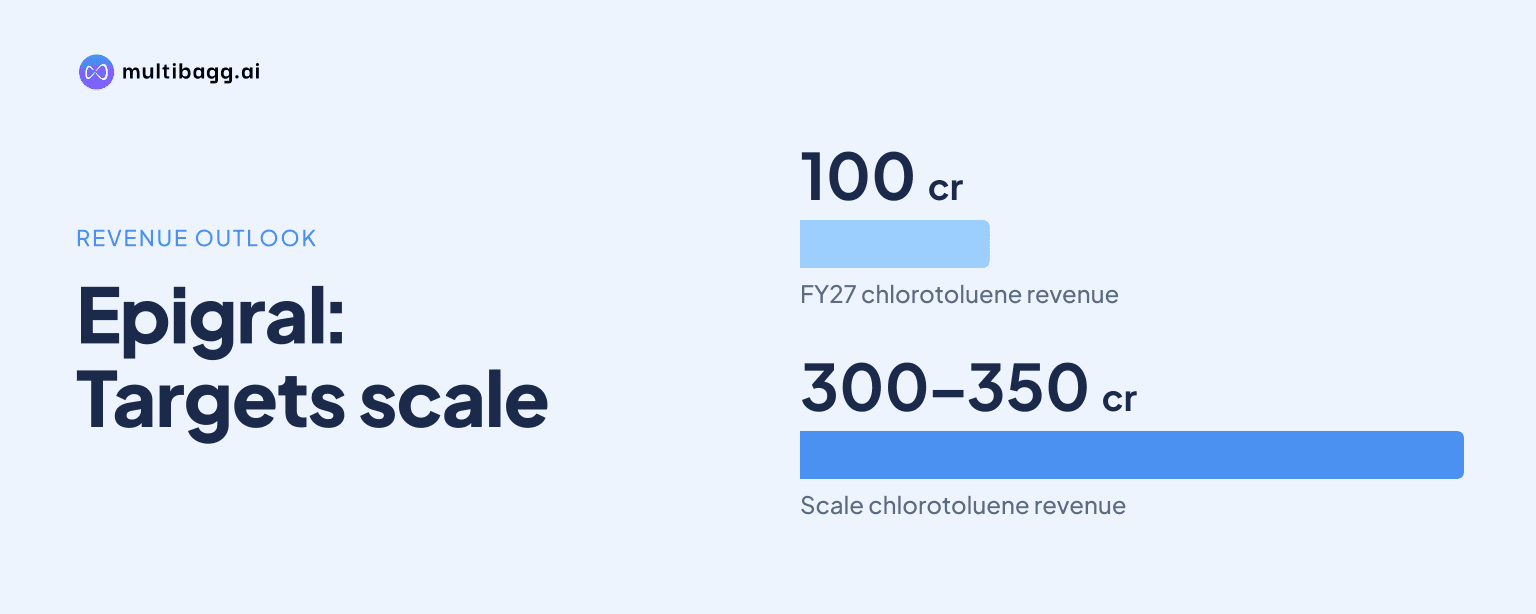
Epigral Limited expects its chlorotoluene business to generate Rs 300-350 crore of revenue at optimum utilisation, compared with close to Rs 100 crore in FY27, as volumes rise quarter on quarter and the company develops downstream pharma and agrochemical intermediate chemistry.
Know Epigral inside out
Results, valuation, peers and who's buying, in one view.
What is Epigral's chlorotoluene revenue target?
Epigral's stated chlorotoluene revenue target is Rs 300-350 crore at optimum utilisation. Management gave that range during its Q2 FY27 earnings call, after saying the business should generate close to Rs 100 crore in FY27. It did not state the date at which it expects to reach optimum utilisation.
The target represents a threefold to 3.5-fold increase over the FY27 expectation, although it is a management estimate rather than reported revenue. Management also distinguished the existing chlorotoluene opportunity from future downstream products, saying the current chlorotoluene side is around Rs 300 crore and value addition could raise the contribution further.
The call did not disclose chlorotoluene installed capacity, current utilisation, quarterly revenue, customer count or product-specific profitability. That leaves the Rs 300-350 crore range as the clearest disclosed benchmark for the business, while the timing and economics of the ramp remain unquantified.
How is Epigral ramping up chlorotoluene volumes?
Epigral said chlorotoluene volumes are rising quarter on quarter and should support close to Rs 100 crore of revenue in FY27. Management said its commercial focus is on ortho-chlorotoluene, or OCT, and para-chlorotoluene, or PCT, rather than the benzyl chloride, benzyl alcohol and related benzyl chain raised by an analyst.
Management said no one manufactures OCT and PCT in India, and that Epigral is pursuing value-added chemistry for pharma intermediates and agrochemical intermediates that can consume these molecules. The company did not provide market-size data, customer names, selling prices or an end-market split between pharmaceutical and agrochemical applications.
The chlorotoluene ramp is occurring as the company shifts its wider sales mix toward derivatives and specialty products. That portfolio accounted for 57% of total revenue in Q2 FY27, when total revenue rose 28% year on year to Rs 752 crore from Rs 589 crore in Q2 FY26. The company did not quantify chlorotoluene's contribution to that quarterly revenue growth.
Q2 FY27 profitability did not provide a separate read-through for chlorotoluene because Epigral does not disclose product-level margins. Company-wide earnings before interest, tax, depreciation and amortisation, or EBITDA, increased 3% to Rs 136 crore from Rs 132 crore a year earlier, while management attributed margin pressure to higher raw-material costs amid global uncertainty.
Got a follow-up? Ask IRIS
Which products could increase Epigral's chlorotoluene revenue further?
Epigral said selected downstream pharma and agrochemical chemistry could lift chlorotoluene revenue beyond Rs 300-350 crore. This remains a conditional opportunity because the relevant products are at research and development and pilot-plant stages, with no commercial-volume target, customer list or additional revenue estimate disclosed.
The multipurpose plant, or MPP, pilot plant was ready in Q2 FY27, and management said customer approvals would begin soon. Its stated purpose is to reduce qualification time once commercial manufacturing starts. Management added that approvals for value-added chlorotoluene chemistry should occur faster than those during the initial chlorotoluene business ramp, without giving a completion date.
Epigral has explicitly excluded one alternative route. It said it will not enter the benzyl alcohol and benzyl value chain, instead retaining its focus on OCT and PCT and the downstream intermediate chemistry based on those products. This narrows the announced expansion path to the chemicals management identified during the Q2 FY27 call.
Product economics have not been disclosed. When asked for chlorotoluene realisation and margins, management said it does not share product-wise margins and referred to an overall margin range of around 22%. In H1 FY27, Epigral reported EBITDA of Rs 315 crore on revenue of Rs 1,461 crore, compared with Rs 296 crore on revenue of Rs 1,204 crore in H1 FY26.
How does chlorotoluene fit into Epigral's expansion plans?
Epigral's chlorotoluene ramp sits beside capacity expansions in chlorinated polyvinyl chloride, or CPVC, and epichlorohydrin, or ECH, which management expected to commission within a quarter of the Q2 FY27 call. The company said trial runs were under way, while epoxy resin and MPP pilot plants were prepared for customer-approval work.
Management estimated that the CPVC and ECH additions would raise gross block from about Rs 3,000 crore to Rs 3,500-3,600 crore. At optimum utilisation, it said this asset base could support Rs 3,600-3,700 crore of revenue. This is a company-wide capacity estimate based on current realisations, not a projection specific to chlorotoluene.
The next planned stage is approximately Rs 600 crore of capital expenditure for epoxy resin and MPP projects. Management said this could take gross block to Rs 4,100-4,200 crore and support Rs 5,000-5,100 crore of revenue by FY31, assuming gradual commissioning and utilisation ramp-up. It separately targeted commissioning the epoxy resin project by March 2028.
Funding remains relevant to the broader programme. Epigral spent Rs 88 crore on capital expenditure in H1 FY27 and reported net debt of Rs 514 crore at September 30, 2026, compared with Rs 496 crore on September 30, 2025. Net debt to EBITDA was 0.9, compared with 0.8 a year earlier.
Conclusion
Epigral has set a defined commercial benchmark for chlorotoluene: close to Rs 100 crore of revenue in FY27 and Rs 300-350 crore at optimum utilisation. The gap between those figures depends on continuing volume growth in OCT and PCT, while any revenue above that range depends on the conversion of pilot-stage downstream chemistry into approved commercial products.
The next milestones are the expected CPVC and ECH commissioning within a quarter of the Q2 FY27 call, the start of customer approvals for MPP chemistry, and the targeted March 2028 epoxy resin commissioning. Management has not disclosed a chlorotoluene utilisation target or dated route to Rs 300-350 crore, making progress on volumes and customer approvals the key unresolved matters.