










Epigral targets up to 35% renewable power within three years
Key highlights
- Epigral expects solar and wind projects to meet 30% to 35% of total power demand within two to three years.
- Epigral plans to invest 26% of SPV equity and make a 20-year power commitment.
- The complex’s power requirement was discussed at about 120 to 140 megawatts, depending on utilisation.
- Management linked chlor-alkali pressure to higher coal and energy costs after an analyst cited a Rs 43 crore sequential operating-profit decline.
powered by IRIS
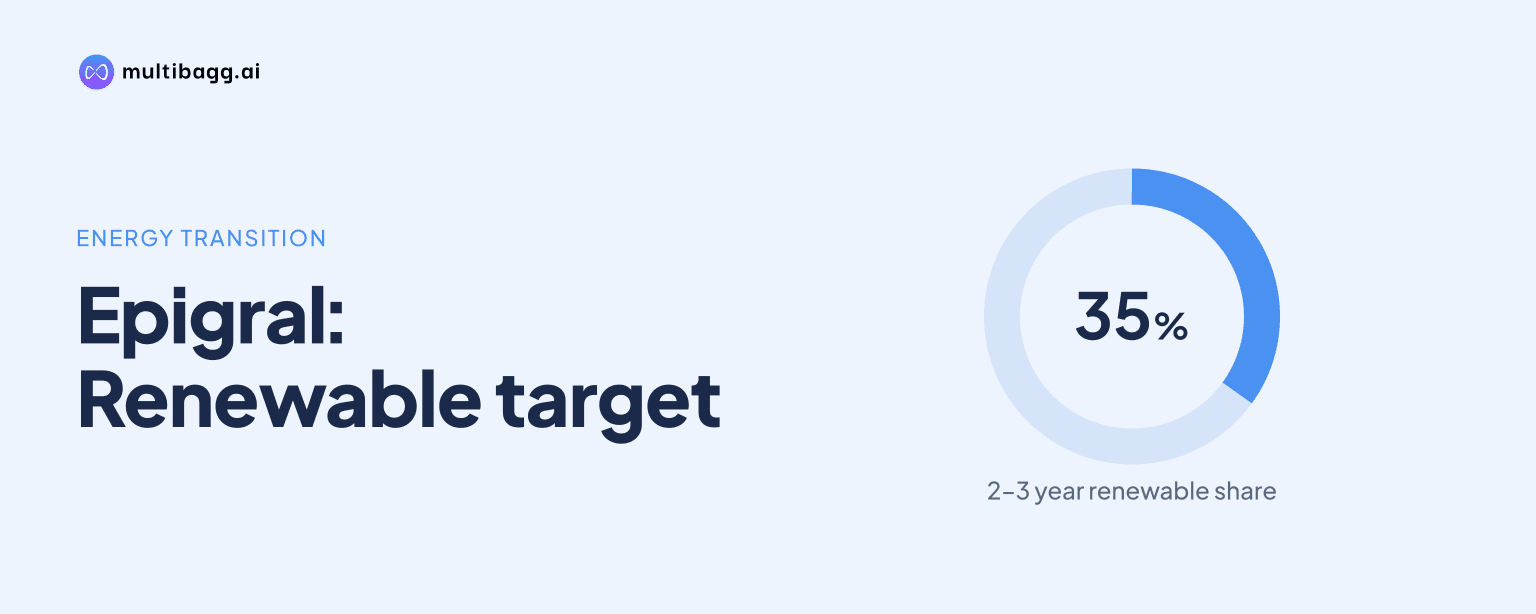
Epigral expects solar and wind hybrid projects to meet 30% to 35% of total power demand within two to three years. Management said the model requires a 26% equity investment in special purpose vehicles, or SPVs, and 20-year commitments, aiming to reduce energy costs without substantial direct capital expenditure.
Know Epigral inside out
Results, valuation, peers and who's buying, in one view.
How much of Epigral’s power demand could renewables supply?
Epigral expects solar and wind hybrid projects to supply 30% to 35% of its total power demand within two to three years. Management gave this expectation while answering a question on reducing the company’s exposure to coal-based power and did not specify a calendar-year deadline.
The complex’s total power requirement was discussed at about 120 to 140 megawatts, depending on product utilisation levels. Epigral has already commissioned one solar and wind hybrid project and announced a second, but management did not disclose their generation capacity, annual output or the share of current demand already served.
At the stated 30% to 35% range, renewable supply would remain a partial replacement for conventional power procurement. The call did not state what proportion of the remaining 65% to 70% of demand would be supplied by coal-based generation, so the eventual reduction in coal-linked exposure cannot be calculated from the disclosed information.
How will Epigral structure renewable-power investments?
Epigral plans to invest 26% of the equity in each relevant SPV and provide a long-term commitment of 20 years. Management said these are the principal requirements for Epigral, rather than substantial investment in wholly owned renewable-generation assets.
An SPV is a separate project company used for the solar and wind hybrid arrangement. Management said this approach is being used in the chemical industry to reduce energy costs, while allowing Epigral to limit direct capital expenditure; it did not identify project partners, equity amounts, total project costs or contracted electricity tariffs.
The renewable arrangement differs from Epigral’s manufacturing expansion programme because it is designed as a procurement-linked equity structure. Management described it as not being a major capital-expenditure item, although the 26% equity contribution and 20-year commitment mean the company retains both an investment and a long-term power-purchase obligation.
Why is lower-cost power relevant to Epigral’s chlor-alkali operations?
Lower-cost power is relevant because management said higher coal and energy prices were the major reason chlor-alkali profitability declined sequentially. An analyst said operating profit fell by Rs 43 crore quarter on quarter, and management identified the energy-intensive chlor-alkali business as the principal area affected by rising coal-linked power costs.
Caustic soda, a chlor-alkali product, operated at about 75% utilisation in the second quarter, according to management. That compared with 75% to 80% for epichlorohydrin, or ECH, and about 95% for hydrogen peroxide, showing that the power-cost issue was tied to the chlor-alkali segment rather than an across-the-board decline in utilisation.
Management placed electrochemical unit, or ECU, realisation at Rs 32,000 to Rs 33,000. It also said global caustic prices could increase in the third and fourth quarters because winter energy costs in Europe could raise prices, but this was management’s market view and not a forecast of Epigral’s margins.
Got a follow-up? Ask IRIS
How does the power plan compare with Epigral’s manufacturing capex?
Epigral’s renewable structure is smaller in direct capital intensity than the chemical projects outlined on the call. Management said annual maintenance capital expenditure is generally around 1.5% of gross block, while the renewable plan involves 26% SPV equity stakes rather than building and owning all generation capacity directly.
Management said gross block was about Rs 3,000 crore and could increase by Rs 500 crore to Rs 600 crore after CPVC and ECH projects are commissioned. It also cited about Rs 600 crore of capital expenditure for multipurpose plant, or MPP, and epoxy-resin projects, which are distinct from the solar-wind power arrangement.
The manufacturing projects are expected to increase production capacity and potentially power requirements over time. Management said ECH capacity would be doubled with a gradual ramp-up, while epoxy resin was targeted for commissioning by March 2028 and could begin contributing revenue from financial year 2029 onward.
What disclosures will show progress in Epigral’s renewable rollout?
Progress will be shown by whether the second announced solar and wind hybrid project advances sufficiently for Epigral to reach a 30% to 35% renewable share within two to three years. The call did not provide commissioning dates for either project, making future timing disclosures important to assessing the stated plan.
The key missing measures are project capacity, power generated, electricity delivered to Epigral’s complex and the tariff or cost under the 20-year commitment. Management also gave no projected rupee savings, so a direct comparison between renewable procurement and coal-linked energy costs is not yet available.
Future chlor-alkali profitability will provide operating context for the plan. Management linked the sequential pressure in that segment to coal and energy prices, while caustic soda utilisation was about 75%; later disclosures may indicate whether a larger solar-wind share changes this cost relationship.
Conclusion
Epigral’s renewable strategy is a partial shift in power procurement rather than a full replacement of conventional supply. Management expects solar and wind hybrid projects to supply 30% to 35% of total demand within two to three years, using 26% SPV equity stakes and 20-year commitments to address energy costs without substantial direct capital expenditure.
The next disclosed milestone is execution of the second announced solar and wind hybrid project. Management has not provided project capacities, investment amounts, tariffs or expected savings, while ECH expansion and epoxy resin commissioning targeted by March 2028 could alter the complex’s demand profile over the planned rollout period.