










Gayatri Rubbers says FY27 revenue may exceed Rs 55 crore
Key highlights
- Gayatri Rubbers recorded Rs 27.52 crore of income in H1 FY27 against its Rs 55 crore FY27 revenue target.
- Management expects EBITDA margin of around 25% in H2 FY27, versus around 23.5% in H1 FY27.
- Gayatri Rubbers’ Rs 10 crore to Rs 12 crore order book is expected to be fully executed in FY27.
- Management estimates railway pads could eventually generate Rs 70 crore to Rs 100 crore of revenue after approval and ramp-up.
powered by IRIS
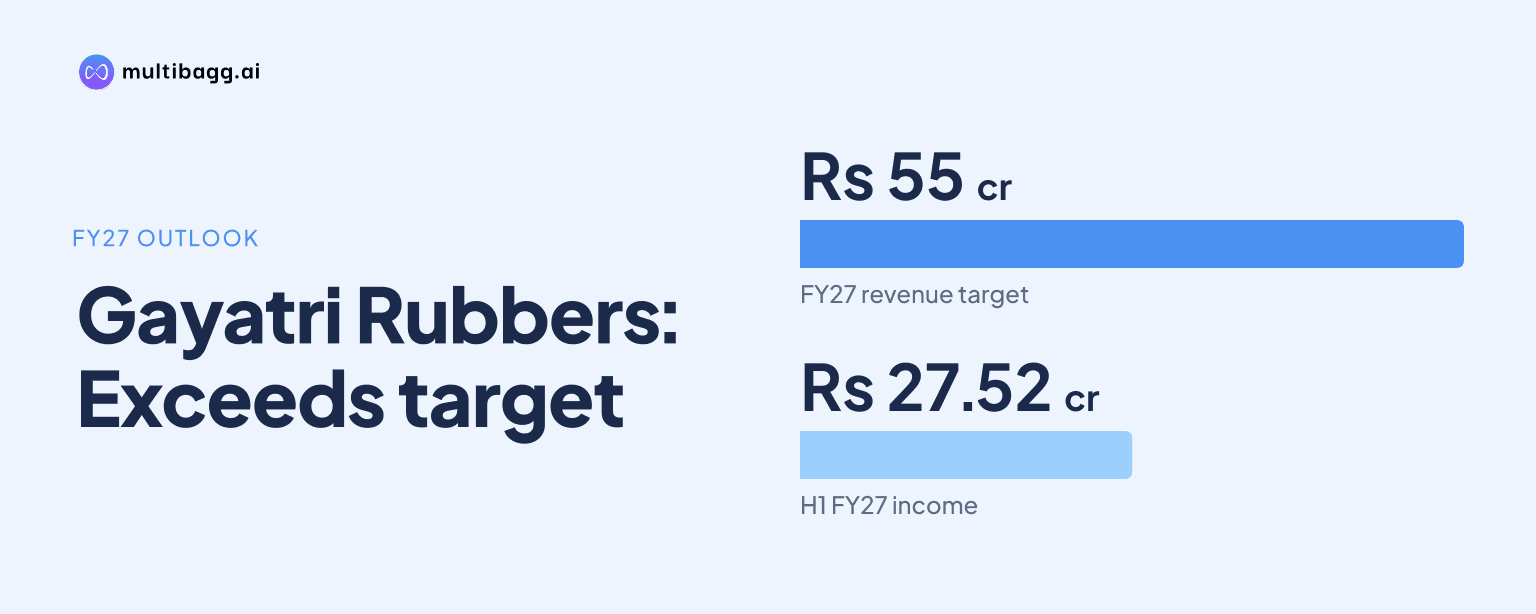
Gayatri Rubbers and Chemicals Limited said it may exceed its Rs 55 crore financial year 2027 (FY27) revenue target after Rs 27.52 crore of first-half (H1) income, with Indian Railways and smart meters expected to support second-half (H2) sales and earnings before interest, tax, depreciation and amortisation (EBITDA) margin projected at about 25%.
Know Gayatri Rubbers and Chemicals inside out
Results, valuation, peers and who's buying, in one view.
Can Gayatri Rubbers exceed its Rs 55 crore FY27 revenue target?
Yes, Gayatri Rubbers said it is on track to meet its Rs 55 crore FY27 revenue target and that revenue may exceed that figure. With Rs 27.52 crore of income recorded in H1 FY27, Rs 27.48 crore would be needed in H2 to reach the stated annual target.
Management said Indian Railways made a good contribution in H1 FY27 and that both Indian Railways and smart meters should contribute again in H2. Around 50% of Gayatri Rubbers’ revenue comes from Indian Railways, while its other served sectors include smart metering, architectural, automotive and industrial applications.
The Rs 27.48 crore H2 amount is a calculation from the disclosed H1 income and the Rs 55 crore target, rather than a management forecast for the half-year split. Management did not provide a revised quantified revenue target above Rs 55 crore, so the possible overachievement remains unquantified.
Why does Gayatri Rubbers expect a higher H2 FY27 margin?
Gayatri Rubbers expects EBITDA margin of around 25% in H2 FY27, compared with around 23.5% in H1 FY27. The expected H2 level is also above the 21.11% FY26 EBITDA margin cited by an analyst during the call and the around 21% FY27 guidance level referred to by that analyst.
Management said the H1 FY27 margin was sustainable and that it would seek to improve it further, but did not give a raw-material, pricing or product-mix bridge for the expected 25% H2 margin. It identified Indian Railways as the main H1 contributor and said industrial and railway sectors were more sustainable and more profitable than architectural and automobile businesses.
Fire-retardant compliance is another mechanism management said supports tender qualification and pricing. Gayatri Rubbers said it has an in-house laboratory for fire-retardant compliance and that only three companies in India have such a laboratory, while suppliers that do not meet the criterion can be disqualified from some large tenders.
How much FY27 revenue visibility does Gayatri Rubbers have from railways?
Gayatri Rubbers has an order book of around Rs 10 crore to Rs 12 crore, which management said would be fully completed in FY27. The company supplies around 65 products required in a single railway coach and said it currently serves 65 out of an addressable 75 railway products.
Management expects approximately Rs 10 crore to Rs 15 crore of FY27 revenue from Vande Bharat and Metro projects, separate from its other Indian Railways business. It said it is receiving good orders for Vande Bharat and expects some good Metro orders, without disclosing individual order values or delivery schedules.
Tender timing could still shift revenue between quarters. Management said a tender delay may affect quarterly revenue somewhat, but it did not expect a significant half-yearly impact because of recurring smart-meter orders and sales to architectural, automotive and industrial sectors.
Got a follow-up? Ask IRIS
What could expand Gayatri Rubbers’ railway business after FY27?
Gayatri Rubbers is seeking approval from the Research Designs and Standards Organisation (RDSO) for railway pads, which management estimates could ultimately generate Rs 70 crore to Rs 100 crore of revenue alone. One of four approval stages had been cleared, and management said complete clearance could take nine to 12 months.
Management said Gayatri Rubbers would be eligible for 20% of railway-pad orders during a nine-month development stage after approval. Its stated sequence implies that the Rs 70 crore to Rs 100 crore railway-pad revenue potential would take about 21 to 24 months, rather than being a material contributor to the FY27 target.
Management expects railway-pad margins of at least 20% to 25% if approval is secured, though that estimate depends on approval and the start of manufacturing. It also said Plant 3 would be considered only after railway-pad approval, leaving its capital expenditure, timing and funding mix undecided.
How do smart meters and manufacturing capacity support the outlook?
Gayatri Rubbers said smart meters remain part of its H2 FY27 revenue expectation, although management does not expect much increase in smart-meter demand by FY28. The company supplies smart-meter material on a roll basis at around 600 units per roll, and said roughly one to 1.5 metres of its product is used in one smart meter.
For two main smart-meter manufacturers, management said Gayatri Rubbers is a single-source supplier. Plant 1 was operating at around 85% capacity and Plant 2 at around 35% to 40%, with Plant 1 expected to be fully utilised around FY27 and Plant 2 by the end of FY28.
Management said Plant 2 could support peak revenue of around Rs 50 crore to Rs 60 crore, depending on machinery use. Separately, Gayatri Rubbers said 70% of documents, permissions and certificates needed for potential exports to European countries had been completed, but it did not estimate export revenue.
Conclusion
Gayatri Rubbers’ FY27 outlook is based on Rs 27.52 crore of H1 income, a Rs 55 crore revenue target that management says may be exceeded, and an expected EBITDA margin increase from around 23.5% in H1 to around 25% in H2. Indian Railways contributes around 50% of revenue, while smart meters are expected to provide recurring H2 business.
The next disclosed milestones are execution of the Rs 10 crore to Rs 12 crore FY27 order book, the expected Rs 10 crore to Rs 15 crore contribution from Vande Bharat and Metro, and railway-pad approval in about 10 months. Management’s Rs 70 crore to Rs 100 crore railway-pad revenue estimate depends on approval, a nine-month development stage and a subsequent production ramp-up.