










Gayatri Rubbers and Chemicals Limited targets Rs 70-100 crore
Key highlights
- GRCL expects railway-pad revenue potential of Rs 70 crore to Rs 100 crore after a roughly 21- to 24-month process.
- GRCL expects further railway-pad approvals in around 10 months after clearing its first approval stage.
- GRCL said it would be eligible for 20% of railway-pad orders during a nine-month development stage.
- GRCL supplies around 65 of 75 railway products and has a Rs 10 crore to Rs 12 crore order book for FY27 completion.
powered by IRIS
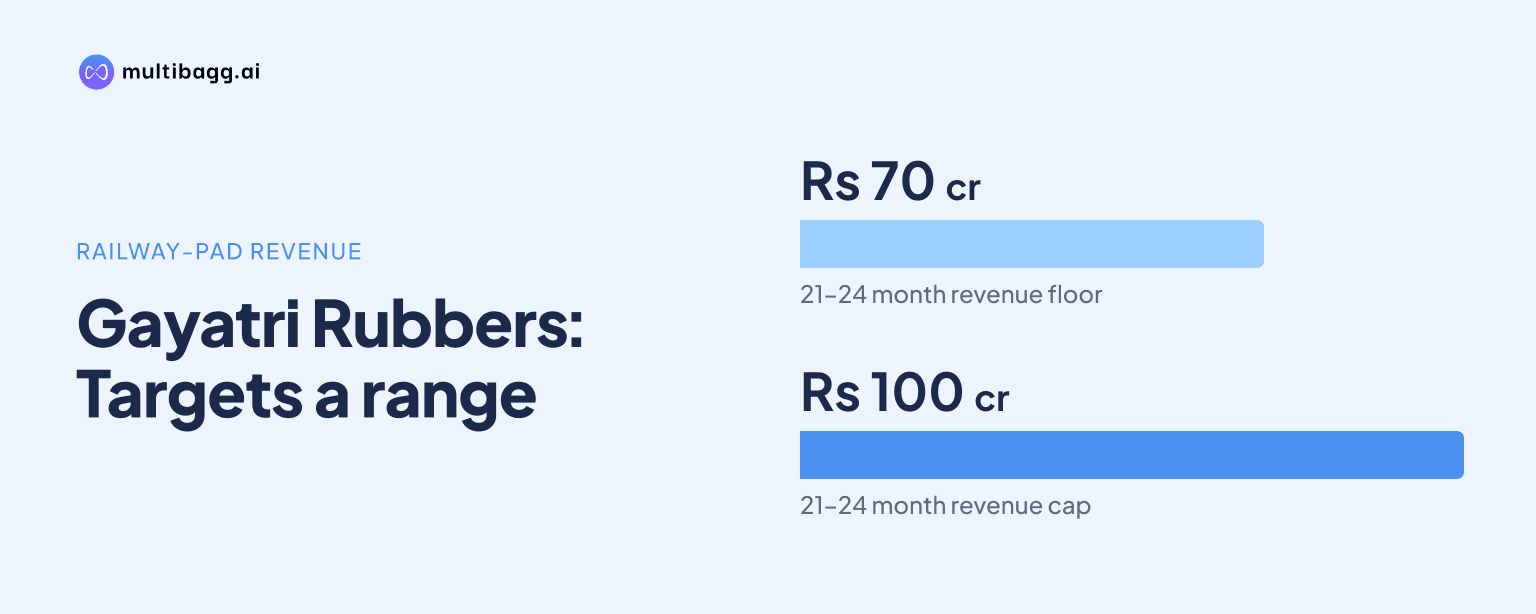
Gayatri Rubbers and Chemicals Limited expects railway pads to generate Rs 70 crore to Rs 100 crore of revenue about 21 to 24 months after completing its approval and development path. GRCL said its first approval stage is cleared, expects further approvals in around 10 months, and would initially be eligible for 20% of orders during a nine-month development stage.
Know Gayatri Rubbers and Chemicals inside out
Results, valuation, peers and who's buying, in one view.
What revenue does GRCL expect from railway pads?
GRCL expects railway pads alone to generate around Rs 70 crore to Rs 100 crore after the approval and production ramp is completed. Management described railway pads as products placed beneath railway tracks that must meet hard, strictly compliant specifications. The estimate is management's revenue-potential outlook, not a booked order value or reported revenue, and it depends on obtaining approvals and commencing manufacturing.
The potential is larger than GRCL's company-wide FY27 revenue target of Rs 55 crore. Management said it was on track to meet that target and that it might exceed it, with Indian Railways and smart meters contributing in H1 FY27 and expected to contribute in H2. The proposed pad-business range is Rs 15 crore to Rs 45 crore above the FY27 target, but it refers to a later potential annual business after the stated 21- to 24-month process.
GRCL's current order book of around Rs 10 crore to Rs 12 crore is expected to be completed in FY27, according to management. This is materially different from the railway-pad estimate: the order book is an existing position for FY27, while the pad range is conditional on approval, development-stage eligibility and subsequent scaling. Management did not disclose the expected annual quantity of pads or the tender value underlying its Rs 70 crore to Rs 100 crore estimate.
How long will GRCL take to build railway-pad revenue?
GRCL expects the route to the full railway-pad opportunity to take approximately 21 to 24 months. Management said the first approval stage has already been cleared and that it expects the next approvals in around 10 months. It then expects a nine-month development stage, during which the company would be eligible for 20% of orders rather than the full order opportunity.
After the initial nine-month development period, management described another nine months before it expects the Rs 70 crore to Rs 100 crore revenue potential from railway pads. The stated sequence is therefore around 10 months to approval, nine months at the initial 20% allocation and a further nine-month period, producing the approximate 21- to 24-month timeframe. The transcript does not give a rupee revenue estimate for the 20% development-stage allocation.
Railway-pad approval involves process inspection by the Research Designs and Standards Organisation, or RDSO, according to management. GRCL said RDSO personnel would remain at the company's facility to inspect manufacturing processes, the raw materials used and other operating details. Management characterized this requirement as a barrier to entry, but did not identify a scheduled inspection date or disclose the remaining approval stages beyond expecting approvals in around 10 months.
Management expects railway-pad margins of 20% to 25% if GRCL receives approval. It did not define whether this range refers to gross margin, earnings before interest, tax, depreciation and amortisation margin, or another profitability measure. For comparison, management said H1 FY27 earnings before interest, tax, depreciation and amortisation margin was around 23.5% and it expected around 25% in H2, while an analyst said FY26 margin had been 21.11%.
Got a follow-up? Ask IRIS
What railway position does GRCL already have?
GRCL already supplies around 65 railway products required in a single railway coach and said it caters to 65 of 75 products in its railway product requirement. Of the remaining 10 products, management identified two to three as high-revenue opportunities, specifically including railway pads and automatic inter-car gangways. Further expansion into those products depends on RDSO approval, management said.
This means the pad initiative would extend GRCL's existing Indian Railways supply activity rather than introduce the company to a new end market. Management said Indian Railways made a good contribution in H1 FY27, alongside smart meters, and expected both businesses to contribute in H2. It did not disclose segment revenue, the share of H1 FY27 sales from Indian Railways, or revenue from the existing 65 railway products.
GRCL said it is a Class I supplier to Indian Railways and identified timely supply as the principal factor behind that status, with competitive rates as a secondary factor. Management also said compliance determines who can supply railway products and that it did not see competitive pressure as significant. Those statements are management's view of its railway operating environment and do not quantify market share, tender-win rates or the number of approved competitors.
The company said Indian Railways typically involves a maximum receivable period of 30 to 45 days, although this depends on the payment cycle. Management also said a delay in railway tendering could affect quarterly revenue, but it did not expect a significant effect on half-yearly revenue because of recurring smart-meter orders and sales to architectural, automotive and industrial customers. This indicates that railway timing can affect individual quarters even while other businesses contribute to a half-year period.
What could change GRCL's railway-pad timetable?
The clearest factor is the approval process, because the Rs 70 crore to Rs 100 crore outlook assumes further approvals in around 10 months and a nine-month development stage thereafter. GRCL has completed its first approval stage, but management did not say that final approval had been granted. A change in RDSO inspection, development-stage clearance or manufacturing commencement would change the timing management has set out.
Initial order access is also limited by the 20% allocation management expects during the development phase. GRCL said it would undertake the development stage for nine months after approval and would be eligible for 20% of orders during that period. Consequently, the potential Rs 70 crore to Rs 100 crore business should not be read as revenue expected immediately after approval or as an amount available during the initial development period.
GRCL said it has capacity to supply Indian Railways and can prioritise railway emergency orders, while other clients can wait up to 30 days. The company also said 80% to 90% of production is undertaken in-house and around 10% is procured externally. On inputs, management said fire-retardant chemicals are not completely and easily available in India, but GRCL has two sources for them.
Management said it is not currently pursuing backward integration, although it said this could be done. It also said industrial and railway sectors appear more sustainable and more profitable to management than architectural and automobile segments. Separately, management said it plans to consider entering defence after railway-pad approval, but gave no revenue target, investment amount or timeline for that potential business beyond placing it after the pad-approval process.
Conclusion
GRCL has presented railway pads as a conditional future revenue opportunity of Rs 70 crore to Rs 100 crore, exceeding its Rs 55 crore FY27 company-wide target. The proposal builds on a railway portfolio of 65 out of 75 products and a Class I supplier position, but it is not current pad revenue and relies on approval, development-stage participation and a later scale-up.
The next disclosed milestone is management's expectation of further approvals in around 10 months, followed by a nine-month development stage with eligibility for 20% of orders. Investors can watch whether GRCL converts the cleared first stage into manufacturing approval, provides a revenue update on the development allocation, and maintains its stated 20% to 25% railway-pad margin expectation.