










Glen Industries cuts FY27 outlook as plant start slips back
Key highlights
- Glen Industries cut FY27 revenue outlook to Rs 225-230 crore from an earlier Rs 350 crore target.
- The delayed new facility may contribute at most Rs 25 crore in FY27, versus Rs 125 crore included in the earlier plan.
- Management expects injection moulding to start in January 2027 and all three divisions to begin production by April 2027.
- Glen Industries expects about Rs 550 crore of turnover when the expansion’s full effect is realised in 2028-29.
powered by IRIS
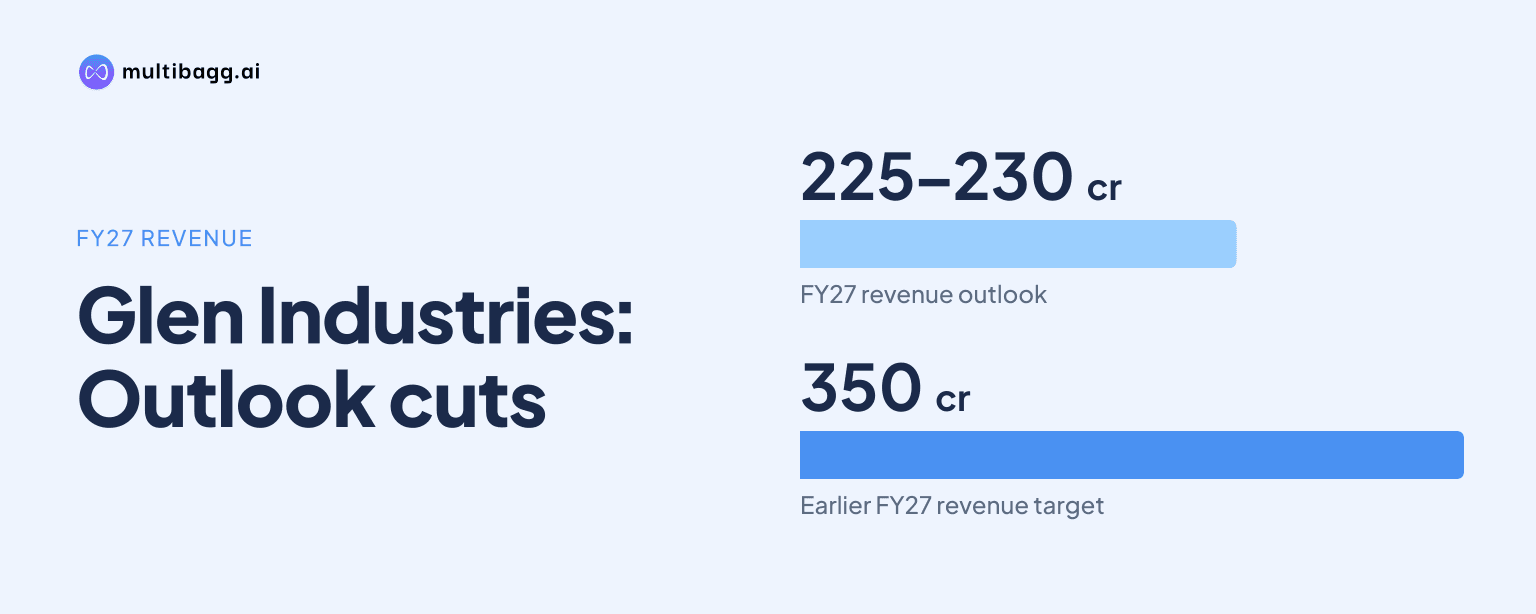
Glen Industries Limited has reduced its FY27 revenue outlook to Rs 225-230 crore because its delayed new facility may contribute at most Rs 25 crore during the year, against Rs 125 crore included in the earlier Rs 350 crore target. Management expects injection moulding to begin in January 2027 and all three divisions to start production by April 2027.
Know GLEN Industries inside out
Results, valuation, peers and who's buying, in one view.
Why has Glen Industries delayed the new facility?
Glen Industries said the project is about six months behind schedule because civil work faced disruptions from February 2026 through October 2026. Management attributed the delay first to elections and the SIR process, then to administrative disruption after the election, and subsequently to severe monsoon conditions in West Bengal.
Management said West Bengal received 30% excess rainfall during the monsoon, compared with a 12% rainfall deficit across India, affecting construction work. Several machines have already arrived and are stored in warehouses, while other machines remain ready in China because they could not be shipped before civil construction is complete.
The revised sequence is to begin with injection moulding in January 2027, followed by thermoforming and then paper products. Glen Industries expects to complete process setting and start production across the injection, thermoforming and paper divisions by April 2027, although management described the January start as an expectation.
How much has Glen Industries cut its FY27 revenue outlook?
Glen Industries has cut its FY27 revenue outlook to Rs 225-230 crore from the earlier Rs 350 crore target, primarily because the new project will make a limited contribution during the year. Management said the previous Rs 350 crore target included about Rs 125 crore from the new facility.
Management initially said FY27 revenue from the facility could be Rs 25-40 crore, depending on the speed of start-up. In its later explanation of the revised total outlook, it said the company could realise at most Rs 25 crore, making that the more conservative contribution estimate.
The implementation delay has not changed the project’s Rs 130 crore capital-expenditure budget. Glen Industries said existing annual depreciation is about Rs 7 crore and expects a further Rs 10-11 crore after the project is implemented, taking annual depreciation to about Rs 17-18 crore.
When will Glen Industries reach the expansion’s full revenue potential?
Glen Industries expects to need five to six months after the 2027 production start to stabilise the full production capacity. Management said operations could be fully in stream by September or October, and annual turnover in the ramp-up year could be Rs 400-500 crore.
Management expects the full impact of the new capacity in 2028-29, when turnover could reach about Rs 550 crore. The facility’s incremental revenue capacity remains Rs 300-350 crore, while an analyst on the call described the existing revenue base as about Rs 200-230 crore.
Glen Industries said it does not foresee a problem selling the additional output once production becomes available. That is management’s demand assessment rather than a disclosure of contracted sales, and the company said it will need to build and stabilise production before the facility delivers its full revenue potential.
Management also identified a Rs 1,000 crore revenue target by 2030, but explicitly said this was not a commitment. After the current project starts in March or April 2027, it plans a three- to four-month cooling period before evaluating which further capacity project to pursue.
Got a follow-up? Ask IRIS
What will Glen Industries add through the expansion?
Glen Industries plans to add thermoforming, paper packaging and in-mould labelling, or IML, alongside injection moulding. The paper line will make paper cups, paper food containers and other paper-packaging products, with management saying the same customer base purchases products across injection, thermoforming and paper categories.
Management said thermoformed products will complement, rather than compete with, injection-moulded products. It identified fruit, bakery, namkeen and meal-tray packaging as thermoforming uses, while noting that injection moulding can be more expensive for meal trays.
The company also plans printing equipment and IML capability to provide value-added packaging. Management identified sweet manufacturers, ice-cream producers and candy manufacturers as potential IML customers, while saying restaurants have also begun adopting IML products.
At full ramp-up, management illustrated Rs 550 crore of turnover with an 18% earnings before interest, tax, depreciation and amortisation, or EBITDA, margin, equivalent to Rs 99 crore. It estimated about Rs 15 crore of interest, Rs 18 crore of depreciation and Rs 14 crore of tax, leaving profit after tax, or PAT, of about Rs 50-55 crore; these are management estimates, not FY27 guidance.
How could exports and raw-material pricing affect the ramp-up?
Glen Industries said exports currently account for about 25% of revenue and management aims to raise that share to around 35% after capacity expands. Thin-wall food containers already have an export share of almost 50%, and management identified Europe and North America as the principal growth markets.
The company attended the PEC Expo in the United States in October 2026 and plans to attend the Canton Fair in April and the National Restaurant Association show in the United States next year. Management said these events could add customers and that existing customers could increase their purchase basket, but it did not disclose any orders from the exhibitions.
Raw-material costs also affect reported revenue and percentage margins. Management said raw-material prices rose from about Rs 100 to Rs 160, while selling prices rose from around Rs 200 to Rs 260-270, a price increase of about 35% implemented in stages from April through July-August.
Management said margins had declined by about 1-2 percentage points in percentage terms as input costs increased, while its internal focus includes realisation and value addition per metric tonne. It also said selling prices would decline if raw-material prices fall, as they have in earlier periods.
Conclusion
Glen Industries has deferred, rather than cancelled, a Rs 130 crore expansion with Rs 300-350 crore of annual revenue capacity. The later start materially changes FY27: management now expects Rs 225-230 crore of revenue because only a limited part of the new facility’s output can be recorded during the year.
The next disclosed milestones are an expected January 2027 injection-moulding start, production in all three divisions by April 2027, and capacity stabilisation within five to six months. Management expects the full expansion effect in 2028-29, when it has indicated turnover of about Rs 550 crore.