










Glen Industries targets 35% exports as capacity expands
Key highlights
- Glen Industries targets exports of about 35% of sales, versus the 26.34% share cited on its November 18, 2026 call.
- Glen Industries said almost 50% of thin-wall food containers are exported.
- Management identified North America as its major export opportunity, followed by Europe.
- Management expects revenue of around Rs 225 crore to Rs 230 crore after project delays.
powered by IRIS
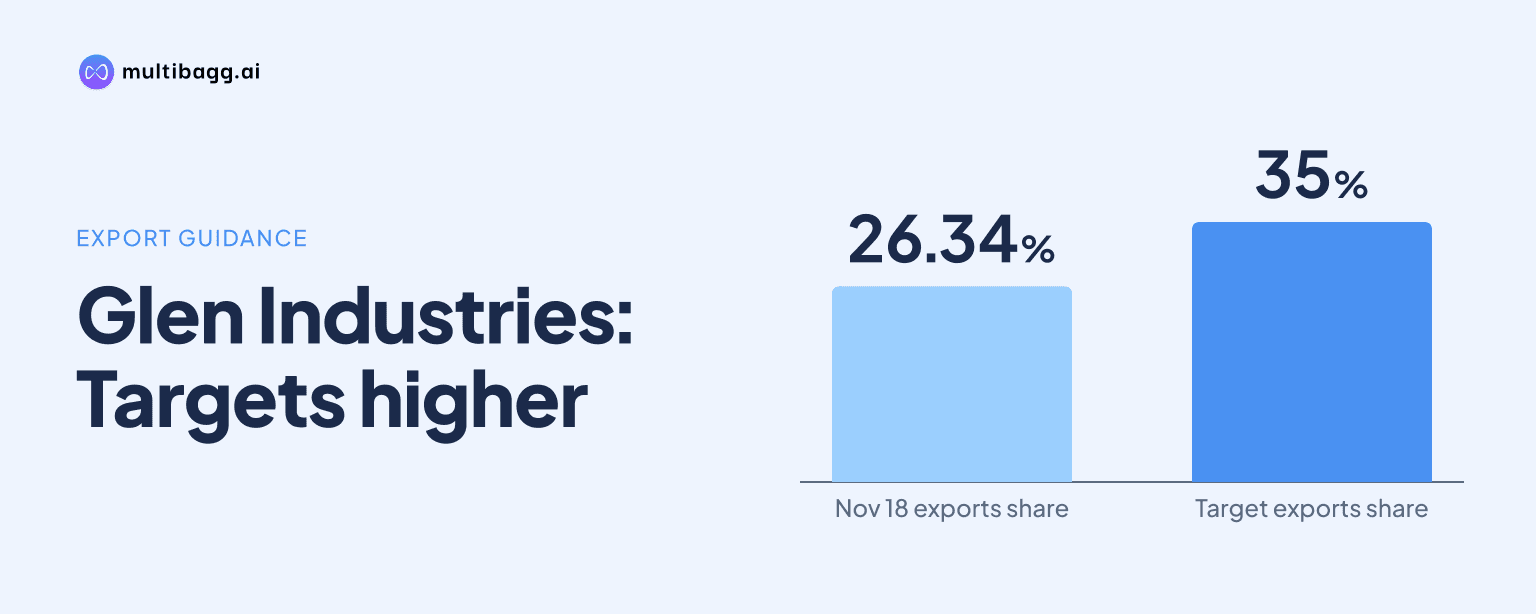
On November 18, 2026, Glen Industries Limited said it is targeting exports of about 35% of sales, versus the 26.34% contribution cited on the call, by using expanded capacity to pursue North America and Europe. Management identified North America as the major market and Europe as the next priority, while giving no timetable for the mix target.
Know GLEN Industries inside out
Results, valuation, peers and who's buying, in one view.
How much of Glen Industries sales could come from exports?
Glen Industries is targeting an export contribution of around 35% of sales, up from the 26.34% share cited by an investor during the November 18 call. The implied increase is 8.66 percentage points. Management did not disclose a target year, export revenue in rupees, or a region-by-region sales split for achieving the 35% mix.
The export mix differs by product line. Glen Industries said it exports almost 50% of its thin-wall food-container segment, a much higher share than the company-wide 26.34% figure. That indicates overseas demand is already more important in this food-packaging category than across the wider business.
Management linked the higher export goal to the capacity expansion and customer-development activity, rather than to a specific order book. It said existing customers could increase their basket sizes, while participation in trade fairs is intended to add customers. The call did not quantify confirmed export orders or the conversion of customer inquiries into sales.
Which export markets is Glen Industries prioritising?
Glen Industries is prioritising North America, followed by Europe, after its capacity expansion. Management said it already exports across Europe, the United States and Australia, and received many inquiries from Canada and Mexico at a US trade fair held in October 2026. North America therefore includes the US, Canada and Mexico in the company’s market-development plans.
Europe remains an established export destination where Glen Industries expects further penetration. Management said Europe and North America offer the principal market possibilities for the additional output. It did not provide country-level revenue, volumes, customer counts or a forecast for sales from Europe, the US, Canada or Mexico.
Management ruled out some regions as priorities on the call. It said Southeast Asia does not offer an opportunity for Glen Industries, while exports to the Middle East are costly from Kolkata. That assessment concentrates the post-expansion export effort on North America and Europe rather than a broad expansion across all overseas markets.
How will Glen Industries build overseas customer demand?
Glen Industries is using trade fairs and its existing customer channels to build overseas demand. It participated in PEC Expo in the US in October 2026, plans to attend the Canton Fair in April, and also plans to attend the National Restaurant Association show in the US. Management said these events are intended to capture new customers alongside larger purchases by current customers.
The company expects thermoformed containers to use the same marketing channel as injection-moulded packaging. Management described thermoforming as complementary to injection moulding because it can serve fruit packaging, bakery packaging, namkeen packaging and food meal trays, where injection products may be more expensive. This means Glen Industries does not expect to establish a separate route to market for the new product range.
The target customers for thermoformed packaging are therefore broadly the same food-packaging buyers served by the injection business. Management said restaurant owners recognise quality differences in containers, including leakage issues. It said lower-quality products may require taping around the package, while its products do not, though the call included no independent quality metrics or customer-retention data.
Got a follow-up? Ask IRIS
When could added capacity support Glen Industries exports?
Glen Industries said the project schedule is the main dependency for added export capacity. On November 18, management said civil work was progressing quickly and it was pushing to start the injection division in January 2027. In another answer, management said it would assess additional projects only after the current project starts and has a three-to-four-month cooling period.
Project delays have reduced management’s near-term revenue expectation. It said revenue could be around Rs 225 crore to Rs 230 crore, compared with an earlier Rs 350 crore expectation that included about Rs 125 crore from the new project. Management said at most about Rs 25 crore from the project could be realised in the current year, limiting its initial contribution to both domestic and export sales.
Management also said revenue could reach Rs 245 crore to Rs 250 crore with marginal turnover from the new project. It expects revenue to start building from April after commissioning. The differing revenue indications reflect the unresolved commissioning and ramp-up timing, rather than a revised export-share target.
What factors could affect Glen Industries export revenue?
Glen Industries said selling prices move with raw-material costs in both directions. Management said raw-material prices rose from around Rs 100 to Rs 160, while selling prices increased from about Rs 200 to Rs 260 or Rs 270, a rise it described as roughly 35%. It said the increases occurred in stages from April through July and August, while volumes were marginally higher or broadly unchanged.
By October 2026, management said raw-material prices had started to decline slightly. It expects any reduction in input costs to be passed on, potentially causing a marginal decline in revenue at the existing facility without affecting absolute profitability. Management cited the COVID period, when material prices moved from about US$1,500 to US$1,600 per tonne down to US$850 before stabilising around US$1,000.
Management also cited relative freight, labour and customs-duty conditions in discussing exports against Chinese suppliers. It said India pays about 13% to 13.5% duty in the US, compared with 35% for China, while Chinese export freight costs and labour costs are higher. It also said a possible 6.5% customs-duty advantage in Europe depends on a Euro FTA coming into effect, so that benefit is not presented as current.
Conclusion
Glen Industries’ plan is to raise exports from the 26.34% share cited on the November 2026 call to around 35%, centred on North America and Europe. The strategy combines incremental capacity, trade-fair participation and the use of existing channels for thermoformed and injection-moulded packaging. Thin-wall food containers, with almost 50% exported, show that some product lines already have a larger overseas orientation.
The next issue to watch is whether the injection division starts in January 2027 and whether revenue begins building from April, as management indicated. Investors can also monitor the planned Canton Fair in April and National Restaurant Association show in the US, along with progress toward management’s Rs 225 crore to Rs 230 crore revenue expectation and the higher Rs 245 crore to Rs 250 crore scenario with initial project turnover.