










Glen Industries targets Rs 550 crore FY29 revenue, Rs 50-55 crore PAT
Key highlights
- Glen Industries' FY29 framework assumes about Rs 550 crore of revenue and Rs 50 crore to Rs 55 crore of PAT.
- Management's FY29 illustration uses an 18% EBITDA margin, producing about Rs 99 crore of EBITDA.
- The Rs 130 crore expansion is expected to raise annual depreciation from about Rs 7 crore to Rs 17 crore to Rs 18 crore.
- Glen Industries revised its FY27 revenue expectation to Rs 225 crore to Rs 230 crore after the project delay.
powered by IRIS
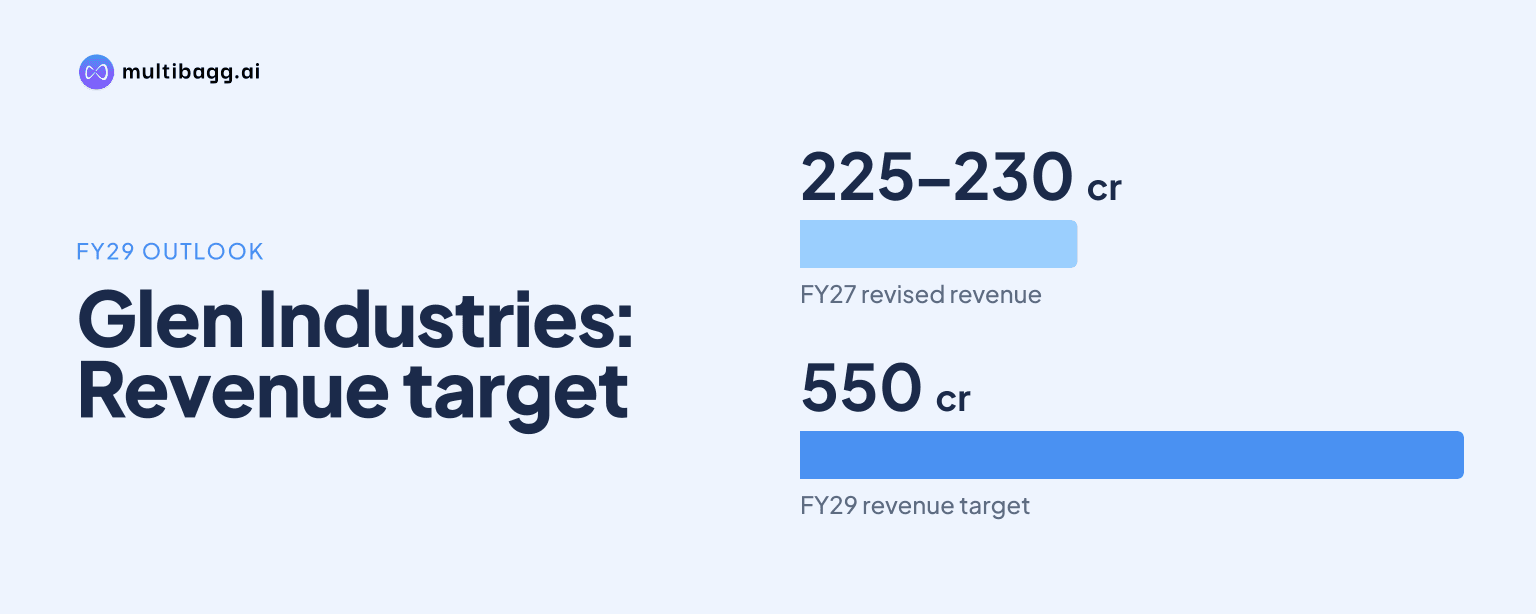
Glen Industries Limited targets about Rs 550 crore of revenue and Rs 50 crore to Rs 55 crore of profit after tax in FY29, when its new capacity reaches full revenue realisation. Management’s illustration assumes an 18% EBITDA margin, generating about Rs 99 crore of EBITDA and roughly Rs 52 crore of profit after tax.
Know GLEN Industries inside out
Results, valuation, peers and who's buying, in one view.
What is Glen Industries' FY29 profit framework?
Glen Industries expects turnover of about Rs 550 crore in FY29 after the expansion reaches full run-rate, with EBITDA, or earnings before interest, tax, depreciation and amortisation, equal to 18% of revenue. Management calculated EBITDA of about Rs 99 crore under that assumption and said profit after tax, or PAT, could be between Rs 50 crore and Rs 55 crore.
Management’s calculation deducts about Rs 15 crore of interest and around Rs 18 crore of depreciation from Rs 99 crore of EBITDA. That produces about Rs 66 crore before tax; after a roughly Rs 14 crore tax charge, management arrived at about Rs 52 crore of PAT. This is management’s illustrative full-revenue scenario rather than a reported FY29 result.
The Rs 550 crore framework is materially above Glen Industries’ revised expectation of Rs 225 crore to Rs 230 crore for FY27. Management said about Rs 125 crore of its earlier Rs 350 crore FY27 expectation was linked to the new project, but it now expects at most Rs 25 crore from that project in the current year because of the start-up delay.
When will Glen Industries' new capacity reach full run-rate?
Glen Industries said it expects the new project to start in 2027 and require five to six months to stabilise, with operations expected to be fully in stream by September or October. Management agreed with an analyst’s view that the facility could operate at 100% capacity utilisation from the second half of FY28, while FY29 would show the full revenue impact.
The project was delayed by disruption to civil work from February through October 2026, management said. It cited the election and SIR process, followed by reduced government functioning, and severe West Bengal monsoon conditions, with rainfall 30% higher in the state compared with a 12% deficit across India.
Management said many machines had already arrived and were being stored in a warehouse, while other equipment was ready in China but could not be shipped before civil construction progressed. It said it was pushing to begin the injection division in January 2027, while another response described a March or April start followed by a three-to-four-month cooling period before evaluating further projects.
For the ramp-up year, Glen Industries indicated turnover of Rs 400 crore to Rs 500 crore for the full year after stabilisation. Management also said it did not foresee a sales problem once production is available, but the Rs 550 crore FY29 framework still depends on construction completion, commissioning and the five-to-six-month stabilisation period.
How will Glen Industries' capex and borrowings affect FY29 profit?
Glen Industries said the total capital expenditure for the expansion remains Rs 130 crore. Existing annual depreciation is about Rs 7 crore, while the project is expected to add Rs 10 crore to Rs 11 crore, taking the annual total to about Rs 17 crore to Rs 18 crore after implementation.
Management said existing term loans should stand at about Rs 5 crore by the end of the year, alongside a further Rs 50 crore bank term loan for the project. Total term loans would therefore be about Rs 55 crore, repayable over seven years, with banking borrowing costs of around 8% to 8.5%.
The company separately identified working-capital bank liability of around Rs 80 crore when responding to an investor’s reference to Rs 290 crore of total liabilities. Management said the Rs 290 crore figure included multiple components and was not its actual bank liability, while the Rs 15 crore interest charge remains a key assumption in its FY29 PAT calculation.
Got a follow-up? Ask IRIS
What could change Glen Industries' revenue mix and margins?
Glen Industries said additional value-added products could improve margin per piece, including in-mould labelling, or IML, and printing equipment in the new project. Management identified sweet manufacturers, ice-cream makers, candy manufacturers and institutional buyers as potential IML customers because branding can be printed directly on the product.
Management said its pricing moves in both directions with raw-material costs. It gave an example of raw-material prices rising from around Rs 100 to Rs 160, while selling prices increased from around Rs 200 to Rs 260 or Rs 270, representing an increase of about 35%; it said selling prices would also decline if input costs fall.
Exports account for about 25% of Glen Industries’ revenue, and management targets an increase to around 35%. It said thin-wall food containers already have an export share of almost 50%, while Europe and North America are the priority markets for added capacity, including inquiries from Canada and Mexico after an October trade fair in the United States.
Thermoformed products are complementary to injection-moulded products, according to management, and can be used for fruit, bakery, namkeen and meal-tray packaging where injection products can be more expensive. Glen Industries plans to attend the Canton Fair in April and the National Restaurant Association show in the United States as it seeks customers for the expanded product range.
What is Glen Industries' longer-term expansion plan?
Glen Industries has a management target of Rs 1,000 crore of revenue by 2030, although management said there was no commitment on the next project after the current expansion. It said it has several projects available for evaluation, including potential expansion in existing or similar product lines, depending on demand realisation.
Management said it would first complete the current project, start operations in March or April, and allow a three-to-four-month cooling period before deciding which additional project to implement. It also said a main-board listing could be considered after completion of the required three-year period on the SME platform.
Conclusion
Glen Industries’ FY29 framework sets out management’s expected earnings profile at full revenue realisation: about Rs 550 crore of turnover, Rs 99 crore of EBITDA at an 18% margin, and Rs 50 crore to Rs 55 crore of PAT. Compared with the revised Rs 225 crore to Rs 230 crore FY27 revenue expectation, the plan depends heavily on the delayed Rs 130 crore expansion and its contribution to capacity.
The next item to watch is the planned start of the injection division in January 2027, alongside progress on civil construction and the subsequent five-to-six-month stabilisation period. Management also plans to assess further projects after a three-to-four-month cooling period, while maintaining its separate Rs 1,000 crore revenue target for 2030.