










Glen Industries Says Pass-Through Preserves Absolute EBITDA
Key highlights
- Glen Industries said raw-material prices rose from about Rs 100 to Rs 160, while selling prices increased about 35% to Rs 260 to Rs 270.
- Management said lower input prices could cause a marginal revenue reduction but should not affect absolute profitability.
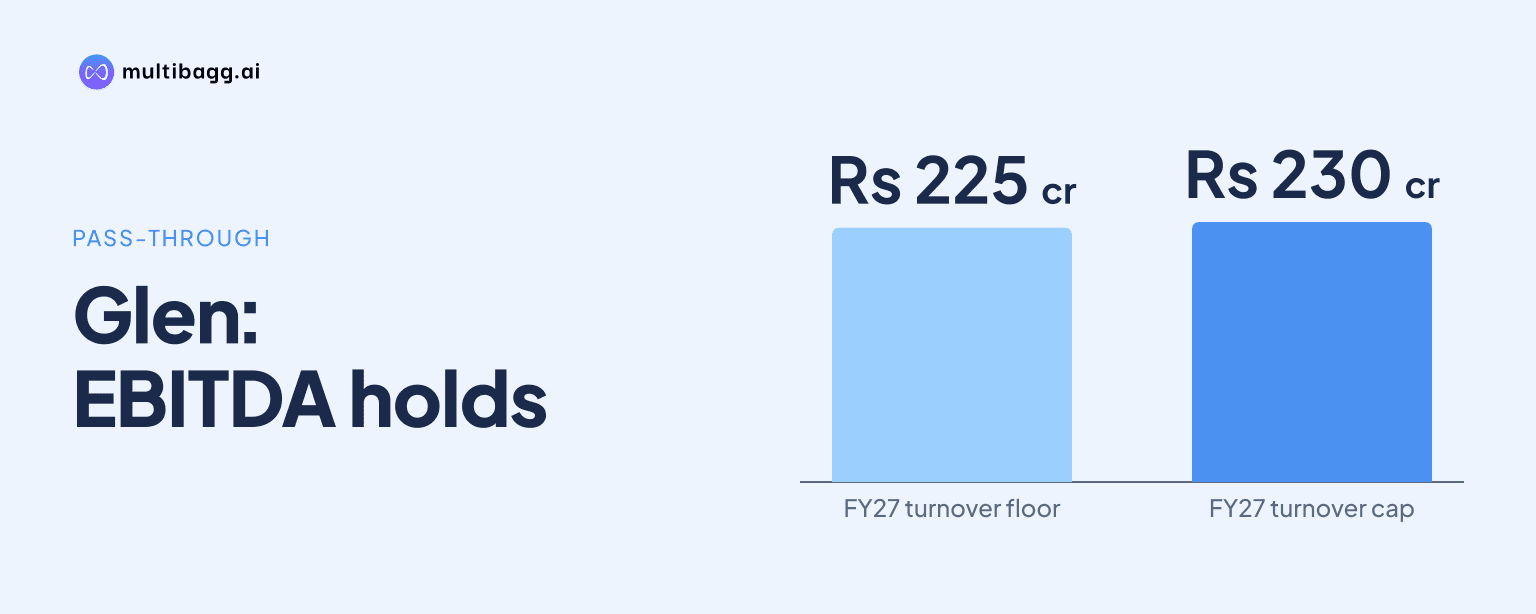
- Glen Industries expects FY27 turnover of about Rs 225 crore to Rs 230 crore after the new-facility delay.
- At about Rs 550 crore turnover, management illustrated EBITDA of Rs 99 crore and PAT of around Rs 52 crore.
powered by IRIS
On November 18, 2026, Glen Industries Limited said higher raw-material costs had lifted selling prices by about 35%, but management expects its two-way price pass-through to keep absolute EBITDA broadly at Rs 90 crore to Rs 100 crore when full capacity is realised, even if reported revenue falls as input costs ease.
Know GLEN Industries inside out
Results, valuation, peers and who's buying, in one view.
How did Glen Industries respond to raw-material inflation?
Glen Industries raised selling prices as raw-material costs increased, management said. Input prices were around Rs 100 before what management called the Middle East war and were about Rs 160 at the time of the call, an increase of Rs 60. Selling prices that had been around Rs 200 were raised to about Rs 260 to Rs 270, representing management’s stated increase of roughly 35%.
Management said neither manufacturers nor customers could absorb a cost increase of that scale because competing suppliers faced similar raw-material conditions. Its explanation was that customers shifting to another supplier would encounter comparable prices. This is management’s assessment of the market mechanism, rather than an indication that higher prices would have no effect on demand.
Will Glen Industries reduce prices when inputs become cheaper?
Yes. Glen Industries said selling prices would decline if raw-material costs fell, just as they rose when costs increased. Management cited the COVID period as an example of pricing moving in both directions, saying input prices had dropped sharply before later stabilising. It did not indicate that the Rs 260 to Rs 270 selling-price range would be retained if lower costs were sustained.
Management said raw-material prices had started to come down slightly by October 2026, so revenue may reduce marginally. It distinguished lower revenue per unit from absolute profitability, saying the expected reduction in realisation would not affect absolute profit. The call did not provide a stated profit-per-tonne target or a formula linking each input-cost movement to a selling-price adjustment.
Why did Glen Industries’ price increase not match revenue growth?
Glen Industries said the roughly 35% price increase occurred in stages from April through July and August 2026, rather than in one move. Management said raw-material prices near Rs 160 had affected operations only for the final one to one-and-a-half months before the November 18 call. It therefore said the current price level should not be compared directly with first-half revenue growth.
Management said volume had increased marginally or remained broadly unchanged in the first half, rejecting an investor’s suggestion of volume decline. It reported first-half turnover of Rs 115 crore and expected another Rs 115 crore over the following six months, implying about Rs 230 crore for the whole year. October production was also lower because festival holidays in Kolkata reduced operating days, management said.
What could lower realisations mean for Glen Industries’ revenue?
Glen Industries said revenue from its existing facility may decline marginally if raw-material prices continue to fall, with the outcome depending on the extent of the reduction. Management indicated that any second-half growth would primarily depend on the new facility starting operations, not on further selling-price increases at the existing business.
The delayed new facility has changed the company’s near-term turnover expectations. Management said a previously discussed Rs 350 crore FY27 target included about Rs 125 crore from the new project, but only up to Rs 25 crore from that project could be realised in the current year. It consequently gave an FY27 turnover expectation of about Rs 225 crore to Rs 230 crore and attributed the revision to the delay.
Got a follow-up? Ask IRIS
How does Glen Industries expect absolute EBITDA to remain intact?
Glen Industries agreed with an analyst’s framing that turnover at full capacity could be Rs 500 crore or Rs 550 crore depending on realisation, while absolute EBITDA could remain around Rs 95 crore to Rs 100 crore. Management said the Rs 90 crore, Rs 95 crore or even Rs 100 crore figure would not change whether raw-material prices moved up or down.
For an illustration based on Rs 550 crore turnover, management applied an 18% EBITDA margin, producing Rs 99 crore of EBITDA. It then assumed interest of about Rs 15 crore and depreciation of around Rs 18 crore, leaving roughly Rs 66 crore before tax. After a tax burden of about Rs 14 crore, management estimated profit after tax, or PAT, at around Rs 52 crore, within a Rs 50 crore to Rs 55 crore range when full revenue is realised.
Management did not expect margin expansion from scale. It said EBITDA margin should remain around 18% to 19%, describing 19% as an upside outcome against its usual 18% planning assumption. The stated pricing approach is therefore intended to protect absolute earnings generated by the expanded business, rather than to retain a higher percentage margin when input costs rise.
Which expansion and export plans could support volume growth?
Glen Industries said it was pushing to start its injection division in January 2027, with civil work progressing at speed. Management said it would allow a three-to-four-month cooling period after the current project starts before evaluating later projects. It has set a target of Rs 1,000 crore turnover by 2030, while stating that the projects required to reach that target have not yet been selected.
Exports accounted for about 25% of revenue, according to management, which is targeting about 35%. Glen Industries identified Europe and North America, including the United States, Canada and Mexico, as the main markets for capacity-led growth. It attended PEC Expo in the United States in October 2026 and plans to attend the Canton Fair in April and the National Restaurant Association show in the United States next year.
Conclusion
Glen Industries’ stated strategy is to move selling prices with raw-material costs rather than retain the revenue uplift created by inflation. Management expects this two-way mechanism to create variability in reported turnover, particularly if input costs decline, while preserving an absolute EBITDA range of roughly Rs 90 crore to Rs 100 crore at full revenue realisation. Its Rs 50 crore to Rs 55 crore PAT illustration depends on about Rs 550 crore turnover, an 18% EBITDA margin, Rs 15 crore of interest and Rs 18 crore of depreciation.
The next items to watch are the planned January 2027 injection-division start, the revenue contribution after the launch and the direction of raw-material prices following their slight October 2026 decline. Management’s FY27 turnover range of Rs 225 crore to Rs 230 crore reflects the facility delay, while its Rs 1,000 crore turnover target for 2030 depends on projects it said it will evaluate after completing the current expansion.