










Godawari Power & Ispat Limited targets 5 GWh BESS output
Key highlights
- Godawari targets 5 GWh of BESS output by March 2028 after a June-July 2027 main-line start.
- Godawari has sanctioned BESS facilities of Rs 2,795 crore, including Rs 800 crore of funded limits.
- Management expects long-term BESS EBITDA margins of 5%-7%.
- Godawari plans a separate 3 gigawatt BESS line with Rs 135 crore of capex and a December 2027 commissioning target.
powered by IRIS
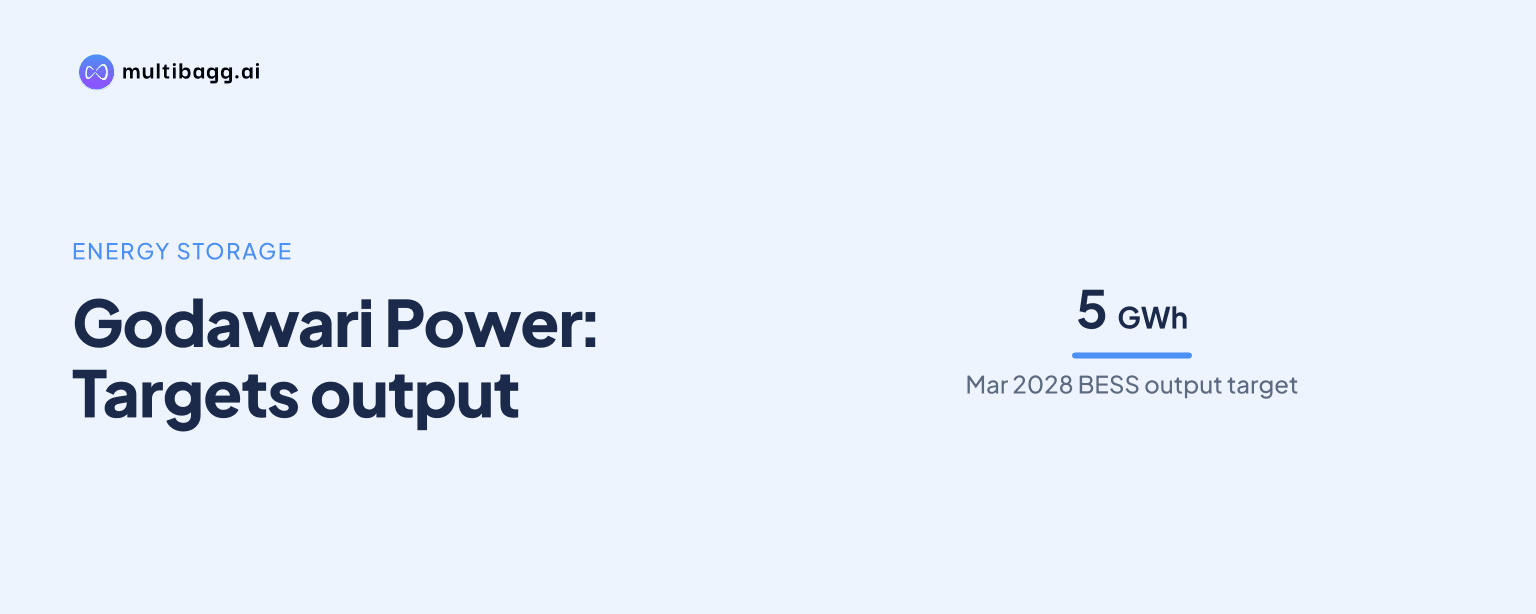
Godawari Power & Ispat Limited expects to produce 5 gigawatt-hours (GWh) of battery energy storage systems by March 2028 after its 20 gigawatt BESS line begins commissioning in June-July 2027. Management described the target as reaching 20%-25% utilisation during the initial ramp-up and said machinery supply for the main line had already started.
Know Godawari Power & Ispat inside out
Results, valuation, peers and who's buying, in one view.
When will Godawari’s 20 gigawatt BESS line begin output?
Godawari expects the first container from its 20 gigawatt BESS line to come out by the end of the first quarter of FY28 or early in the second quarter, which management identified as June-July 2027. Executive Director Abhishek Agrawal said the first machinery lot had been dispatched from China after testing, while equipment supply for the larger line had already begun.
The June-July 2027 timing refined an earlier statement that the project was progressing towards commissioning in the first quarter of FY27, a period that had already passed by the November 16, 2026 earnings call. Management said the initial containers will serve grid-scale applications and will be configured at 5 megawatts and above.
Godawari’s separate 3 gigawatt BESS line has a different schedule and market. Machinery supply for that smaller-system line is expected to begin in July-August 2027, with commissioning targeted for December 2027, although management had also previously stated a March 2028 target for the project.
How much BESS output is Godawari targeting during ramp-up?
Godawari is targeting 5 GWh of BESS production by March 2028, following a June-July 2027 start for the main line. Management said this would represent 20%-25% utilisation during the first operating period, which covers roughly nine months to the March 2028 financial year-end.
The main line has a stated 20 gigawatt capacity, while management’s 5 GWh ramp-up target is an output measure. The transcript uses gigawatt capacity for the line and refers to 5 gigawatt of production in the initial year; the target has been expressed as 5 GWh in the company’s stated project context.
Management also gave an 80% utilisation illustration for the main line, equating it to 15 gigawatt of output. At that level, it estimated annual turnover of about Rs 13,000 crore and annual earnings before interest, tax, depreciation and amortisation, or EBITDA, of about Rs 600 crore at a 5% margin. These were management illustrations rather than FY28 guidance or reported results.
How is Godawari funding its BESS manufacturing plan?
Godawari has completed financial closure for the BESS business with sanctioned facilities of Rs 2,795 crore, management said on November 16, 2026. The package includes a Rs 700 crore term loan for the BESS project, a Rs 100 crore fund-based working-capital limit and about Rs 1,995 crore of non-fund-based limits.
Chief Financial Officer Sanjay Bothra said the funded portion is Rs 800 crore, comprising the Rs 700 crore term loan and Rs 100 crore of working capital. He said the remaining about Rs 1,995 crore consists primarily of supply-chain financing, guarantees and performance guarantees, meaning the full sanctioned amount is not funded borrowing.
Godawari also said it had about Rs 900 crore of free cash as of the call. Separately, it approved Rs 135 crore of capital expenditure for the 3 gigawatt line for commercial and industrial customers, which will be installed alongside the larger project without additional land.
The 3 gigawatt line is intended to make 261 kilowatt-hour and 418 kilowatt-hour storage systems, rather than the 5 megawatt-and-above containers planned for grid applications. Management compared the smaller systems with diesel-generator replacement, where power can be stored from the grid and discharged during an interruption.
Got a follow-up? Ask IRIS
How will Godawari seek initial BESS orders?
Godawari plans to pursue government tenders, supply partnerships and direct bidding to build demand for its 5 megawatt-and-above BESS containers. It has formed Godawari Energy Solutions Limited as an in-house engineering, procurement and construction support company for tender participation.
Management said 90%-95% of current BESS demand is coming from government tenders, citing the Solar Energy Corporation of India, Coal India, NTPC and state distribution companies. Godawari had already begun bidding by the November 2026 call but had not won a tender, and management said it was still learning the tender process.
Godawari said it intends to explore direct tender participation, tie-ups with larger bidders and back-to-back supply arrangements. Management referred to creating 40%-50% of consumption through tender activity for a portion of the 20 gigawatt line, but it did not disclose awarded orders, customer volumes or contracted revenue supporting the 5 GWh ramp-up goal.
Management said announced BESS capacity across the market was “alarming” on paper, while noting that execution of a project generally takes 18-24 months. Its stated response is to bring the main line into production in June-July 2027 and keep multiple sales routes open rather than rely on a single tender channel.
What margin and execution factors has Godawari identified for BESS?
Godawari expects a long-term BESS EBITDA margin of 5%-7%, according to Abhishek Agrawal. He said a 12%-13% figure cited by an analyst from the annual report should be corrected, and described the 5%-7% range as the margin envisaged for a high-volume business.
Management’s 80% utilisation scenario assumes output of 15 gigawatt, turnover of about Rs 13,000 crore and EBITDA of about Rs 600 crore at a 5% margin. It estimated a payback period of three to three-and-a-half years at most, including ramp-up and stabilisation, but did not provide a project internal-rate-of-return target.
Godawari plans to use 628 ampere-hour cells under its Chinese supplier agreement for the 5 megawatt container. Management estimated that the higher-capacity cells could reduce operating cost by 4%-5% and add about 1.5 percentage points to EBITDA, although this remains an expectation rather than an achieved saving.
The company said BESS tenders currently require 20% domestic content by value, rather than domestic cells, because cells used by importers and Indian assemblers are sourced from China. Management said Godawari qualifies under that criterion, but order conversion, plant commissioning and early utilisation remain the key unreported execution measures.
Conclusion
Godawari has progressed from announcing BESS capacity to setting out a commissioning timetable, initial production objective, funding structure and tender-led sales plan. The central operational milestone is 5 GWh of output by March 2028 from a main line expected to begin producing containers in June-July 2027, alongside a stated long-term EBITDA margin range of 5%-7%.
The next disclosures to watch are the first main-line container in June-July 2027, tender wins or supply agreements through Godawari Energy Solutions Limited, and output by March 2028 against the 5 GWh target. Management also plans to commission the separate 3 gigawatt commercial and industrial line in December 2027, while the main line’s 80% utilisation illustration remains a longer-term scenario rather than a scheduled result.