










GPIL cuts FY27 ore and pellet guidance as clearance delays
Key highlights
- GPIL cut FY27 iron ore mining guidance by 0.9 million tonnes to 2.5 million tonnes.
- GPIL reduced FY27 pellet production guidance by 0.9 million tonnes to 3.5 million tonnes.
- GPIL expects roughly 2 million tonnes of market iron ore purchases in FY27.
- Q2 FY27 revenue rose 25% year on year to Rs 1,632 crore, while EBITDA margin was 12%.
powered by IRIS
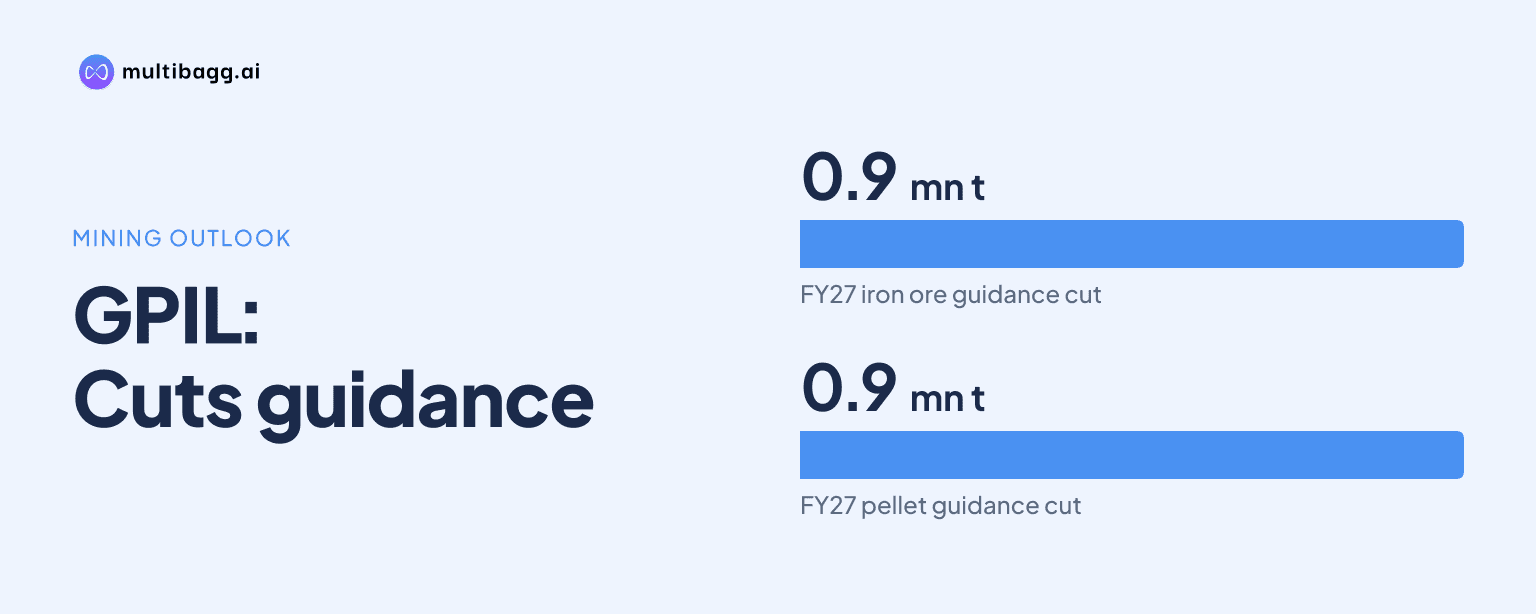
Godawari Power & Ispat Limited (GPIL) cut its FY27 iron ore mining target to 2.5 million tonnes and pellet target to 3.5 million tonnes after delayed approval for an overburden-dumping area constrained captive mining, forcing roughly 2 million tonnes of market ore purchases and leaving Q3 profitability similar to Q2.
Know Godawari Power & Ispat inside out
Results, valuation, peers and who's buying, in one view.
Why did GPIL cut its FY27 production guidance?
GPIL cut guidance because limited space to dump overburden, the soil and rock removed to access ore, restricted mining at its captive operations. Management reduced its FY27 iron ore mining target from 3.4 million tonnes to 2.5 million tonnes, while reducing pellet production guidance from 4.4 million tonnes to 3.5 million tonnes. Production in other key segments remained on track, with ferroalloys and sponge iron exceeding 50% of their annual targets at the November 16, 2026 call.
The constraint applies to overburden from both existing and expanded mine activity, rather than only to new capacity. GPIL said it needed permission to use additional land for dumping, followed by about three to four weeks of tree clearing and land preparation before it could begin using the area. Management expected the approval process to be completed by the end of Q3 FY27, but the revised annual guidance reflects the time needed to build mining infrastructure after approval.
How is market iron ore affecting GPIL's pellet margins?
Market ore purchases are reducing GPIL's pellet profitability because management estimated external iron ore fines cost about Rs 3,000 to Rs 3,500 per tonne more than captive supply on a yearly-average basis. The company expects to source roughly 2 million tonnes from the market across FY27, with about 7 lakh to 8 lakh tonnes expected in the second half. This procurement is necessary while captive production remains constrained, but it changes the cost base of pellet production.
GPIL also stopped merchant sales of high-grade pellets because available captive ore is being used internally for steelmaking. Management said it had previously sold about 50,000 to 1 lakh tonnes of high-grade pellets and earned a premium exceeding Rs 1,000 per tonne; those sales had fallen to zero in recent months. Pellet prices moved from Rs 8,500 per tonne at the end of Q1 and early Q2 FY27 to Rs 11,000 to Rs 11,500 per tonne, before returning to around Rs 10,500 per tonne during the market lull described on the call.
The financial effect was visible in reported margins. Consolidated revenue rose 25% year on year to Rs 1,632 crore in Q2 FY27 and 29% to Rs 3,382 crore in H1 FY27, aided by volumes and realizations. However, Q2 earnings before interest, tax, depreciation and amortisation, or EBITDA, margin was 12%, while profit after tax, or PAT, margin was 5.2%; H1 FY27 EBITDA and PAT margins were 15.7% and 9.1%, respectively. Management attributed the pressure to purchased ore, lower pellet realization and higher coal costs amid the West Asia crisis.
Got a follow-up? Ask IRIS
When does GPIL expect mining and pellet output to recover?
GPIL expects a slight improvement in Q4 FY27 and a more substantial mining recovery from Q1 FY28, subject to the dumping-land approval and subsequent site work. Management said that if it could begin using the land around December 2, it would still need time to establish infrastructure, which is why the operational effect is expected in Q4 rather than immediately in Q3. It forecast mining at about 70% to 80% of capacity from Q1 FY28.
The 5 million-tonne beneficiation plant, which upgrades ore quality before pellet production, is targeted for commissioning in Q3 FY27. GPIL said the plant should support a production ramp-up from Q4 FY27 and full-scale operation by FY28. It also expects the plant to improve pellet quality and increase captive iron ore availability, linking the project directly to the recovery in pellet volumes and unit economics.
Management guided that Q3 FY27 margins should be similar to Q2 because external ore purchases would continue. It expects some margin improvement in Q4 FY27, with a return to more normal operations from Q1 FY28. These are management expectations rather than reported results and depend on clearance timing, the pace of mining development and commodity prices.
What does GPIL expect for captive ore use in FY28 and FY29?
GPIL expects to produce about 5 million to 5.2 million tonnes of iron ore in FY28, or 80% to 85% of capacity, leaving a maximum market purchase of about 0.5 million tonnes. Management said some external procurement would continue during the first half of FY28, even as pellet plants run at full capacity and pellet volumes rise from Q1 FY28. It expects practical mining capacity to reach 6 million tonnes from October 2027 after the monsoon.
Management's stated objective is to become fully captive in iron ore from FY29. That trajectory matters because it would reverse the FY27 reliance on approximately 2 million tonnes of purchased ore, which management described as an expensive input for pellets. At full mining capacity and a pellet price of Rs 10,000 per tonne, management estimated pellet EBITDA could exceed Rs 4,000 per tonne, against an indicated production cost of Rs 5,500 to Rs 6,000 per tonne.
The broader steel chain was less affected than pellets, according to management. It said sponge iron through billet operations were running at desired capacity, although higher energy costs remained a burden. Coal costs in direct reduced iron, or DRI, were up by about Rs 1,000 to Rs 1,500 per tonne, while management estimated the quarterly effect of higher power costs at Rs 25 crore to Rs 30 crore; it noted that some finished-product prices had also increased.
Conclusion
GPIL's FY27 guidance cut is principally a timing issue in captive mining rather than a change to its stated long-term mine expansion plans. The reduction of 0.9 million tonnes each in mining and pellet targets, combined with roughly 2 million tonnes of market ore purchases, explains why 25% Q2 FY27 revenue growth did not translate into comparable profitability and why management expects Q3 margins to remain near Q2 levels.
The next indicators are the promised dumping-area and tree-cutting approvals, the Q3 FY27 commissioning target for the 5 million-tonne beneficiation plant, and whether mining rises in Q4 FY27 as management expects. Investors can also watch the scale of FY28 purchased ore, which GPIL projects at no more than 0.5 million tonnes, before its stated goal of fully captive iron ore supply from FY29.