










Godawari Power and Ispat Q2 revenue rises 25% as margins narrow
Key highlights
- GPIL's Q2 FY27 consolidated revenue rose 25% year on year to ₹1,632 crore.
- GPIL reported Q2 FY27 EBITDA of ₹196 crore, with EBITDA margin at 12.0%.
- GPIL's H1 FY27 consolidated revenue increased 29% year on year to ₹3,382 crore.
- GPIL reported Q2 FY27 profit after tax of ₹85 crore and a PAT margin of 5.2%.
powered by IRIS
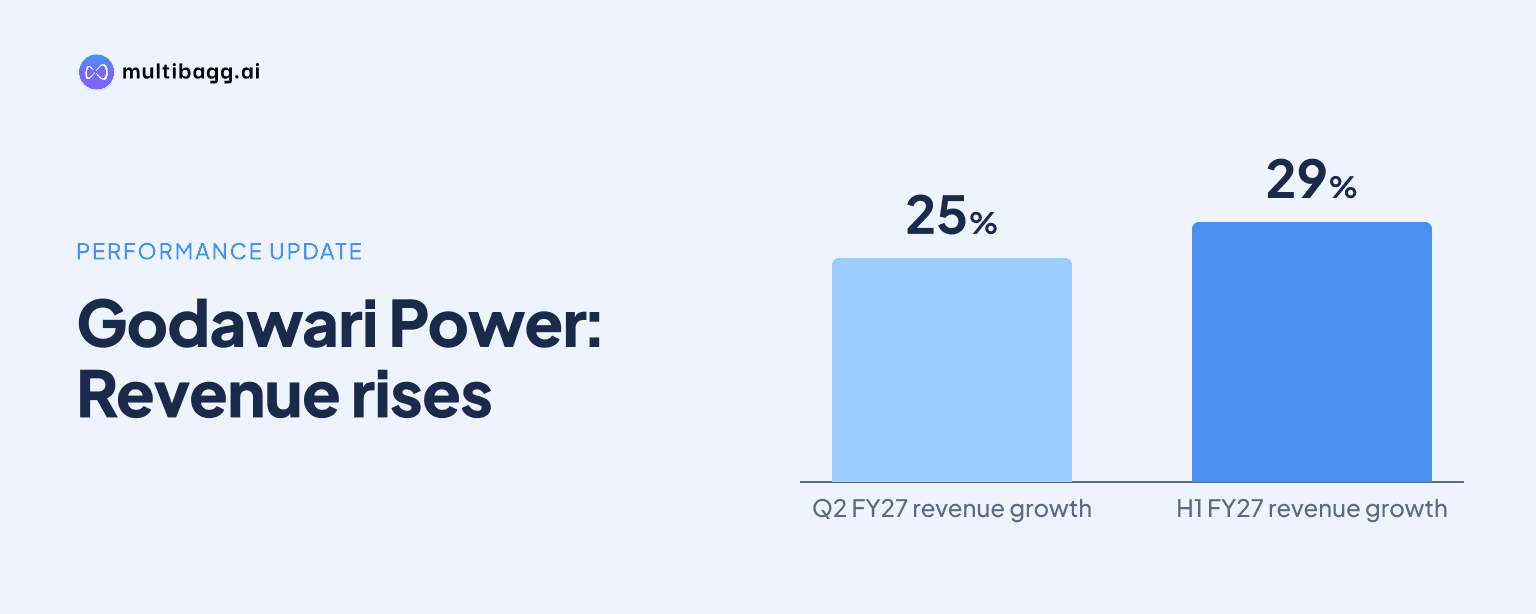
Godawari Power and Ispat Limited reported Q2 FY27 revenue of ₹1,632 crore, up 25% year on year, but its EBITDA margin fell to 12% as iron ore and coal costs increased. Higher sales volumes and improved realisations supported revenue, while greater dependence on market-sourced ore and lower pellet realisations weighed on profitability.
Know Godawari Power & Ispat inside out
Results, valuation, peers and who's buying, in one view.
What drove GPIL's Q2 FY27 revenue growth?
GPIL's consolidated revenue increased 25% year on year to ₹1,632 crore in Q2 FY27, supported by healthy sales volumes and improved realisations. For the first half of FY27, consolidated revenue rose 29% year on year to ₹3,382 crore.
The revenue performance shows that sales demand and pricing realisations supported the company's top line during the quarter. Management also pointed to encouraging domestic steel demand, with infrastructure and housing activity providing demand visibility for steel products.
The company held its Q2 and H1 FY27 earnings conference call on November 16, 2026. Its financial results and earnings presentation were made available on its website and stock exchanges, while the company also filed the audio recording of the call under Regulation 30 of the SEBI Listing Obligations and Disclosure Requirements regulations.
Why did GPIL's operating margins decline?
GPIL's Q2 EBITDA margin declined to 12%, as higher input costs and operational constraints offset the benefit of revenue growth. The company reported Q2 EBITDA of ₹196 crore and profit after tax of ₹85 crore.
During the analyst interaction, a participant noted that operating margins had fallen from about 20% to around 11%-12%. The factors cited were higher purchases of iron ore from the external market while the company awaited tree-cutting approvals at its captive mine, along with higher coal costs.
Lower pellet realisations added to the pressure on profitability. Captive iron ore availability is important for an integrated steel producer because external ore procurement can raise raw-material costs and reduce the cost advantage normally associated with captive mining operations.
Management said it expects margins to improve from Q4 as mine clearances, access for overburden dumping and beneficiation capacity enable higher captive ore production. This was presented as an operational objective rather than a quantified margin forecast.
Got a follow-up? Ask IRIS
What guidance and expansion plans did GPIL outline?
GPIL reduced its FY27 production guidance for iron ore and pellets, reflecting the mine-related constraints discussed during the call. The material provided does not specify the earlier or revised production volumes, so the scale of the revision cannot be assessed from the disclosed information.
The company said its growth plans cover iron ore, pellets, steel value-added products and battery storage. These initiatives indicate that GPIL is continuing to pursue capacity and product development alongside efforts to restore higher captive ore production.
GPIL has also formed Godavari Energy Solutions to bid for tenders from SECI, Coal India, NTPC and state discoms. Management said the entity had not won a tender at the time of the call and was targeting first-year utilisation of 20%-25%, or about 5 GW, by March 2028.
The energy-storage initiative remains separate from the company's reported Q2 steel and mining performance. Its progress will depend on tender outcomes, which had not been disclosed as of November 16, 2026.
How does the quarter affect GPIL and the steel market?
GPIL's Q2 result shows that stronger revenue does not necessarily translate into higher profit when raw-material costs rise and captive supply is constrained. The gap between 25% revenue growth and a 12% EBITDA margin illustrates the effect of external ore purchases, higher coal costs and lower pellet realisations on the operating result.
For investors, the key disclosed operating variable is the timing of mine clearances and related access required to increase captive ore output. Management linked a potential improvement from Q4 to these operational developments, but did not provide a specific EBITDA margin or profit target.
The company also stated that imports into India would increase because supply was not able to match demand. This observation was made in the context of domestic steel-market conditions, where infrastructure and housing demand were described as supportive.
For customers and industry participants, the quarter reflects the sensitivity of steel producers to iron ore availability, coal costs and product realisations. GPIL's revenue growth indicates sales momentum, but its margin performance demonstrates that cost pressures can materially affect financial outcomes even in a period of higher turnover.
What should investors monitor after GPIL's Q2 FY27 results?
GPIL's Q2 FY27 performance combined a 25% rise in revenue with weaker profitability, as higher market-sourced iron ore and coal costs compressed EBITDA margin to 12%. The company's first-half revenue growth of 29% to ₹3,382 crore provides context for the sales trend, while the margin outcome highlights the importance of captive mining operations.
Investors should monitor whether the disclosed mine clearances, overburden-dumping access and beneficiation capacity allow higher captive ore production from Q4. Other points to watch are the execution of the revised iron ore and pellet guidance, pellet realisations, coal costs and any tender progress at Godavari Energy Solutions by its March 2028 utilisation target.