










Hero Motors sees Rs 200 crore Bengaluru revenue in FY29
Key highlights
- Hero Motors expects Rs 60 crore to Rs 80 crore of Bengaluru-facility revenue in FY28.
- Hero Motors cited FY29 Bengaluru-facility revenue visibility of about Rs 200 crore, plus or minus 10%.
- River will use Hero Motors as its 100% transmission-system supplier and will also source scooter chassis from the site.
- EV and hybrid applications reached 26% of Hero Motors revenue in Q2 FY27, up from 20% a year earlier.
powered by IRIS
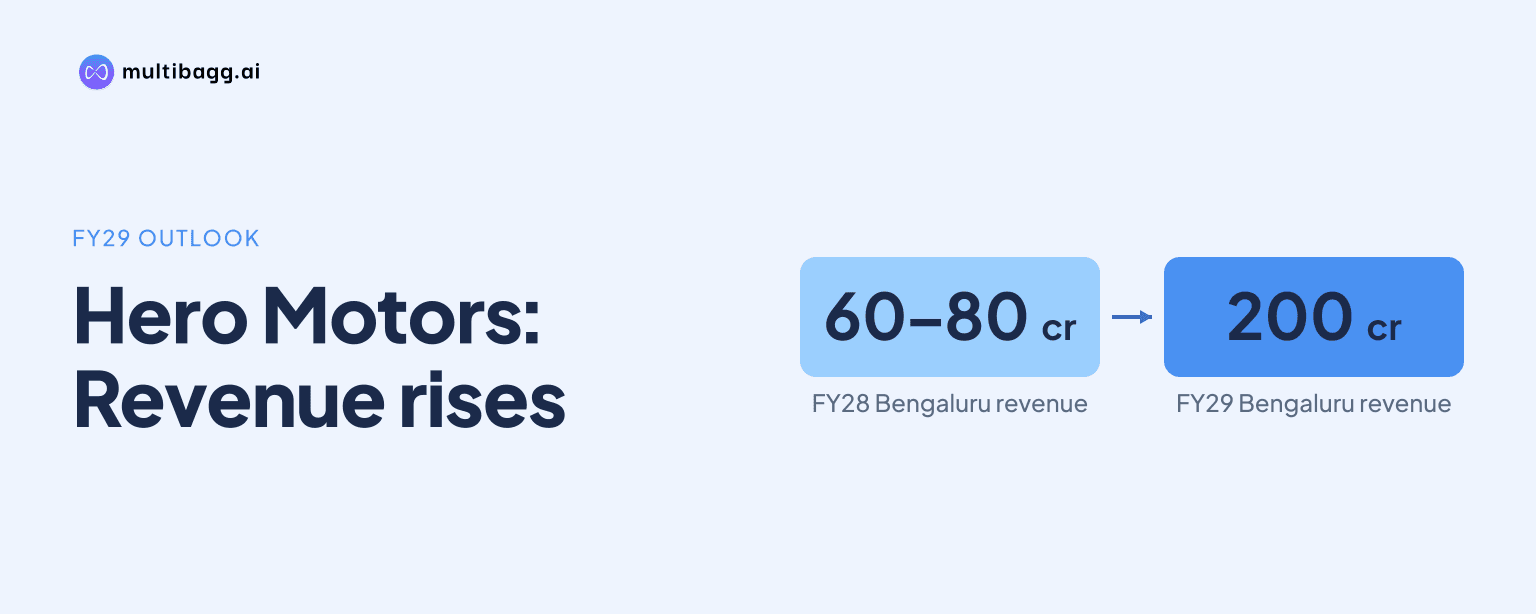
Hero Motors said in Q2 FY27 that its planned Bengaluru electric-vehicle systems facility has confirmed customer orders supporting about Rs 200 crore of revenue in FY29, plus or minus 10%, after an expected Rs 60 crore to Rs 80 crore in FY28. River is the principal customer, with Hero Motors designated its 100% transmission-system supplier.
Know Hero Motors inside out
Results, valuation, peers and who's buying, in one view.
What will Hero Motors make at its Bengaluru facility?
Hero Motors plans to manufacture electric-vehicle, or EV, systems at the Bengaluru facility, including transmission systems and chassis for River electric scooters. Management said River will be the major customer and that Hero Motors will be the sole supplier of the transmission systems River uses for its electric bike and scooter products. The facility is intended to extend Hero Motors' Bike Powertrain activity, where products include motors and electronic drive units, or EDUs.
Hero Motors said it plans to establish the facility in March or April 2027 and ramp it over one year. Management did not disclose a dedicated capital-expenditure figure for the Bengaluru site, its installed capacity or the duration of River's programme. It did, however, describe the revenue projections as confirmed orders scheduled by customers, rather than an uncontracted sales opportunity.
The FY29 outlook would be materially above the FY28 range as the plant moves beyond its first year of operations. Management framed the Rs 200 crore projection as “very good visibility” based on customer schedules, while specifying a variation of plus or minus 10%. That qualification matters because the transcript did not provide unit volumes, pricing, capacity utilisation or a separate revenue split between River transmission systems and scooter chassis.
How important is River to Hero Motors' new plant?
River is the anchor customer disclosed for Hero Motors' Bengaluru facility, with a 100% supply position for the EV maker's transmission systems. Hero Motors also said it will make chassis for River electric scooters at the same location. This combines a powertrain-related system and a structural vehicle part in one planned manufacturing site, rather than limiting the facility to gears or individual components.
The River programme fits Hero Motors' stated shift toward complete systems. Management said the company historically derived only about 5% to 7% of business from complete solutions 20 to 25 years ago, whereas systems now account for the majority of Powertrain Solutions business. In Bike Powertrain, Hero Motors said 100% of activity is in EV and hybrid solutions and systems or parts of systems, not conventional component-only supply.
River's role also sits within a broader order pipeline, but the disclosed Rs 200 crore FY29 facility outlook should not be equated with the whole company pipeline. Hero Motors reported approximately Rs 4,000 crore of project lifetime revenue across products with typical lifecycles of five to eight years, and sometimes up to 12 years. Management said most of those projects are confirmed customer orders, with products still in development, testing or launch stages.
Got a follow-up? Ask IRIS
How does the Bengaluru plan fit Hero Motors' EV business?
The Bengaluru plan adds domestic EV-system production as EV and hybrid applications increased to 26% of Hero Motors' revenue in Q2 FY27 from 20% in the corresponding quarter a year earlier. Internal-combustion-engine, or ICE, applications represented the remaining 74% in the quarter. For H1 FY27, EV and hybrid applications were 24% of revenue, compared with 20% in H1 FY26.
Bike Powertrain was the fastest-growing reported segment in H1 FY27, with revenue rising 37% year on year to Rs 89 crore. Gears and Transmission revenue increased 15% to Rs 265 crore, while Alloy and Metallics rose 26% to Rs 330 crore. The Bengaluru facility's River orders relate most directly to the Bike Powertrain and EV-systems strategy, although management did not assign the facility's future revenue to a reporting segment.
Management said Bike Powertrain represented 13% of total revenue in Q2 FY27, compared with 39% for Gears and Transmission and 48% for Alloy and Metallics. It expects the highest compound annual growth rate, or CAGR, in Bike Powertrain because it is a newer segment and all of its products serve EVs. That is management's growth expectation, not a quantitative forecast for the Bengaluru plant beyond the FY28 and FY29 revenue indications.
What financial position supports Hero Motors' expansion plans?
Hero Motors reported consolidated revenue from operations of Rs 365 crore in Q2 FY27, up 21% year on year from Rs 301 crore, while consolidated profit after tax rose 62% to Rs 18 crore from Rs 11 crore. Consolidated earnings before interest, tax, depreciation and amortisation, or EBITDA, increased 23% to Rs 47 crore, and the EBITDA margin improved 22 basis points to 12.8%.
For H1 FY27, consolidated revenue increased 23% year on year to Rs 684 crore and EBITDA rose 32% to Rs 87 crore. The consolidated EBITDA margin was 12.5%, up 103 basis points, while profit after tax reached Rs 28 crore, an 84% increase. These reported results precede the proposed Bengaluru ramp-up and therefore do not include the facility's projected FY28 or FY29 revenue.
The balance-sheet position changed after loan repayment. Management said debt to equity improved from 0.89 times in FY26 to 0.21 times in H1 FY27 after Hero Motors repaid Rs 190 crore of loans in August, reducing loans to about Rs 220 crore from approximately Rs 410 crore. It said quarterly interest cost, previously Rs 8 crore to Rs 9 crore, is expected to fall to Rs 1.5 crore to Rs 2 crore going forward.
Conclusion
Hero Motors has identified a defined near-term use for its Bengaluru EV-systems site: serving River with transmission systems on a 100% supply basis and producing scooter chassis. The disclosed revenue path, from Rs 60 crore to Rs 80 crore in FY28 to about Rs 200 crore in FY29, aligns with the company's rising EV and hybrid revenue mix of 26% in Q2 FY27 and the 37% H1 FY27 growth in Bike Powertrain.
The next disclosed milestone is establishment of the facility in March or April 2027, followed by a one-year ramp-up. The key disclosed measures to watch are whether customer schedules support the FY29 revenue range and whether confirmed projects across Hero Motors reach the Rs 500 crore to Rs 600 crore annual ramp-up that management said could be achieved by FY28.