










Hero Motors STP targets 15-20% forging EBITDA margins in 2027
Key highlights
- Hero Motors said STP forging and machining could generate EBITDA margins of about 15%-20%, versus 6%-7% historically in Alloy and Metallics.
- Hero Motors expects approximately 70% of STP revenue from global markets and 30% from India.
- Alloy and Metallics revenue grew 26% year on year to Rs 330 crore in H1 FY27.
- Hero Motors reported a 15.2% standalone EBITDA margin in H1 FY27, up 292 basis points year on year.
powered by IRIS
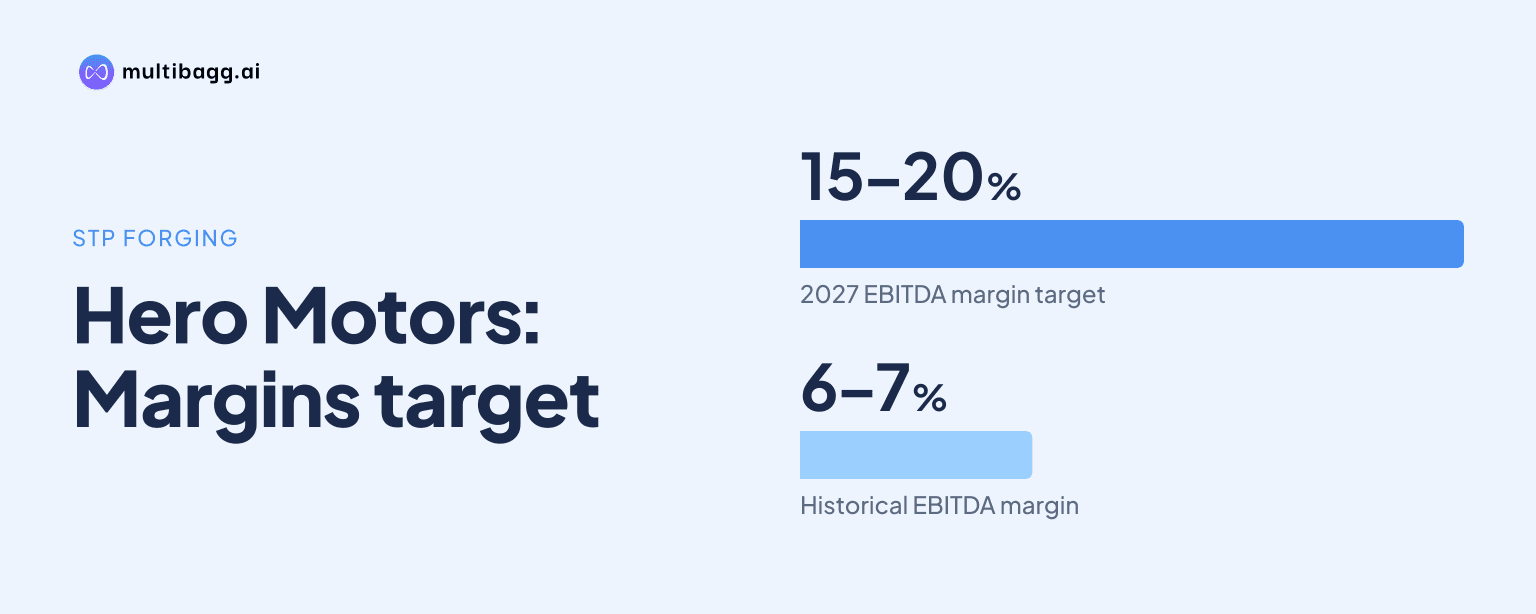
Hero Motors expects its STP precision-forging venture to begin manufacturing in calendar 2027 and generate EBITDA margins of about 15%-20%, compared with the Alloy and Metallics segment’s historical 6%-7% range. Management also expects approximately 70% of STP revenue to come from global markets, subject to project execution and customer conversion.
Know Hero Motors inside out
Results, valuation, peers and who's buying, in one view.
How could STP change Alloy and Metallics margins?
STP is intended to raise the Alloy and Metallics margin profile by adding high-precision forging and machining to a business that has historically produced EBITDA margins of about 6%-7%. Management put margins for forging and machining at 15%-20%, while separately describing high-precision forging as broadly a 14%-15% EBITDA-margin business.
The planned shift is toward premium, higher-value products rather than a stated target for the legacy business alone. Management said Alloy and Metallics revenue rose 26% year on year to Rs 330 crore in H1 FY27, compared with 15% growth to Rs 265 crore in Gears and Transmission and 37% growth to Rs 89 crore in Bike Powertrain. New customers, new products and European sales supported Alloy and Metallics growth, but management said the major growth contribution should come after STP begins commercial production.
STP is not expected to match the reported margin range of Gears and Transmission solely on the basis of management’s comments. Management said system-level products can produce margins of about 18%-25%, versus 6%-7% or up to 8% for Alloy and Metallics in one response, because systems include design work and final-solution responsibility. Actual margins vary by project, according to management.
When will Hero Motors begin STP manufacturing?
Hero Motors expects STP manufacturing to start in calendar 2027, although management said a war-related disruption during Q1 could cause a slight delay. When asked about a possible Q1 FY28 start, management said it remained committed to the timeline but cautioned that commissioning timing could vary.
The immediate focus is machine ordering and construction rather than disclosed customer orders. STP is a joint venture started last year, and management said it was already engaging with a few potential customers but could not share the order position. That leaves the timing and scale of the commercial ramp-up dependent on facility completion, customer feasibility work and order conversion.
Management clarified that the approximately Rs 350 crore capex discussed on the call covers the broader growth business rather than STP alone. It said STP investment would be around 50% of that amount, or slightly lower, and would be phased over three to five years in line with revenue generated. Hero Motors also agreed with an analyst’s suggestion of about 1.5 times asset turns for forging assets, but that was not presented as formal company guidance.
Got a follow-up? Ask IRIS
Why does Hero Motors expect most STP revenue overseas?
Hero Motors expects about 70% of STP revenue from global markets and 30% from India. Management said STP’s customer portfolio supplies global original equipment manufacturers, or OEMs, mainly in Europe, where it sees precision forging and machining work shifting to countries including India.
Europe is an opportunity rather than a disclosed STP contract base. Management said existing European customers, including BMW, were keen to explore the facility and assess feasibility, but it did not identify confirmed STP production orders. The expected export mix therefore reflects the project’s intended market positioning, not booked revenue.
The export plan would extend changes already under way in Alloy and Metallics. Management described the segment as mainly domestic about three years ago, before it added new customers, products and European sales. STP is intended to complement existing alloy, machining and painting work with global precision-forging capability.
What does STP mean for Hero Motors’ wider margin mix?
STP is one component of Hero Motors’ plan to increase the share of higher-margin powertrain and systems work. Management said the overall margin profile could improve by 100 to 200 basis points over time, rather than immediately, as powertrain solutions become a larger part of revenue and high-precision forgings enter Alloy and Metallics.
Hero Motors reported standalone revenue of Rs 596 crore for H1 FY27, up 28% year on year, while EBITDA increased 57% to Rs 92 crore. That produced a 15.2% standalone EBITDA margin, up 292 basis points. Consolidated revenue rose 23% to Rs 684 crore and consolidated EBITDA grew 32% to Rs 87 crore, lifting the consolidated margin by 103 basis points to 12.5%.
The 2.7-percentage-point gap between H1 FY27 standalone and consolidated EBITDA margins reflects the different maturity of the operations, according to management. Standalone results include established Gears and Transmission, legacy Alloy and Metallics and PVT system operations, while consolidated results include newer E-sync, EDU and HYM businesses. Management said some subsidiaries could break even in the current year and others in the next year.
For FY27, management expects revenue growth above 20% and EBITDA margins in the 14%-15% range for the broader business. That outlook is not an STP-specific forecast. It indicates that the 15%-20% margin range cited for forging is a future segment opportunity rather than an immediate consolidated-margin outcome.
Conclusion
Hero Motors is using STP to add precision forging and machining to Alloy and Metallics, where management sees a 15%-20% EBITDA-margin activity replacing part of a historical 6%-7% margin mix. The proposed 70% global revenue share also positions the project toward European-led OEM supply chains rather than the segment’s earlier domestic orientation.
The next development to watch is the calendar 2027 manufacturing start, as management has flagged a possible slight delay from disruption in Q1. Construction, machine ordering, customer feasibility assessments and any disclosed STP orders will determine whether the project supports the management-cited 100-to-200-basis-point long-term improvement in Hero Motors’ overall margin profile.