










Hero Motors says Rs 500 crore to Rs 600 crore ramp-up by FY28
Key highlights
- Hero Motors expects projects with approximately Rs 4,000 crore of lifecycle value to ramp up fully in FY28.
- Management expects the project pipeline to add approximately Rs 500 crore to Rs 600 crore of annual revenue at ramp-up.
- Hero Motors said approximately Rs 100 crore to Rs 150 crore of pipeline orders could begin in FY27.
- Consolidated revenue rose 23% year on year to Rs 684 crore in H1 FY27, while bike powertrain revenue grew 37% to Rs 89 crore.
powered by IRIS
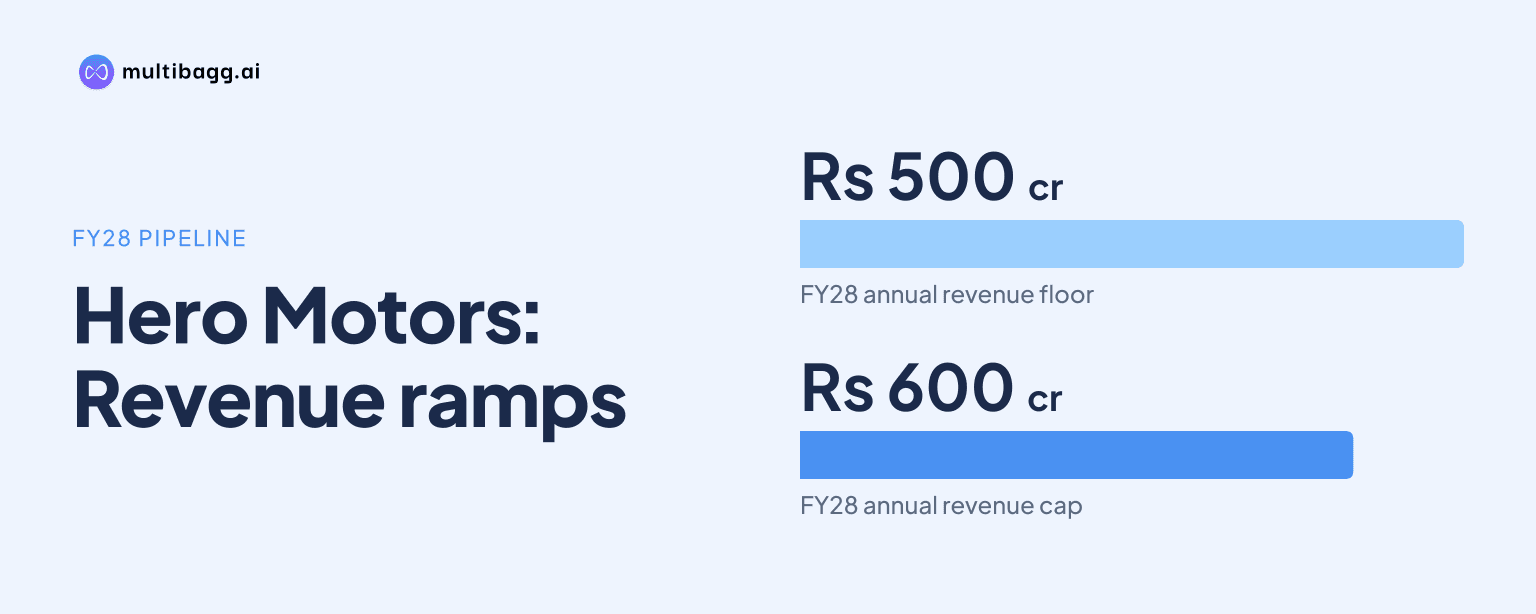
Hero Motors says projects with approximately Rs 4,000 crore of lifecycle revenue can add Rs 500 crore to Rs 600 crore in annual revenue at a more or less full FY28 ramp-up, after about Rs 100 crore to Rs 150 crore of orders begin in FY27.
Know Hero Motors inside out
Results, valuation, peers and who's buying, in one view.
When will Hero Motors' project pipeline fully ramp up?
Hero Motors expects a more or less 100% ramp-up of the projects' annual revenue contribution in FY28. Management said approximately Rs 100 crore to Rs 150 crore of orders could start within FY27, while other programmes are scheduled to start next year before reaching their intended production levels.
The timing reflects the development process for products such as transmissions, electric vehicle systems and other powertrain products. Hero Motors said a project normally takes one to two years to develop and begin supplies, after which products undergo testing at either the customer's site or the company's facilities before final start of production, or SOP.
Management said the Rs 500 crore to Rs 600 crore annual contribution would sit on top of Hero Motors' existing business. That is an annual run-rate estimate rather than the value of the entire pipeline, and it depends on customer product launches, testing and supplier-transition schedules being completed as planned.
How large and confirmed is Hero Motors' project pipeline?
Hero Motors puts the lifecycle revenue of projects under development at approximately Rs 4,000 crore. Management said individual projects generally have lifecycles of five to eight years and can sometimes extend to 12 years, so the Rs 4,000 crore figure is not expected to be recognised in one financial year.
Management described the projects as having confirmed orders or very high visibility and said the products were already under development. In the question-and-answer session, it said most orders were confirmed by customers and later said all the orders were confirmed from the customer side, although customers' own final products remain in new-product development, launch or supplier-shift stages.
An analyst referred to an implied annual value of Rs 550 crore to Rs 650 crore from the order book. Management instead reaffirmed approximately Rs 500 crore to Rs 600 crore as the annual value at ramp-up, making that the company-disclosed range for assessing the expected FY28 contribution.
Which programmes support Hero Motors' FY28 revenue ramp-up?
Hero Motors' development programmes cover powertrain systems, including gears and transmissions, bike powertrain products, electric vehicle systems and marine applications. The company said its model increasingly centres on complete systems and design-to-cost work, in which it designs, prototypes, tests and validates products before manufacturing supplies begin.
A planned Bengaluru electric vehicle-system facility is one identified contributor. Hero Motors said it expected to establish the facility in March or April 2027, with confirmed customer orders supporting expected revenue of approximately Rs 60 crore to Rs 80 crore in 2027-28 and about Rs 200 crore, plus or minus 10%, in 2028-29.
Management named River as a major Bengaluru customer and said Hero Motors would be the 100% supplier of transmission systems used in River's electric bike and electric scooter. It also plans to manufacture electric-scooter chassis at the facility, linking the site to both transmission and chassis supply rather than only component assembly.
Other programmes include a Formula 2 project involving six-speed transmissions, integrated starter systems and advanced differentials, with supplies due to start by the end of the year. Hero Motors is also developing transmission programmes for premium and super-premium cars for FY27-28, while a marine design assignment has design fees of approximately Rs 5 crore to Rs 6 crore; management said any later serial-production order could be larger but did not quantify it.
Got a follow-up? Ask IRIS
What do Hero Motors' current results show about its business mix?
Hero Motors reported consolidated revenue from operations of Rs 365 crore in Q2 FY27, up 21% year on year, while profit after tax rose 62% to Rs 18 crore. Consolidated earnings before interest, taxes, depreciation and amortisation, or EBITDA, increased 23% to Rs 47 crore, and the EBITDA margin increased by 22 basis points to 12.8%.
Powertrain, comprising gears and transmission plus bike powertrain, represented approximately 52% of Q2 FY27 revenue, compared with a 20% share five to six years earlier. In Q2 FY27, alloy and metallics accounted for 48% of revenue, gears and transmission for 39%, and bike powertrain for 13%, showing the shift in mix toward the businesses associated with system-level development work.
For H1 FY27, consolidated revenue grew 23% to Rs 684 crore and EBITDA rose 32% to Rs 87 crore, with the EBITDA margin improving 103 basis points to 12.5%. Bike powertrain revenue increased 37% to Rs 89 crore, faster than alloy and metallics, which grew 26% to Rs 330 crore, and gears and transmission, which grew 15% to Rs 265 crore.
Electric vehicle and hybrid applications accounted for 24% of H1 FY27 revenue, compared with 20% in H1 FY26, while internal-combustion-engine applications represented the remaining 76%. Hero Motors also reported that its debt-to-equity ratio declined to 0.21 times in H1 FY27 from 0.89 times in FY26.
How is Hero Motors funding its growth projects?
Hero Motors said it plans to use Rs 200 crore of initial public offering proceeds for capital expenditure over the current and next two years, alongside approximately Rs 150 crore of additional capital expenditure. Management said the investment would mainly support gears and transmission, the new STP facility and selected bike powertrain spending.
Management said loans had declined to approximately Rs 220 crore after repayment of Rs 190 crore in August, from about Rs 410 crore previously. It expects quarterly interest costs to decline from a historical Rs 8 crore to Rs 9 crore range to approximately Rs 1.50 crore to Rs 2 crore, while the planned capital expenditure supports the growth programmes.
The STP joint venture is expected to start manufacturing in calendar year 2027, according to management. Hero Motors said it was focusing on execution, machine ordering and construction, and anticipated about 70% of STP revenue would come from global markets and 30% from India, without disclosing an order value for the facility.
Conclusion
Hero Motors has set out a specific timetable for projects carrying approximately Rs 4,000 crore of lifecycle revenue: initial supplies from some orders in FY27 and a more or less full annual ramp-up of Rs 500 crore to Rs 600 crore in FY28. The disclosed projects are linked to a business mix in which powertrain represented approximately 52% of Q2 FY27 revenue, compared with 20% five to six years earlier.
The next disclosed milestones are the start of approximately Rs 100 crore to Rs 150 crore of orders in FY27, the planned March or April 2027 establishment of the Bengaluru facility, and its expected revenue ramp from Rs 60 crore to Rs 80 crore in 2027-28 toward about Rs 200 crore in 2028-29. Management also expects Formula 2 supplies to begin by the end of the year and STP manufacturing to start in calendar year 2027.