










Hero Motors Ltd reports 21% Q2 revenue growth, guides 20% FY27
Key highlights
- Hero Motors Ltd reported Q2 FY27 consolidated revenue of ₹365 crore, up 21% year on year.
- Q2 FY27 consolidated PAT rose 62% year on year to ₹18 crore.
- Hero Motors Ltd expects FY27 revenue of ₹1,400 crore to ₹1,500 crore and growth above 20%.
- Projects under development represent about ₹4,000 crore of lifetime revenue and could add ₹500 crore to ₹600 crore annually at full ramp-up.
powered by IRIS
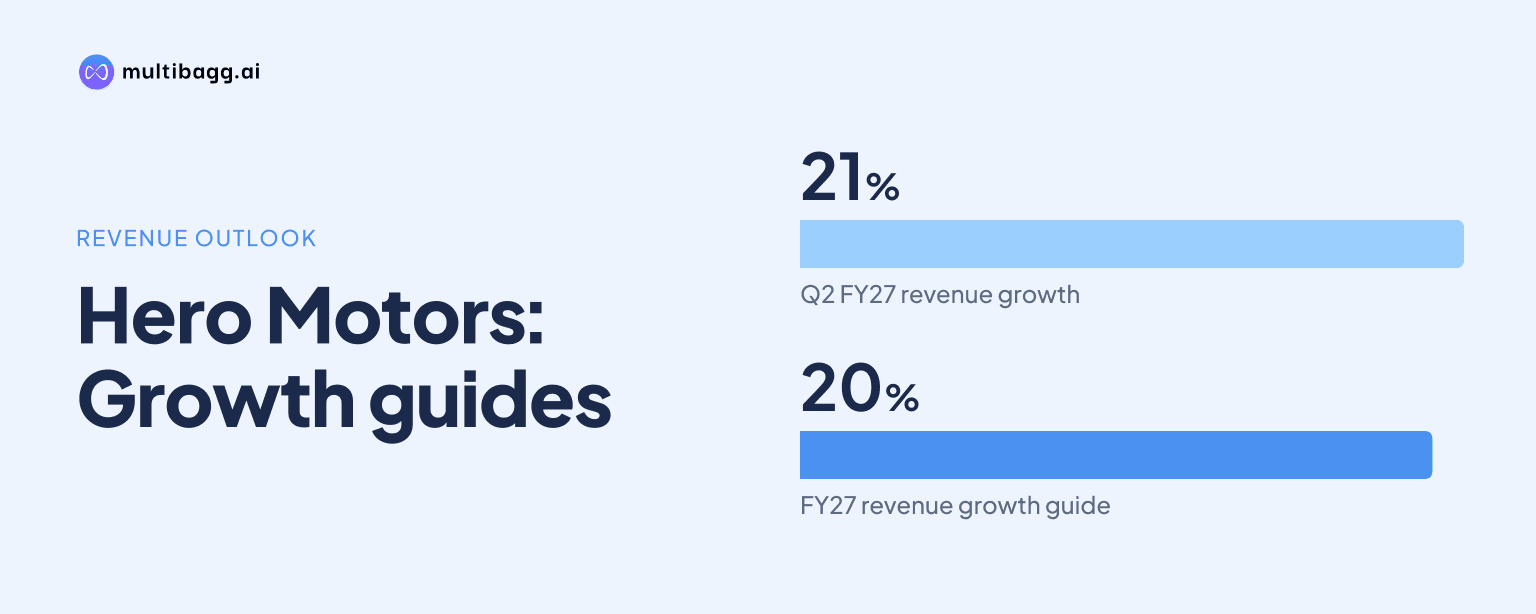
Hero Motors Ltd reported consolidated revenue of ₹365 crore in Q2 FY27, up 21% year on year, and net profit of ₹18 crore, up 62%, while management maintained guidance for revenue growth of more than 20% in FY27. The performance was led by standalone operations and a growing share of powertrain systems.
Know Hero Motors inside out
Results, valuation, peers and who's buying, in one view.
What drove Hero Motors Ltd's Q2 FY27 growth?
Hero Motors Ltd's Q2 FY27 growth was supported by expansion across all three reported operating segments, with standalone revenue rising 27% year on year to ₹318 crore. Consolidated EBITDA increased 23% to ₹47 crore, while the consolidated EBITDA margin stood at 12.8%. The company reported a 62% increase in consolidated profit after tax to ₹18 crore, equivalent to a 4.9% PAT margin.
Alloy and metallics revenue rose 24% year on year to ₹174 crore during the quarter. Gears and transmission contributed ₹142 crore, up 16%, while bike powertrain revenue increased 27% to ₹48 crore. The results marked Hero Motors' first earnings call after its initial public offering, giving investors a detailed view of the business mix, pipeline and planned investment.
Why is powertrain becoming more important for Hero Motors?
Powertrain has become more important because it now accounts for about 52% of Hero Motors' revenue, compared with roughly 20% five to six years earlier. The business includes gears, transmission systems and electric drive systems. Management said gears and transmission typically generate EBITDA margins of 22% to 25%, compared with 6% to 7% for alloy and metallics activities.
The company is also moving from supplying individual components to delivering larger systems. Management indicated that complete systems can earn margins of 18% to 25%, compared with 6% to 8% for parts. Its UK technology centre is developing a six-speed transmission for Formula 2 cars, with supplies expected from the end of the financial year. Hero Motors has also won design work for marine transmissions, where design fees may precede manufacturing orders.
EV and hybrid applications accounted for 26% of revenue, up from 20% a year earlier. Electronic Drive Unit revenue increased from ₹2.5 crore in FY25 to ₹27 crore in FY26, and management said H1 FY27 revenue had already exceeded the FY26 total. The planned Bengaluru EV systems facility is expected to begin operations around March or April 2027.
What do the project pipeline and FY27 guidance indicate?
Hero Motors has guided for FY27 revenue growth of more than 20% and expects second-half sales to contribute a larger part of the year's revenue. Managing Director and Chief Executive Officer Amit Gupta said the company expects FY27 revenue of ₹1,400 crore to ₹1,500 crore. Management also indicated that EBITDA margin should be higher than the previous year.
The company has confirmed projects with about ₹4,000 crore of lifetime revenue under development. These programmes are expected to run for five to eight years and could add ₹500 crore to ₹600 crore of annual revenue at full ramp-up. Hero Motors expects ₹100 crore to ₹150 crore of this revenue to begin in the current year, with projects nearing full ramp-up by FY28.
Management said the Bengaluru facility could generate ₹60 crore to ₹80 crore of revenue in FY28 and around ₹200 crore in FY29, with River identified as the main customer. Gupta also said the transmission business for India's electric three-wheeler market could generate ₹200 crore to ₹300 crore of revenue over the next two years, with seven OEM customers using or evaluating its products.
Got a follow-up? Ask IRIS
Why do consolidated margins remain below standalone margins?
Consolidated margins remain below standalone margins because newer subsidiaries are still loss-making. Standalone EBITDA margin was 14.4% in Q2 FY27, compared with a consolidated EBITDA margin of 12.8%. For H1 FY27, standalone EBITDA margin was 15.2%, while the consolidated margin was 12.5%.
Management said some subsidiaries are expected to break even during the current year and the remaining businesses during the following year. This gap is relevant for investors because the company is increasing investment in businesses that may contribute to revenue growth but have not yet matched the profitability of the established standalone operations.
The forging joint venture with STP Germany is another project that could influence the consolidated mix. Hero Motors expects the venture to have export sales of about 70% and EBITDA margins of 15% to 20% once operations stabilise. Production is planned for calendar 2027, although management noted that war-related slippage could cause a slight delay to the timetable.
How has the IPO changed Hero Motors' balance sheet and investment plans?
The IPO has reduced Hero Motors' debt burden after the company repaid ₹190 crore of loans. Debt-to-equity declined to 0.21 from 0.89 in FY26. Management expects quarterly interest expense to reduce from about ₹8 crore to ₹9 crore to ₹1.5 crore to ₹2 crore, which can support profitability if operating performance remains on track.
Hero Motors plans growth capital expenditure of about ₹350 crore over the current year and the following two years, including ₹200 crore from IPO proceeds. The investments cover the EV systems facility and other capacity and product-development requirements. The plan reflects the company's focus on powertrain systems and electrified mobility applications, while execution timelines and the profitability of new subsidiaries remain important factors to monitor.
Conclusion
Hero Motors' Q2 FY27 results showed revenue growth across alloy and metallics, gears and transmission, and bike powertrain, alongside a faster increase in profit. The higher contribution from powertrain systems and EV and hybrid applications supports the company's effort to improve the overall product mix, although subsidiary losses continue to hold consolidated margins below standalone levels.
Investors will next watch the second-half contribution needed to meet the ₹1,400 crore to ₹1,500 crore FY27 revenue target, the pace of project revenue additions, and progress at the Bengaluru EV facility. The production timeline for the STP Germany forging joint venture also remains an unresolved item after management flagged possible war-related delay.