










Hero Motors Powertrain Generates 52% of Q2 FY27 Revenue
Key highlights
- Hero Motors Limited said Powertrain Solutions contributed about 52% of Q2 FY27 consolidated revenue, compared with 48% from Alloy and Metallics.
- Hero Motors reported Gears and Transmission revenue of Rs 142 crore in Q2 FY27, up 16% year on year.
- Hero Motors reported Bike Powertrain revenue of Rs 48 crore in Q2 FY27, up 27% year on year.
- Hero Motors reported consolidated Q2 FY27 revenue of Rs 365 crore, up 21% year on year from Rs 301 crore.
powered by IRIS
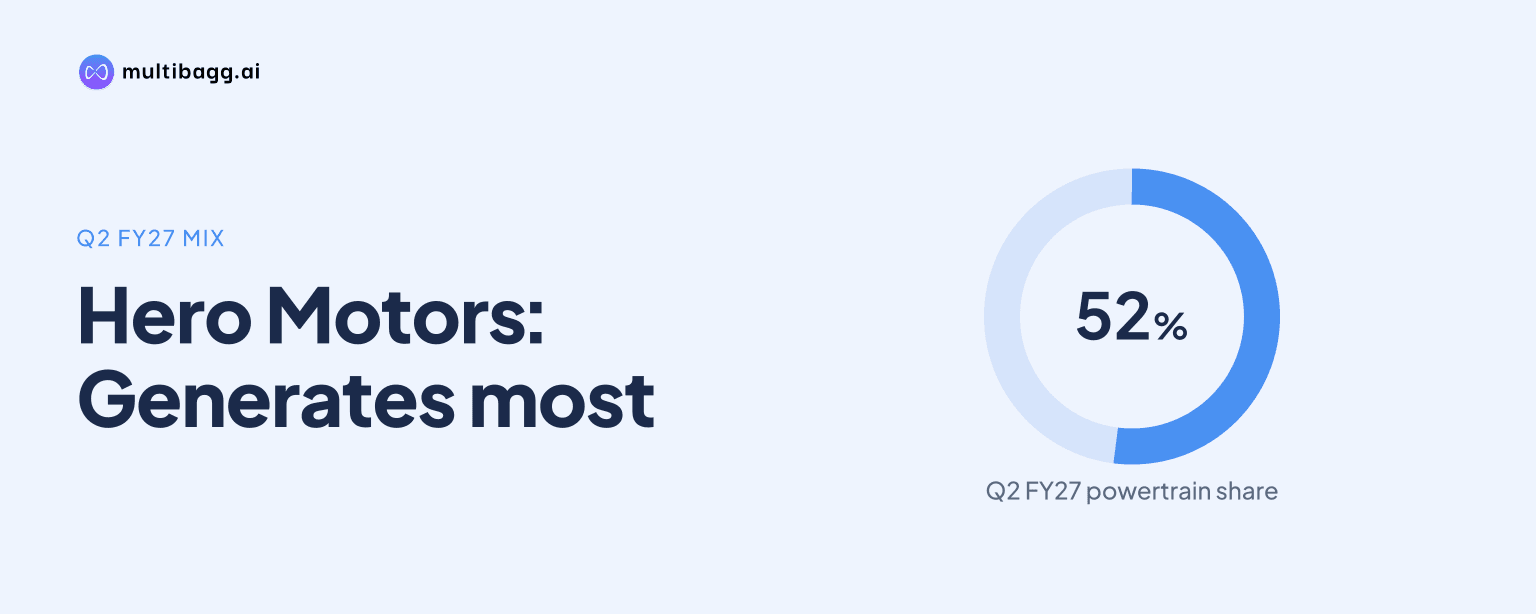
Hero Motors Limited said Powertrain Solutions generated about 52% of consolidated revenue in Q2 FY27, ahead of Alloy and Metallics at 48%, as Gears and Transmission revenue reached Rs 142 crore and Bike Powertrain revenue reached Rs 48 crore. Management said the powertrain share was about 20% five to six years earlier.
Know Hero Motors inside out
Results, valuation, peers and who's buying, in one view.
How much of Hero Motors revenue now comes from powertrain?
Hero Motors said its Gears and Transmission and Bike Powertrain businesses together accounted for about 52% of Q2 FY27 consolidated revenue, compared with 48% from Alloy and Metallics. Gears and Transmission contributed 39% of revenue, while Bike Powertrain contributed 13%, for the quarter ended September 30, 2026.
Management compared that mix with an approximately 80/20 split between Alloy and Metallics and Powertrain Solutions five to six years earlier. On that basis, powertrain’s reported share increased by about 32 percentage points to 52%, while Alloy and Metallics fell to 48%. Management also said Powertrain Solutions had become the majority of the business in published FY26 results.
The two powertrain businesses reported combined revenue of Rs 190 crore in Q2 FY27, Rs 16 crore above the Rs 174 crore reported by Alloy and Metallics. Consolidated revenue from operations was Rs 365 crore, up 21% year on year from Rs 301 crore, according to management’s Q2 FY27 presentation.
Which Hero Motors businesses drove the powertrain shift?
Hero Motors’ Gears and Transmission business was the largest powertrain contributor, reporting Q2 FY27 revenue of Rs 142 crore, up 16% year on year. Bike Powertrain reported Rs 48 crore, up 27%, making it smaller by revenue but faster growing than Gears and Transmission in the reported quarter.
Gears and Transmission supplies complete systems for automotive, aviation, marine and defence applications. Management said about 28% of this business serves electric vehicle and hybrid solutions. Bike Powertrain serves global two-wheeler and three-wheeler micro-mobility markets and is entirely focused on electric vehicle and hybrid applications.
Bike Powertrain, which management said began around 2018-19, represented 13% of total revenue in Q2 FY27. It manufactures motors and electronic drive units, or EDUs, which can combine motors, controllers, batteries and sensors. Management said it integrates, tests and validates these systems before supplying customers.
The company has moved its Gears and Transmission offering from individual components toward gear sets and complete systems. Hero Motors said it operates two technology centres, in India and the United Kingdom, plus six manufacturing facilities: four in India, one in the United Kingdom and one in Thailand. Its model is to manufacture major components in India and, in some cases, complete final assembly nearer to customers.
Why does the revenue mix matter for Hero Motors earnings?
Management said Gears and Transmission earns earnings before interest, tax, depreciation and amortisation, or EBITDA, of more than 20%, compared with 6% to 7% overall for Alloy and Metallics. It said certain Gears and Transmission projects generate EBITDA of 25% to 26%, and in some cases 30%, and that most profits are earned in Powertrain Solutions.
The segment margin figures explain management’s stated focus on systems, but the call did not disclose Q2 FY27 segment-level profit or EBITDA. At the consolidated level, Hero Motors reported EBITDA of Rs 47 crore, up 23% year on year, with a 12.8% margin compared with approximately 12.6% in the comparable period. Consolidated profit after tax rose 62% to Rs 18 crore from Rs 11 crore.
Management said complete solutions accounted for only 5% to 7% of business 20 to 25 years ago, whereas systems now make up the majority of Powertrain Solutions revenue. The company designs some transmissions internally and sometimes develops customer-specific designs, then produces prototypes, tests and validates them before pursuing manufacturing orders.
Alloy and Metallics remains a substantial business despite the mix change, recording Rs 174 crore of Q2 FY27 revenue and 24% year-on-year growth. The division makes sheet-metal components and provides painting and machining, with business primarily in India. The shift therefore reflects Powertrain Solutions growing to Rs 190 crore in combined revenue rather than a reported decline in legacy-business sales.
Got a follow-up? Ask IRIS
How international is Hero Motors’ powertrain business?
Management said about 70% to 75% of Powertrain Solutions revenue comes from global markets, compared with more than 40% of total company revenue in FY26. Alloy and Metallics remains primarily India-focused, although management said it began serving some global customers two to three years before the November 16, 2026 call.
Hero Motors identified Europe, the United States and Asia as markets for Powertrain Solutions. In electric bicycles, it manufactures continuously variable transmissions, or CVTs, with Enviolo for the European market. Management said the CVTs were co-developed with the customer and had been in the European market for the preceding two years.
The company also described its joint venture with Yamaha Motor for micro-mobility motors. In Thailand, management said it makes gear sets in India, assembles complete transmissions at its Thai facility and supplies BMW. It said some programmes also use final assembly in the United Kingdom while major components are manufactured in India.
Management said customer relationships in Powertrain Solutions generally span about one decade to two decades and that Hero Motors had not lost a customer in the past 10 years. The call did not disclose customer concentration, contract values by customer or renewal terms, but management linked the systems strategy to serving multiple projects for existing customers.
What is Hero Motors planning next in powertrain?
Management said Hero Motors is setting up a Bengaluru facility focused on electric vehicle-system manufacturing and plans to establish it in March or April 2027. It expects to ramp the facility over one year and said it could generate sizeable business in FY28 and FY29, without providing a revenue target or capital-expenditure figure.
The company said it is designing six-speed transmissions, integrated starter systems and advanced differentials for a Formula 2 racing programme, with supplies expected to begin by the end of 2026. Management also said it is working on transmissions for premium and super-premium cars in FY27-28, marine applications and L3 and L5 mobility systems. L3 and L5 are vehicle categories used for three-wheelers and similar light vehicles.
Management put the lifecycle value of projects already awarded or confirmed at approximately Rs 4,000 crore, with individual projects running for about five to eight years. It said development usually takes one to two years before supplies start and estimated these projects could add about Rs 500 crore to Rs 600 crore of annual revenue on top of existing business, subject to execution and programme timing.
Conclusion
Hero Motors’ Q2 FY27 disclosures show that Powertrain Solutions has overtaken Alloy and Metallics in the revenue mix, contributing about 52% versus 48%. Gears and Transmission generated Rs 142 crore and Bike Powertrain Rs 48 crore, while Alloy and Metallics remained a growing Rs 174 crore business. The change reflects the company’s transition from components toward engineered systems.
The next disclosures to watch are management’s planned March or April 2027 establishment of the Bengaluru electric vehicle-systems facility and the expected start of Formula 2 supplies by the end of 2026. Hero Motors has also cited Rs 4,000 crore of lifecycle project revenue, but conversion into annual sales will depend on development schedules, customer launches and manufacturing ramp-up.