










Hero Motors expects over 20% FY27 growth, 14-15% EBITDA
Key highlights
- Hero Motors expects FY27 revenue growth above 20% and EBITDA margins of 14% to 15%.
- Consolidated H1 FY27 revenue rose 23% year-on-year to Rs 684 crore and EBITDA increased 32% to Rs 87 crore.
- Bike Powertrain revenue grew 37% year-on-year to Rs 89 crore in H1 FY27, the fastest reported segment growth.
- Hero Motors said some newer subsidiaries could become EBITDA-positive within six months.
powered by IRIS
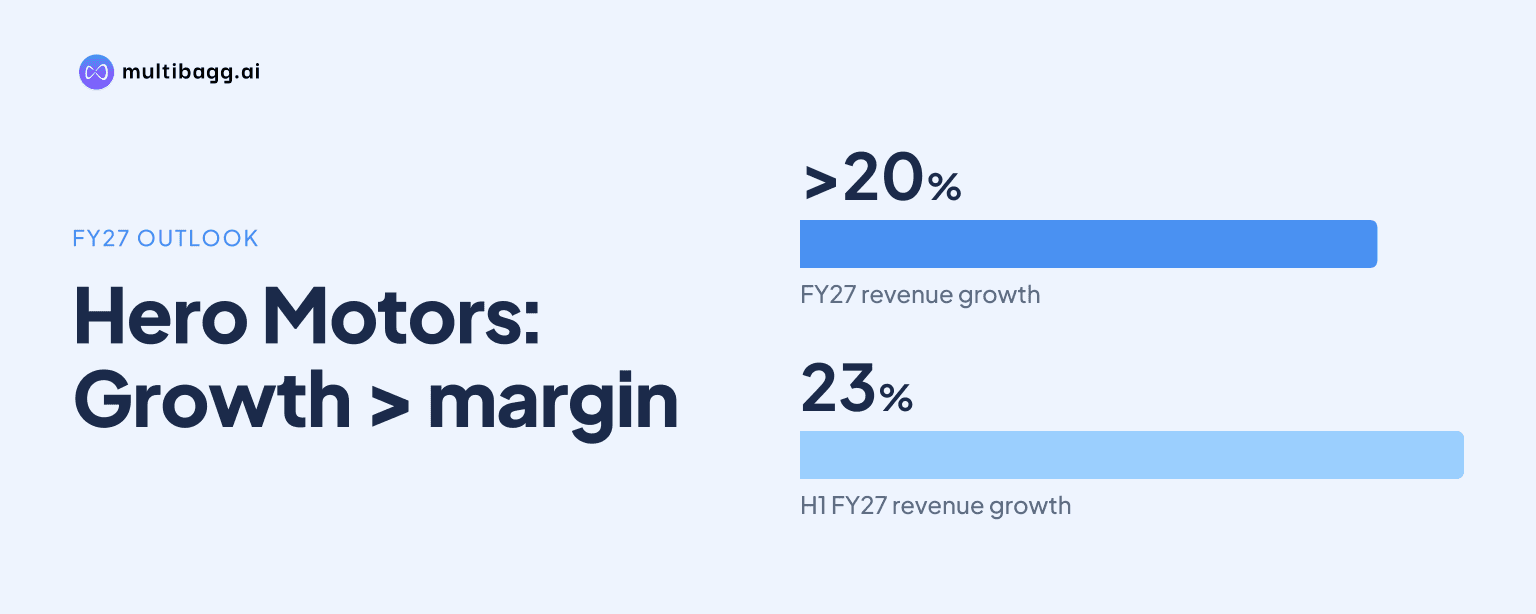
Hero Motors expects FY27 revenue growth of more than 20% and an EBITDA margin of 14% to 15%, following a 32% year-on-year rise in consolidated H1 FY27 EBITDA to Rs 87 crore. Management said newly established subsidiaries continue to reduce consolidated margins, although some are expected to become EBITDA-positive within the next six months.
Know Hero Motors inside out
Results, valuation, peers and who's buying, in one view.
What is Hero Motors' FY27 growth and margin outlook?
Hero Motors expects revenue growth of more than 20% in FY27 and EBITDA margins of about 14% to 15%, management said during the Q2 FY27 earnings call. EBITDA, or earnings before interest, tax, depreciation and amortisation, is expected to be higher as a percentage of revenue than in the previous year, according to management.
The outlook follows 28% year-on-year growth in standalone H1 FY27 revenue to Rs 596 crore and 57% growth in standalone EBITDA to Rs 92 crore. Standalone EBITDA margin rose by 292 basis points to 15.2%, while standalone profit after tax increased 92% to Rs 47 crore and the margin reached 7.8%.
Consolidated H1 FY27 revenue grew more slowly, by 23% to Rs 684 crore, while consolidated EBITDA increased 32% to Rs 87 crore. The resulting 12.5% consolidated EBITDA margin was 2.7 percentage points below the 15.2% standalone margin, reflecting the costs of subsidiaries that are still scaling operations.
How did Hero Motors perform in H1 FY27?
Hero Motors reported consolidated H1 FY27 profit after tax of Rs 28 crore, up 84% year-on-year, alongside revenue of Rs 684 crore and EBITDA of Rs 87 crore. Consolidated EBITDA margin improved by 103 basis points to 12.5%, while profit-after-tax margin improved by 136 basis points to 4%.
In Q2 FY27, consolidated revenue rose 21% year-on-year to Rs 365 crore from Rs 301 crore. Quarterly EBITDA increased 23% to Rs 47 crore, raising the EBITDA margin by 22 basis points to 12.8%, while profit after tax rose 62% to Rs 18 crore from Rs 11 crore and margin reached 4.9%.
Hero Motors also reported lower leverage in H1 FY27, with debt to equity declining to 0.21 times from 0.89 times in FY26. Management said it had repaid Rs 190 crore of loans by August, leaving borrowings of about Rs 220 crore and reducing expected quarterly interest cost to Rs 1.5 crore to Rs 2 crore from a historical Rs 8 crore to Rs 9 crore.
Why are Hero Motors' consolidated margins below standalone margins?
Hero Motors said consolidated margins are below standalone margins because newer subsidiaries remain in a growth phase and their losses are included in group results. Management identified E-sync, EDU and HYM as recently established businesses, unlike the established standalone operations in Gears and Transmission, Alloy and Metallics, and powertrain systems.
The difference was visible in H1 FY27, when standalone EBITDA margin was 15.2% and consolidated EBITDA margin was 12.5%. Standalone profit-after-tax margin was also 7.8%, compared with 4% on a consolidated basis, showing that the margin effect extended below EBITDA.
Management said some subsidiary companies could become EBITDA-positive within six months, while others may reach break-even during the next year. This is a management expectation rather than a reported financial result, and depends on the newer units building revenue sufficient to absorb their operating costs.
Got a follow-up? Ask IRIS
Which Hero Motors segments and products are growing?
Hero Motors' Bike Powertrain segment was the fastest-growing reported business in H1 FY27, with revenue increasing 37% year-on-year to Rs 89 crore. Management expects the highest compound annual growth rate in Bike Powertrain because its products are used entirely in electric-vehicle applications and the business is still relatively new.
Alloy and Metallics remained the largest H1 FY27 segment, generating Rs 330 crore of revenue after 26% growth, while Gears and Transmission generated Rs 265 crore after 15% growth. In Q2 FY27, Alloy and Metallics represented 48% of revenue, Gears and Transmission 39%, and Bike Powertrain 13%.
Powertrain businesses accounted for about 52% of revenue in Q2 FY27, compared with an 80:20 Alloy and Metallics-to-Powertrain revenue mix five to six years earlier. Electric and hybrid applications rose to 24% of H1 FY27 revenue from 20% in H1 FY26, while internal-combustion-engine applications accounted for the remaining 76%.
Management said Gears and Transmission has delivered a compound annual growth rate above 30% over the past five years and generates EBITDA of more than 20% in its gears and transmission activities. Alloy and Metallics operates at an overall EBITDA margin of 6% to 7%, while management expects the STP joint venture to support a higher-margin product mix over time.
How will Hero Motors' order book and new facilities support growth?
Hero Motors said projects under development represent about Rs 4,000 crore of lifecycle revenue, generally across five to eight years, with some extending as long as 12 years. Management said most orders are confirmed by customers and expects the projects to add about Rs 500 crore to Rs 600 crore of annual revenue at full ramp-up.
Management expects about Rs 100 crore to Rs 150 crore of the order book to start during the current year and said FY28 could see more or less full ramp-up. Development and testing for a typical project take one to two years before start of production, meaning the timing of revenue depends on customer product launches and validation.
The planned Bengaluru electric-vehicle systems facility is expected to generate Rs 60 crore to Rs 80 crore of revenue in 2027-28 and about Rs 200 crore, plus or minus 10%, in 2028-29, according to management. The facility is planned for establishment in March or April 2027, with River identified as a major customer for transmission systems and chassis for electric scooters.
Hero Motors said it plans to use Rs 200 crore of initial public offering proceeds for capital expenditure over the current year and the next two years, alongside about Rs 150 crore of additional capital expenditure. Management said the STP joint venture could begin manufacturing in calendar 2027, although it warned that timing may vary slightly following disruption in the first quarter.
Conclusion
Hero Motors' FY27 target combines more than 20% revenue growth with a 14% to 15% EBITDA margin as its powertrain businesses form a larger share of revenue and electric and hybrid applications reach 24% of H1 FY27 sales. Consolidated profitability remains below standalone profitability because new subsidiaries are still absorbing growth-stage costs, but management expects that gap to narrow as those businesses approach break-even.
The next disclosed milestones are potential EBITDA positivity at some subsidiaries within six months, break-even at others during the next year, and the expected FY28 ramp-up of the Rs 4,000 crore project pipeline. Management also plans to establish the Bengaluru facility in March or April 2027 and expects the STP venture to start manufacturing in calendar 2027, subject to possible timing variation.