










Himalaya Nutravedics own brands led H1 FY27 revenue
Key highlights
- Himalaya Nutravedics’ own-brand business contributed 54.7% of H1 FY27 revenue, compared with 45.3% from contract manufacturing.
- Revenue from operations increased 35.8% year-on-year to Rs 27.398 crore in H1 FY27.
- EBITDA rose 51.1% to Rs 5.672 crore and EBITDA margin increased 210 basis points to 20.7%.
- Himalaya Nutravedics proposes to deploy Rs 7.500 crore of net IPO proceeds on branding, performance marketing and customer acquisition.
powered by IRIS
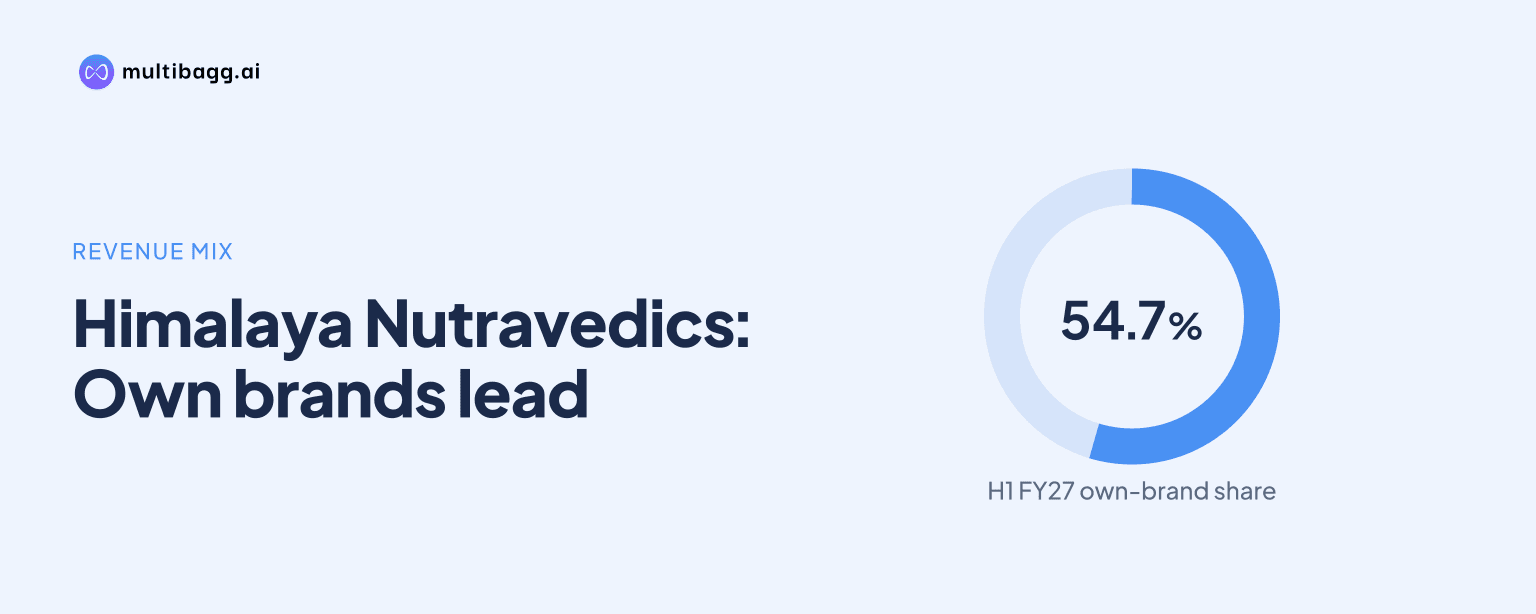
Himalaya Nutravedics India Limited generated 54.7% of revenue from own-brand products in H1 FY27, exceeding the 45.3% contribution from third-party manufacturing as revenue from operations rose 35.8% year-on-year to Rs 27.398 crore. The period marked a larger branded-sales contribution than the 51.1% reported in FY26.
Know Himalaya Nutravedics India inside out
Results, valuation, peers and who's buying, in one view.
How did Himalaya Nutravedics’ revenue mix change in H1 FY27?
Himalaya Nutravedics’ own-brand business was its largest reported revenue segment in H1 FY27 at 54.7%, compared with 45.3% for third-party contract manufacturing. Own brands represented 51.1% in FY26 and 19.7% in FY25, while contract manufacturing declined from 48.9% in FY26 and 80.4% in FY25. The reported mix therefore shows own brands moving from a minority of revenue in FY25 to more than half in H1 FY27.
Himalaya Nutravedics operates two segments: own-branded classical ayurvedic, proprietary ayurvedic and nutraceutical products, and third-party contract manufacturing. The own-brand channel uses a prescription-led, doctor-engagement model supported by super-stockists, stockists and retail pharmacies. Contract manufacturing covers custom formulation, production, packaging and dispatch to client specifications, with a significant part of that business originating in Kerala.
The product mix was predominantly ayurvedic in H1 FY27, with ayurvedic products contributing 98.2% of revenue, up from 94.6% in FY26. Nutraceutical products accounted for 1.8%, down from 5.4% in FY26. Himalaya Nutravedics manufactures softgel capsules, hardgel capsules, tablets, liquid orals, medicated oils and protein powders for categories including pain management, digestive health, women’s wellness and metabolic support.
What supports Himalaya Nutravedics’ own-brand distribution?
Himalaya Nutravedics’ distribution network reached 20 states and one Union Territory in H1 FY27 through super-stockists, stockists and retailers. Operations began in Bihar and Odisha in July 2026, and the company identifies Kerala, Gujarat, Uttar Pradesh and Telangana as markets with deep penetration. Its carrying and forwarding, or C&F, arrangement covers Uttar Pradesh, Uttarakhand, Jharkhand and Bihar.
Kerala remained the company’s anchor market at 47.7% of H1 FY27 revenue, while the rest of India contributed 52.3%. In FY26, Kerala accounted for 49.3% and the rest of India for 50.7%, showing a 1.6-percentage-point reduction in Kerala’s share. The company’s stated route to market remains practitioner-led demand generation, with healthcare professionals supporting product trust and repeat purchase.
The proprietary ayurvedic range includes Cartisage and Heelsage in orthopedic and pain management, Laxosage and Gasosage-SF in gastrointestinal and liver health, and Himarex in men’s health and vitality. Its nutraceutical portfolio includes Coqrite, Coqrite-plus, Lythimin and Lythmin Plus tablets. These products are manufactured at Himalaya Nutravedics’ single Cherlapally, Hyderabad facility, which began commercial operations in September 2022.
Got a follow-up? Ask IRIS
What were Himalaya Nutravedics’ H1 FY27 financial results?
Himalaya Nutravedics reported revenue from operations of Rs 27.398 crore in H1 FY27, up 35.8% from Rs 20.179 crore in H1 FY26. Earnings before interest, tax, depreciation and amortisation, or EBITDA, increased 51.1% to Rs 5.672 crore from Rs 3.754 crore. EBITDA margin rose 210 basis points to 20.7% from 18.6% in the prior-year half.
Profit after tax, or PAT, increased 34.6% to Rs 4.441 crore in H1 FY27 from Rs 3.300 crore a year earlier. PAT margin was 16.2%, down 14 basis points from 16.4%, while earnings per share fell 15.7% to Rs 7.0 from Rs 8.2. Tax expense was Rs 0.820 crore in H1 FY27, compared with Rs 0.022 crore in H1 FY26.
Working-capital measures moved in the opposite direction to operating profit growth. Inventory increased to Rs 13.224 crore in H1 FY27 from Rs 8.915 crore at FY26, while trade receivables rose to Rs 12.265 crore from Rs 10.587 crore. Cash flow from operations was negative Rs 0.655 crore, narrower than negative Rs 3.842 crore in FY26, while the cash conversion cycle increased to 230 days from 201 days in FY25.
How does Himalaya Nutravedics plan to expand its sales channels?
Himalaya Nutravedics plans to add direct-to-consumer, or D2C, sales, e-commerce marketplaces, quick-commerce platforms and a proprietary website while retaining its practitioner-led business-to-business network as the core channel. Its disclosed marketplace plans name Amazon and Flipkart, while Blinkit and Zepto are identified as planned quick-commerce platforms. Management says the digital channels are intended to complement practitioner endorsements and expand consumer reach.
The company proposes to deploy Rs 7.500 crore of net initial public offering proceeds on branding, performance marketing and customer-acquisition campaigns. Its plan includes advertising through Meta and Google, influencer-led content and sponsored listings. Management also intends to introduce new stock-keeping units, or SKUs, in pain management, gut health, women’s wellness and neurological support, while increasing finished-goods inventory across therapeutic categories.
Manufacturing utilisation presents a disclosed operating measure for the expansion plan. Softgel capsule utilisation rose to 83% in H1 FY27 from 64% in FY26, whereas medicated-oil utilisation declined to 43% from 90%. The capacity calculation is based on one eight-hour shift a day, while the Hyderabad facility can operate up to three shifts.
Conclusion
Himalaya Nutravedics’ H1 FY27 results show that own brands accounted for a majority of revenue at 54.7%, ahead of the 45.3% contribution from contract manufacturing. Revenue rose to Rs 27.398 crore and EBITDA margin reached 20.7%, while the company’s ayurvedic products made up 98.2% of revenue and its network covered 20 states and one Union Territory.
The next points to watch are management’s proposed Rs 7.500 crore deployment for branding and digital customer acquisition, the planned D2C website and marketplace presence, and the introduction of new own-brand SKUs. Operating cash flow, which remained negative Rs 0.655 crore in H1 FY27, inventory of Rs 13.224 crore and the 230-day cash conversion cycle will also indicate how the expansion is being funded and managed.