










Homesfy Direct Broking Delivered Rs 1,155 Crore First-Half GTV
Key highlights
- Homesfy reported record 1HFY27 GTV of Rs 1,155 crore, up 11% year on year.
- Direct broking generated Rs 1,004 crore, representing 87% of Homesfy’s 1HFY27 GTV.
- mymagnet bookings fell 47% to 59 as Homesfy focused on quality business and higher developer incentives per deal.
- Homesfy’s EBITDA margin improved to negative 22% in 1HFY27 from negative 45% in 1HFY26.
powered by IRIS
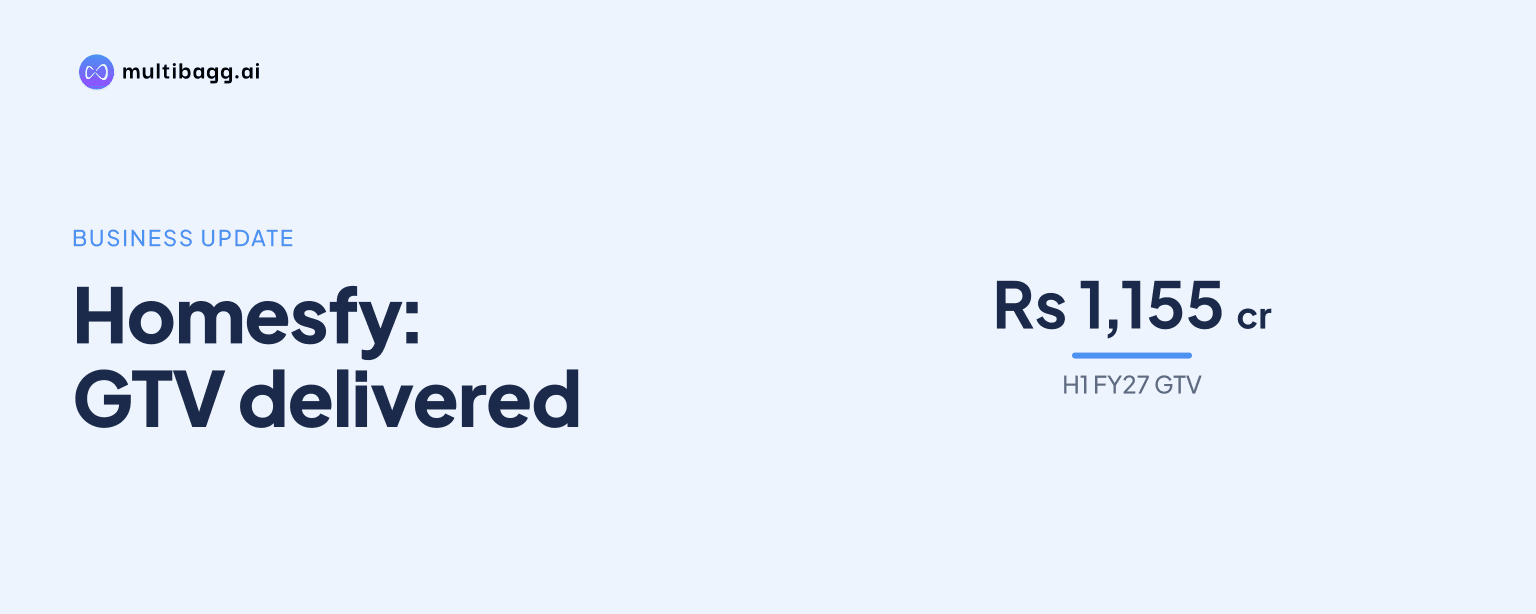
Homesfy Realty reported Rs 1,155 crore of gross transaction value (GTV) in 1HFY27, its highest first half in four years and 11% above 1HFY26, as direct broking supplied Rs 1,004 crore while mymagnet bookings fell 47% to 59. Direct broking represented 87% of the reported GTV total.
Know Homesfy Realty inside out
Results, valuation, peers and who's buying, in one view.
What drove Homesfy’s record first-half GTV?
Direct broking drove Homesfy’s record first-half GTV by generating Rs 1,004 crore, or 87%, of the Rs 1,155 crore reported in 1HFY27. Homesfy describes the business as an end-to-end model from lead generation through deal closure, supported by agents in micro-markets and a performance-marketing-led demand engine. GTV is reported gross and excludes cancellations.
The Rs 1,155 crore result was above each of the prior three first-half totals disclosed: Rs 1,039 crore in 1HFY24, Rs 1,019 crore in 1HFY25 and Rs 1,040 crore in 1HFY26. Homesfy said direct GTV had increased year on year for three consecutive first halves. It also said the second half is seasonally stronger, making 1HFY27 the highest first-half result in its four-year comparison.
Direct GTV increased by Rs 126 crore from 1HFY26, while mymagnet GTV declined by Rs 11 crore. The Rs 115 crore increase in total GTV therefore came despite the lower platform contribution. The comparison shows that expansion in the direct business more than offset the reduction in mymagnet GTV.
How did Homesfy’s business mix change in 1HFY27?
Homesfy’s property-transaction mix shifted further toward direct broking, which accounted for Rs 1,004 crore of 1HFY27 GTV, compared with Rs 151 crore for mymagnet. mymagnet represented 13% of GTV and is presented as a platform that helps small brokers scale through features including higher slab commissions, a brokerage passbook, launch information and market insights.
Home loans were the third engine in Homesfy’s model, with gross disbursements of Rs 202 crore in 1HFY27, up 30% from Rs 156 crore in 1HFY26. Homesfy said it had 51 partner banks and non-banking financial companies (NBFCs), including SBI, HDFC, ICICI Bank, Axis Bank and Bank of Baroda. The service provides application-to-approval support to buyers.
The Rs 202 crore home-loan figure is separate from the Rs 1,155 crore GTV figure. Direct broking and mymagnet make up the disclosed GTV total, while the loan number measures gross disbursements. This distinction matters because Homesfy reports transaction value and loan activity as separate operating measures.
Got a follow-up? Ask IRIS
Why did Homesfy cut mymagnet bookings by 47%?
Homesfy cut mymagnet bookings by 47% to 59 in 1HFY27 to focus on what management described as quality business and to seek higher developer incentives per deal. Management also linked the reduction to a faster booking-to-billing-to-collection cycle. The presentation does not disclose the value of developer incentives or a future booking target.
The booking reduction coincided with higher ticket sizes. Direct broking’s average ticket size reached Rs 1.58 crore per booking in 1HFY27, while mymagnet’s was Rs 2.57 crore; the blended ticket size was Rs 1.66 crore, up 18% from Rs 1.41 crore in 1HFY26. Homesfy described this as value-led growth driven by ticket size rather than volume.
mymagnet GTV fell to Rs 151 crore in 1HFY27 from Rs 162 crore in 1HFY26, even as its disclosed average ticket size increased. Direct GTV moved in the opposite direction, rising to Rs 1,004 crore from Rs 878 crore. The segment data indicate that the record first-half total was driven by direct-broking growth rather than higher mymagnet booking volume.
Which Homesfy markets gained GTV share in 1HFY27?
Pune and Bengaluru gained the most GTV share in Homesfy’s regional mix, adding a combined 9 percentage points in 1HFY27. Pune increased to 23% from 19% in 1HFY26, while Bengaluru rose to 16% from 11%. Homesfy characterised the change as growth broadening beyond the Mumbai Metropolitan Region (MMR).
MMR remained Homesfy’s largest reported market at 56% of 1HFY27 GTV, despite a 2-percentage-point reduction from 58% a year earlier. Hyderabad’s share declined by 7 percentage points to 5%. Homesfy lists Mumbai, Thane, Navi Mumbai, Pune, Bengaluru and Hyderabad within its operating presence.
How did Homesfy reduce operating losses while growing revenue?
Homesfy reported revenue from operations of Rs 25.1 crore in 1HFY27, up 28% year on year, compared with 11% GTV growth. Its earnings before interest, tax, depreciation and amortisation (EBITDA) margin improved to negative 22% from negative 45% in 1HFY26, a 23-percentage-point change. The reported margin remained negative in 1HFY27.
Homesfy attributed the margin movement partly to operating leverage. Average employee count declined 11% year on year to 326, while GTV per employee rose 25% to Rs 3.54 crore per half-year. The company said 75% of employees were in sales roles, and employee cost increased 4% while revenue from operations increased 28%.
Conclusion
Homesfy’s 1HFY27 result combined record GTV of Rs 1,155 crore with a larger direct-broking contribution of Rs 1,004 crore, a blended ticket size of Rs 1.66 crore and home-loan disbursements of Rs 202 crore. Management accepted a 47% reduction in mymagnet bookings to 59 in pursuit of quality business, higher developer incentives per deal and a faster conversion cycle.
The next disclosed period is significant because Homesfy says the second half is seasonally stronger. The key reported measures to monitor are whether direct GTV builds from Rs 1,004 crore, whether the 59 mymagnet bookings support the faster booking-to-billing-to-collection cycle described by management, and whether EBITDA margin improves from negative 22%.