










Homesfy Realty direct ticket size rises 18% with 16 partners
Key highlights
- Homesfy reported a Rs 1.58 crore direct-broking ticket size per booking in 1HFY27, up 18% year on year.
- Homesfy listed 16 marquee developer partners across MMR, Pune, Bengaluru and Hyderabad.
- Homesfy’s total GTV reached Rs 1,155 crore in 1HFY27, up 11% year on year.
- Pune and Bengaluru gained a combined 9 percentage points of Homesfy’s GTV mix in 1HFY27.
powered by IRIS
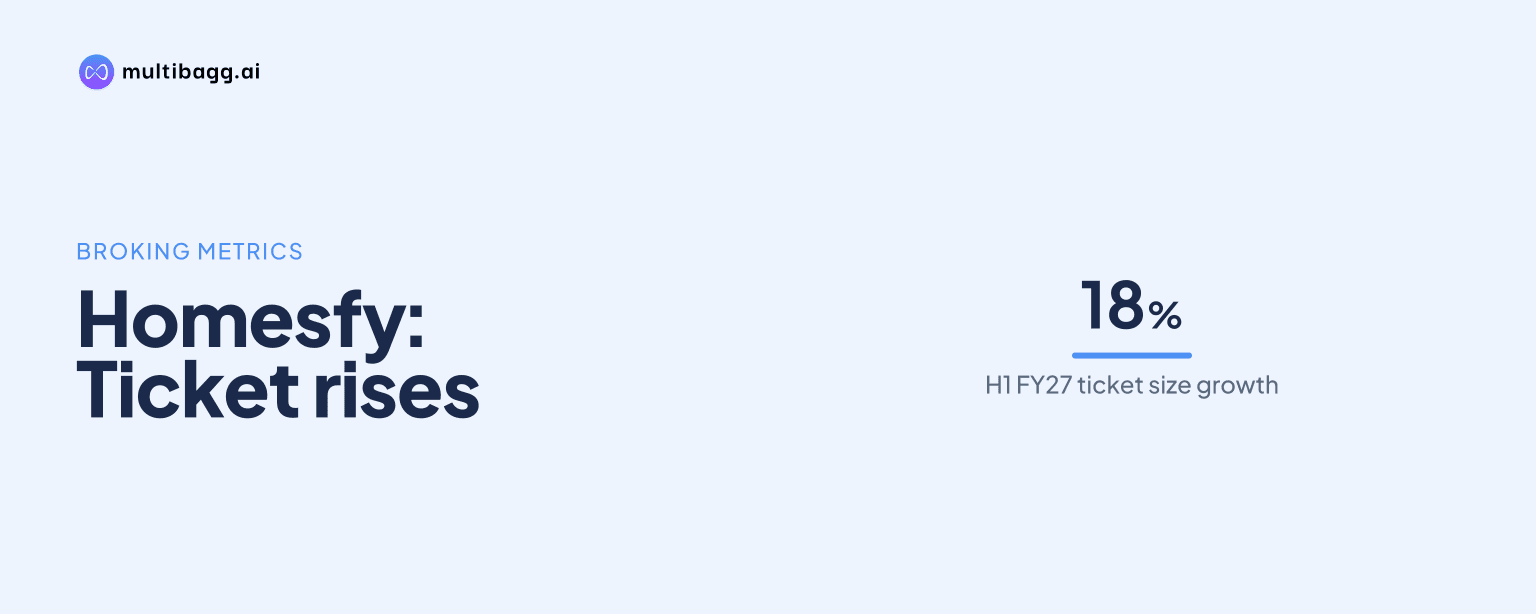
Homesfy Realty reported an 18% year-on-year increase in direct-broking average ticket size in 1HFY27, reaching Rs 1.58 crore per booking as it worked with 16 marquee developer partners. Homesfy linked its selected developer roster to premium inventory access and higher incentive brokerage slabs, while total gross transaction value, or GTV, reached Rs 1,155 crore.
Know Homesfy Realty inside out
Results, valuation, peers and who's buying, in one view.
How much did Homesfy’s direct-broking ticket size increase?
Homesfy’s direct-broking average ticket size was Rs 1.58 crore per booking in 1HFY27, which management described as an 18% year-on-year increase. The company reported a blended average ticket size of Rs 1.66 crore for the half and said its growth focus was value-led, through ticket size rather than volume.
The reported direct-broking ticket size has increased across the displayed first-half periods, from Rs 1.01 crore in 1HFY24 to Rs 1.27 crore in 1HFY25, Rs 1.41 crore in 1HFY26 and Rs 1.58 crore in 1HFY27. Homesfy’s stated 18% growth rate does not precisely match the change calculated from the rounded Rs 1.41 crore and Rs 1.58 crore figures, so both are presented as company disclosures.
Why does Homesfy work with 16 marquee developers?
Homesfy says its roster of 16 marquee developer partners is concentrated by design to access premium inventory and earn higher incentive brokerage slabs. The developer relationships cover Mumbai Metropolitan Region, or MMR, Pune, Bengaluru and Hyderabad, the four regions disclosed in its GTV mix.
The listed partners include L&T Realty, Raymond Realty, Prestige Group, Godrej Properties, Hiranandani, Brigade, Lodha, Sobha, Kolte-Patil, Dosti, Puravankara, Rustomjee, Runwal Realty, Shapoorji Pallonji, Oberoi Realty and Embassy Park. Homesfy does not disclose GTV, booking volumes, revenue or brokerage by individual developer, so the contribution of any partner to Rs 1,004 crore of direct GTV in 1HFY27 is not reported.
Homesfy identifies premium inventory as support for ticket-size growth and higher brokerage slabs as a reason for focusing on selected developers. The presentation gives a similar quality-business rationale for mymagnet, where bookings were reduced 47% to 59 in 1HFY27 to seek higher developer incentives per deal and a faster booking-to-billing-to-collection cycle.
How did Homesfy’s direct and mymagnet businesses compare?
Homesfy’s direct business generated Rs 1,004 crore of GTV in 1HFY27, compared with Rs 151 crore for mymagnet. Combined GTV was Rs 1,155 crore, which the company described as its highest first-half level in four years and 11% above 1HFY26. GTV is gross and excludes cancellations.
Direct GTV increased from Rs 878 crore in 1HFY26 to Rs 1,004 crore in 1HFY27, while mymagnet GTV declined from Rs 162 crore to Rs 151 crore. Meanwhile, mymagnet’s average ticket size rose from Rs 1.46 crore to Rs 2.57 crore per booking, exceeding the Rs 1.58 crore direct-broking average in 1HFY27.
Homesfy says direct GTV has grown year on year for three consecutive first halves. However, it does not disclose direct-broking booking counts, preventing a comparison of booking-volume changes between direct broking and mymagnet beyond the disclosed 59 mymagnet bookings in 1HFY27.
Got a follow-up? Ask IRIS
Which regions gained share in Homesfy’s GTV mix?
Homesfy’s GTV mix shifted towards Pune and Bengaluru in 1HFY27, with Pune rising to 23% from 19% and Bengaluru increasing to 16% from 11%. The two regions together gained 9 percentage points, while MMR remained the largest region at 56% of GTV.
MMR’s GTV share declined by 2 percentage points from 58% in 1HFY26, while Hyderabad’s share fell by 7 percentage points to 5%. Homesfy characterised the movement as growth broadening beyond MMR, although the presentation reports regional percentages rather than regional GTV in rupees.
Homesfy’s disclosed operating footprint includes Mumbai, Thane, Navi Mumbai, Pune, Bengaluru and Hyderabad. Its developer-partnership strategy spans MMR, Pune, Bengaluru and Hyderabad, linking its selected roster to markets that accounted for 100% of the reported 1HFY27 GTV mix.
What other operating metrics supported Homesfy’s strategy?
Homesfy reported Rs 202 crore of gross home loans disbursed in 1HFY27, up 30% from Rs 156 crore in 1HFY26, and attributed the increase to a higher average loan size. The company listed 51 partner banks and non-banking financial companies, or NBFCs, including SBI, HDFC, ICICI Bank, Axis Bank and Bank of Baroda.
Average employee numbers declined 11% to 326 in 1HFY27 from 366 in 1HFY26, while GTV per employee increased 25% to Rs 3.54 crore per half from Rs 2.84 crore. Homesfy said 75% of employees were in sales roles, employee costs increased 4% to Rs 13.20 crore, and revenue from operations increased 28% to Rs 25.07 crore.
The financial result remained loss-making despite the revenue increase. Homesfy reported an earnings before interest, tax, depreciation and amortisation, or EBITDA, loss of Rs 5.57 crore in H1 FY27, compared with a Rs 8.78 crore loss in H1 FY26, while its profit after tax loss narrowed to Rs 6.67 crore from Rs 8.54 crore.
Conclusion
Homesfy’s 1HFY27 disclosures connect higher direct-broking ticket sizes with a deliberately selected group of 16 developers, premium inventory access and higher incentive brokerage slabs. Direct GTV rose to Rs 1,004 crore and total GTV reached Rs 1,155 crore, while Pune and Bengaluru added a combined 9 percentage points to the regional GTV mix.
The next measure to watch is whether Homesfy can maintain ticket-size growth and direct GTV while continuing its stated focus on quality business, premium inventory and higher incentive brokerage per deal. The presentation provides no future ticket-size target, developer-expansion plan or profitability timetable, leaving those outcomes unresolved.