










India EV market grows 74.7% as October car registrations fall
Key highlights
- EV registrations rose 74.7% year-on-year to 36,646 units in October 2026.
- EV market share reached 7.3% in October, up from 3.6% a year earlier.
- Tata Motors held 40.7% of October electric car sales, while Mahindra held 23.7%.
- India sold about 26.6 lakh EVs in FY26, up 30% from FY25.
powered by IRIS
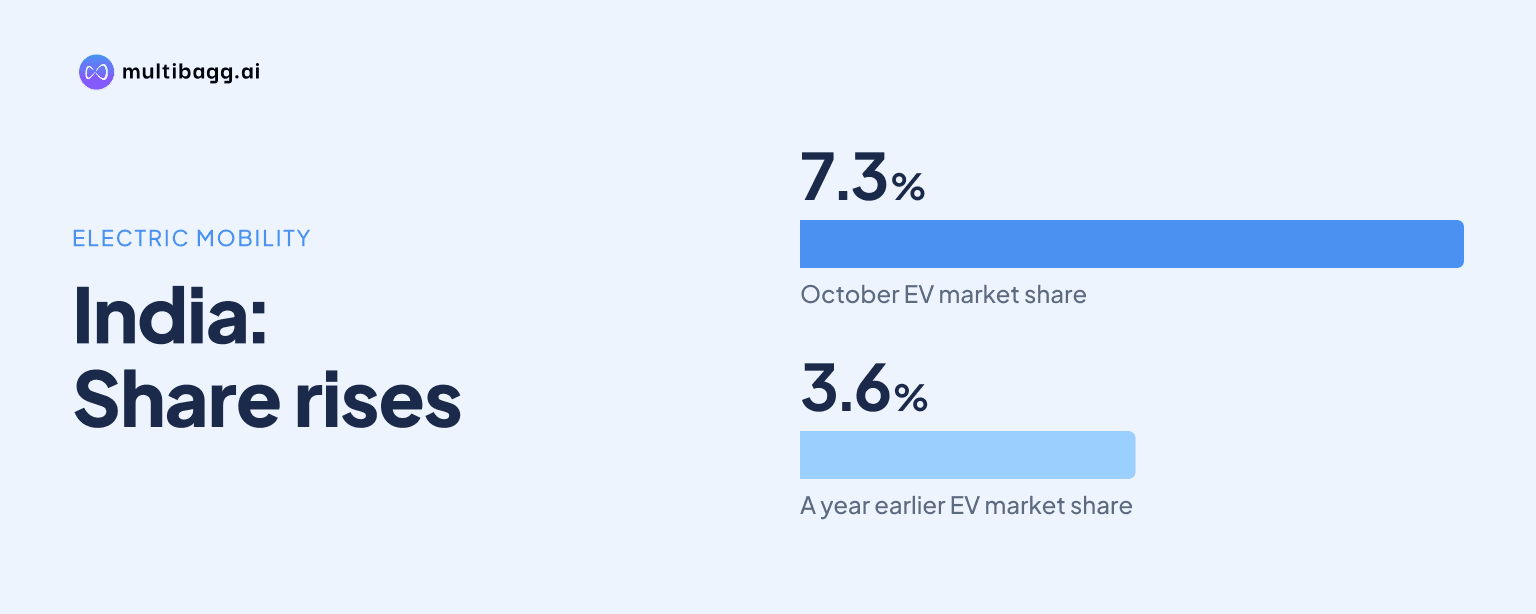
In October 2026, India's electric vehicle market recorded 74.7% year-on-year growth in EV registrations to 36,646 units, even as passenger vehicle registrations fell 14.6%. The India EV market's share almost doubled to 7.3% from 3.6% a year earlier, highlighting stronger electric demand during a weaker month for the wider vehicle market.
Why did India EV registrations rise in October 2026?
India EV registrations rose because high fuel prices, improving charging infrastructure and the launch of models across price points supported demand. The increase came despite pressure on the broader passenger vehicle market, where higher vehicle prices, EMIs, insurance and maintenance costs were cited as possible constraints on purchases.
Electric car registrations were also reported at 35,777 units in October, nearly double the 18,055 units recorded a year earlier. The differing registration figures in the available data indicate that the discussion includes more than one EV data cut, but both point to a sharp year-on-year rise in electric vehicle demand during October.
What do October registrations show about India EV market share?
October registrations show that the India EV market gained share even as total passenger vehicle registrations declined. EVs represented 7.3% of vehicle sales in one set of October data, compared with 3.6% a year earlier, while electric cars accounted for about 7% of passenger vehicle sales versus 3.2% a year earlier.
The trend was also visible earlier in the year. EVs accounted for 6.9% of vehicle sales in May, up from 4.1% in January and 4.2% in February. Electric car registrations in the first 10 months of the calendar year reached 287,453 units, already above the 176,817 units recorded in all of 2025.
Which companies have the strongest direct exposure to India EV demand?
Tata Motors and Mahindra have the strongest direct exposure among the manufacturers named in the available data. Tata Motors held a 40.7% share of the electric car market in October, while Mahindra held 23.7%; together, they accounted for 64.4% of electric cars sold locally that month.
For auto stocks, registration growth does not automatically translate into the same pace of earnings growth. Investors are also assessing model launches, battery availability, semiconductor supply and manufacturing execution. Companies involved in lithium-ion cell production, battery materials and electronic components may benefit from the transition, but their prospects depend on how quickly investments create an economic opportunity.
Got a follow-up? Ask IRIS
How large has India EV market growth been since 2016?
The India EV market has expanded from about 50,000 vehicles sold in 2016 to 2.3 million units in 2025, a 46-fold increase based on the figures discussed online. This growth rate has outpaced the cited global trend, where EV sales increased about 20 times from 918,000 in 2016 to 18.78 million in 2024.
More recent annual data also points to continued expansion across vehicle categories. India sold about 26.6 lakh EVs in FY26, up 30% from FY25, with EVs accounting for 8.6% of total vehicle sales. Two-wheelers reached 11.6% of retail sales in September, while passenger EV share rose to 7.9% from 4% over the referenced period.
What could slow India EV market growth and affect EV stocks?
The India EV market could face constraints from battery material availability, semiconductor shortages and manufacturing capacity. These factors can affect vehicle production, supplier economics and the ability of manufacturers to turn rising demand into profitable volumes.
The import impact also remains an unresolved issue. HSBC Global Research estimates that passenger EVs are likely to remain a net drag on India's import bill through FY35. That means higher EV adoption alone does not settle questions around local value addition, battery supply chains and import dependence, all of which matter for companies across the vehicle and component ecosystem.
Conclusion
The October data shows a clear divergence: the India EV market expanded rapidly while overall passenger vehicle registrations contracted. Rising fuel prices, broader model availability and improving charging infrastructure are supporting the shift, while Tata Motors and Mahindra held a combined 64.4% electric car segment share in October.
The next markers are whether EV penetration can move beyond the projected 10% of passenger vehicle sales by year-end and whether FY27 volumes meet Nomura's expectations of about 380,000 electric passenger vehicles and 2.4 million electric two-wheelers. Investors will also watch supply-chain execution and the progress of domestic battery-related investments.