










Indian Energy Stocks Face Diverging Risks as Crude Tops $100
Key highlights
- Crude traded above $100 a barrel, with one market session reporting prices above $117.
- The Nifty fell 2.36% and the Sensex declined 2.15% amid elevated crude and geopolitical tensions.
- India routes 70% of crude imports outside the Strait of Hormuz, cushioning immediate supply risks.
- Every $1 increase in crude raises India’s annual import bill by roughly $2 billion, according to JM Financial.
powered by IRIS
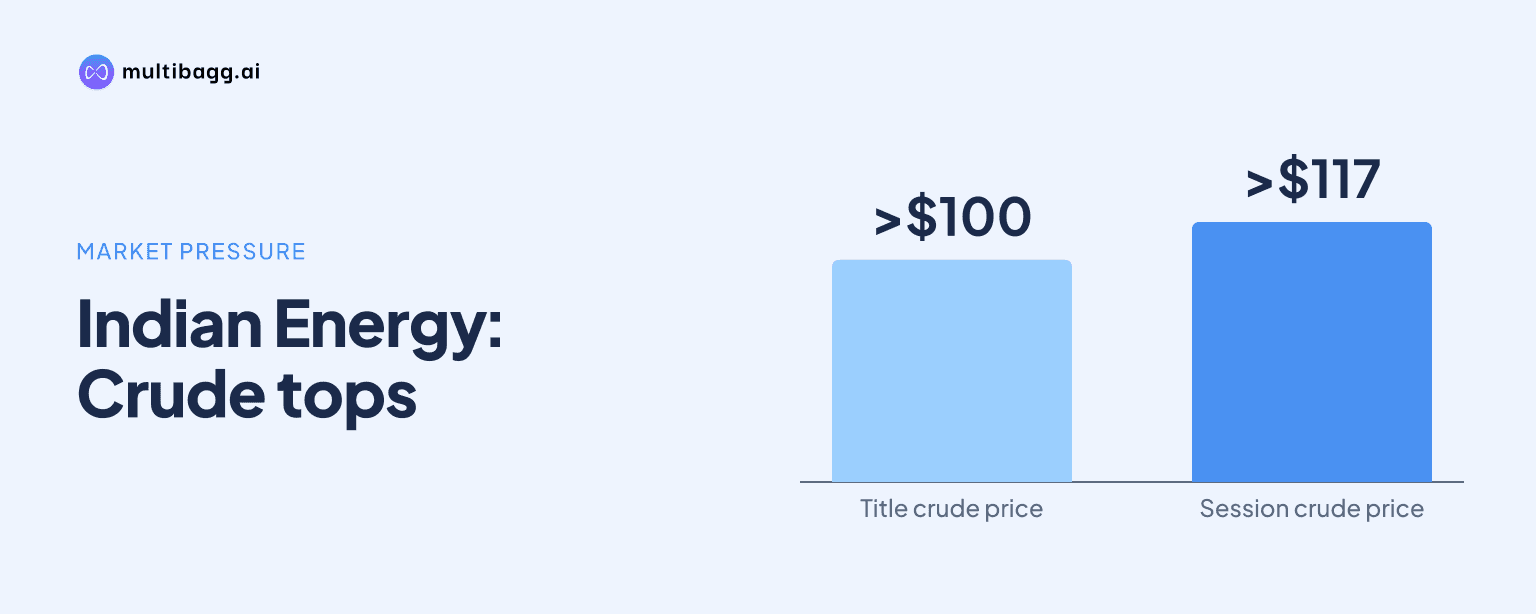
Indian energy stocks face diverging risks as crude oil trades above $100 a barrel amid US-Iran tensions and Strait of Hormuz disruptions, with upstream producers positioned to gain from higher realisations while downstream marketing companies face greater cost pressure. India’s import dependence leaves the wider market exposed to a prolonged price shock.
How are Strait of Hormuz tensions affecting Indian energy stocks?
Strait of Hormuz tensions are raising crude prices and creating an uneven outlook for Indian energy stocks. Attacks involving the US and Iran have disrupted oil flows through the route, which carries nearly 20% of global oil flows. Brent has held above $100 a barrel, while one market session saw crude move above $117 as Indian equities weakened.
The market response reflects both the direct impact of expensive imported energy and the uncertainty around the duration of any disruption. The Nifty fell 2.36% and the Sensex declined 2.15% amid elevated crude prices, foreign institutional investor outflows and geopolitical tension. Higher US Treasury yields have added to the cautious tone for risk assets.
India has diversified its crude sourcing and routing, with 70% of crude imports currently routed outside the Strait of Hormuz. That reduces the immediate risk of a direct supply shortfall, but it does not eliminate exposure to higher international prices, shipping insurance and broader commodity costs.
Which Indian energy stocks could benefit from higher crude prices?
Upstream producers Oil and Natural Gas Corporation (ONGC) and Oil India could benefit if crude remains elevated because higher prices can lift their crude realisations. JM Financial said current valuations of ONGC and Oil India factor in net crude realisations of roughly $55 to $60 per barrel, making a sustained higher-price environment relevant to their outlook.
The potential gain for upstream companies is tied to the persistence of the oil-price move rather than a single volatile trading session. JM Financial’s scenario analysis indicated that limited retaliation could raise prices by $5 to $10 per barrel, while direct damage to Iranian oil infrastructure could add $10 to $12 per barrel. It said Strait of Hormuz disruption could push crude above $90, and a broader regional war could take it beyond $100.
Equirus Securities also flagged the possibility that even partial disruption could add a $20 to $40 per barrel geopolitical premium, taking crude towards the $95 to $110-plus range. These are scenario-based assessments, not forecasts of a certain outcome, but they explain why investors are separating upstream producers from fuel-marketing businesses.
Why are oil marketing companies under pressure when crude rises?
Oil marketing companies Indian Oil Corporation, Bharat Petroleum Corporation and Hindustan Petroleum Corporation face margin pressure when crude stays high and domestic fuel prices remain relatively stable. Their input costs rise with imported crude, while the ability to pass through those costs can determine the eventual impact on profitability.
JM Financial said crude around $90 a barrel for a prolonged period could be a near-term concern for Indian oil marketing companies. Conversely, a moderation towards $80 and subsequently $70 a barrel, as projected by the brokerage, could provide relief to downstream businesses. The direction and duration of crude, rather than the headline level alone, are therefore central for these companies.
The wider effect is not limited to refiners and marketers. Higher fuel and transport costs can weigh on companies exposed to logistics and energy expenses, while airlines are also seen as vulnerable to a sustained rise in crude. This broader earnings risk helps explain why elevated oil prices can weaken overall equity sentiment even when selected upstream stocks gain.
Got a follow-up? Ask IRIS
How exposed is India to a prolonged supply disruption?
India remains exposed to a prolonged disruption because an estimated 50% to 55% of its crude oil and LNG imports transit the Strait of Hormuz, although crude-routing diversification provides an important buffer. Other estimates in the discussion put more than 40% of India’s crude imports through the route, underlining that the exposure is material even with alternative routes in use.
The country’s strategic petroleum reserves cover only eight to nine days of oil demand, according to the discussion, and there are no comparable strategic reserves for natural gas. If disruption extends beyond the very short term, supply-side stress could intensify rapidly. Gas supplies may need to be rationed in the near term under such conditions.
The macroeconomic sensitivity is also significant. JM Financial estimated that every $1 increase in crude raises India’s annual import bill by about $2 billion. Persistently high prices can pressure the rupee, complicate the inflation outlook, widen import costs and weigh on corporate margins across fuel-intensive sectors.
What should investors monitor in the oil-price outlook?
Investors should monitor whether oil above $100 is a temporary geopolitical shock or becomes a sustained supply-side problem. The duration of supply disruptions around the Strait of Hormuz, the condition of regional energy infrastructure and any movement towards a US-Iran agreement are the key variables identified in the market discussion.
Shipping insurance rates and the premium in MCX crude relative to international benchmarks are also relevant for India’s landed energy costs. A prolonged period of elevated prices could further affect inflation expectations and the interest-rate outlook, while a sustained decline in crude could improve investor confidence and the economic outlook.
For energy stocks, the distinction remains clear but conditional: higher crude generally supports ONGC and Oil India, while it can pressure the margins of Indian Oil Corporation, Bharat Petroleum Corporation and Hindustan Petroleum Corporation. The balance can shift quickly if crude falls, domestic fuel pricing changes, or supply flows through the region normalise.
Conclusion
Indian energy stocks are being shaped by a split created by high crude prices. Upstream producers have potential realisation upside, while downstream marketers face input-cost and margin risks. For the broader market, India’s diversified crude routes cushion immediate physical shortages but do not remove the inflation, import-bill and currency implications of expensive oil.
The next signals are the duration of Strait of Hormuz disruption, further developments involving the US and Iran, and whether crude moderates towards the levels cited by JM Financial. Investors will also watch upcoming US inflation data, as it may influence global risk appetite alongside oil prices and geopolitical developments.