










Nifty Energy Outlook: 6.06% Rally Meets November Return Risk
Key highlights
- The S&P BSE Energy sector rose 6.06% on 2 November 2026.
- Nifty Energy has delivered negative November returns in 11 of the past 17 years cited.
- Oil and Natural Gas Corporation gained 4.19% to Rs 234.83 despite a 4.71% fall in MCX crude.
- The Indian Energy industry trades near its three-year average PE of 13.6 times.
powered by IRIS
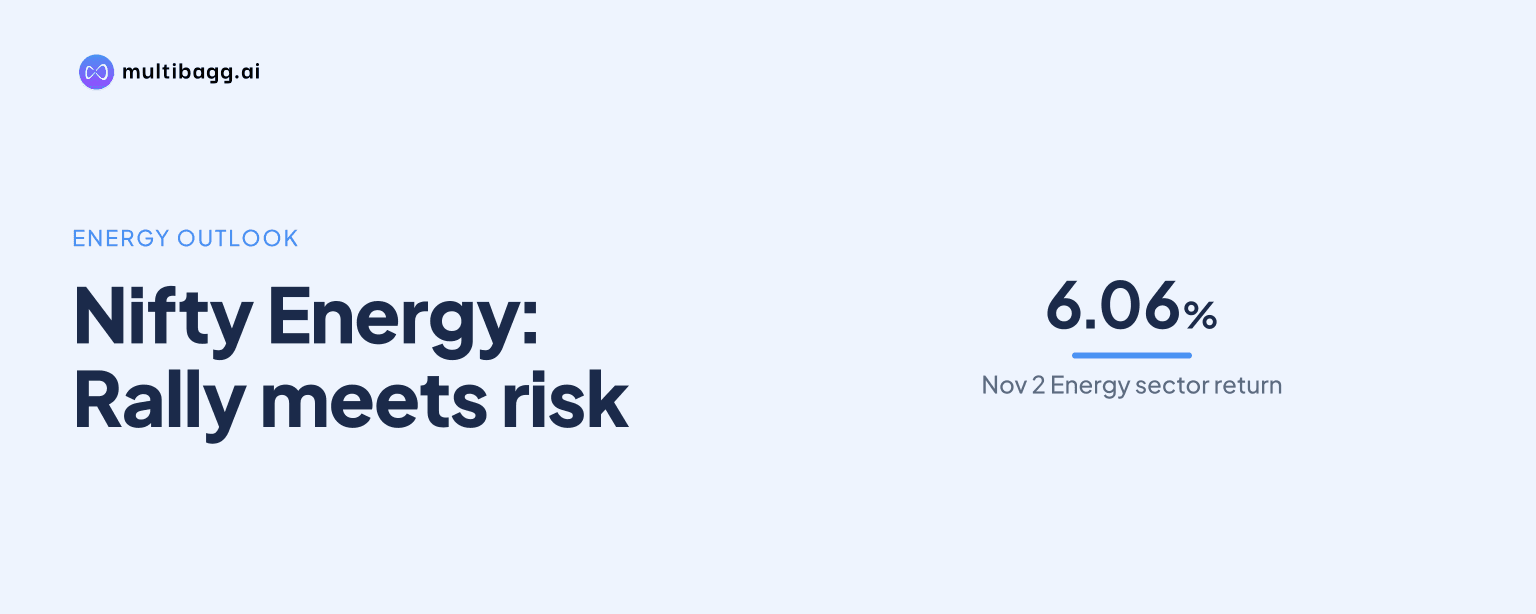
On 2 November 2026, India’s energy-stock rally was led by a 6.06% gain in the S&P BSE Energy sector, while Nifty Energy entered a month in which it has delivered negative returns in 11 of the past 17 years. The near-term setup is constructive, but oil-price moves, earnings and broader market risk remain important constraints.
Why did energy stocks rally on 2 November 2026?
Energy stocks rallied as broad-based buying lifted 13 of 16 major sectoral indices on 2 November, with energy, oil and gas, public-sector banks, consumer durables, infrastructure and automobiles among the leaders. The S&P BSE Energy sector gained 6.06%, while the Nifty Energy, Nifty Oil & Gas and other leading sectoral indices advanced within a range of 1% to 5.9%.
The market backdrop included hopes of progress in negotiations to end the Iran war, expectations of improved energy supplies, quarterly earnings from Reliance Industries, and hopes related to tax breaks. Lower concerns about India’s import bill and inflation can support sectors sensitive to energy costs. Reports also cited healthy market breadth, foreign institutional investor inflows and domestic participation as supportive factors.
There were, however, differing descriptions of crude oil’s role. One account linked firm crude prices to energy-sector strength, while another noted that Oil and Natural Gas Corporation rose even as MCX crude fell sharply. This difference matters because it suggests stock-specific and broader market factors may currently be as influential as the commodity itself.
Is November historically weak for Nifty Energy?
Yes, the historical data cited in the discussion show that Nifty Energy recorded negative returns in November in 11 of 17 years. That seasonal record does not determine the outcome for November 2026, but it is a relevant caution after a sharp sector-wide advance.
The present environment also has competing influences. Easing geopolitical tensions and improved supply expectations could reduce pressure on India’s energy import costs. Conversely, a renewed rise in crude prices amid Middle East tensions has previously weighed on Indian equities and contributed to foreign investor withdrawals. The Nifty 50 has fallen about 12% so far in 2026, according to the context, showing that energy-sector strength is occurring within a still uncertain market year.
What does crude oil mean for Nifty Energy stocks?
Crude oil remains a central variable for Nifty Energy, but the relationship can differ across upstream, downstream and power-related companies. Oil and Natural Gas Corporation, an upstream producer, rose 4.19% to Rs 234.83 on Monday and closed at its day high despite a 4.71% fall in MCX crude, according to the social-media discussion.
Kunal Singla identified Rs 226.15, Monday’s low, as a level Oil and Natural Gas Corporation could hold above, while a move beyond Rs 234.83 would be needed for a fresh extension. Ankit Jaiswal cautioned that stocks had moved against crude and that this gap could close in either direction. A further crude decline may remove support from upstream stocks, while the 4.19% rise also leaves room for a pullback.
Got a follow-up? Ask IRIS
Are Nifty Energy valuations and earnings supportive?
The available industry data indicate a neutral valuation view rather than a clear bargain or excess. The Indian Energy industry is trading close to its three-year average price-to-earnings ratio of 13.6 times and its three-year average price-to-sales ratio of 0.84 times. Over the past three years, revenue grew 5.7% a year while earnings stayed mostly flat.
Forecasts in the context point to 10% annual earnings growth for the broader energy industry. Oil and gas earnings are also expected to grow by 10% annually over the next few years, while Energy Services has the highest forecast growth at about 31% annually over five years. Investors were described as most pessimistic about oil and gas, even though its valuation is close to its three-year average, which underlines the importance of company selection rather than assuming uniform sector gains.
Which signals should investors track next?
Investors should track crude oil, the Nifty 50’s direction and India VIX, as these were identified as key variables for the immediate oil-and-gas outlook. The Nifty Oil & Gas index was described as range-bound with a potential breakout, ending the referenced Friday at 11,298.65, up 1% for the day and 1.1% for the week.
Technical levels cited for the Nifty Oil & Gas index were support at 11,000 and resistance at 11,350, with another calculation placing support at 11,099.50 and resistance at 11,410.70. Reliance Industries’ earnings were identified as a possible catalyst because of its significant index weight. Separate market attention is also focused on results due on 3 November from Bajaj Finserv, Solar Industries and State Bank of India, which may influence overall risk appetite.
Conclusion
Nifty Energy’s investment outlook has improved after strong buying in energy-linked shares, supported by broad market participation and expectations that geopolitical easing could help India’s import and inflation outlook. Yet the 6.06% S&P BSE Energy gain should be viewed alongside November’s weak historical hit rate, mixed crude signals and an industry whose recent revenue growth has not translated into comparable earnings growth.
Next, investors should watch whether crude and upstream shares realign, whether Oil and Natural Gas Corporation holds above Rs 226.15 and can exceed Rs 234.83, and whether Nifty Oil & Gas can move decisively beyond its cited resistance zone. Reliance Industries’ earnings impact, India VIX and the broader Nifty 50 trend will help determine whether the rally develops into a sustained move or remains range-bound.