










India’s Hormuz Exemption Offers Relief, but Fees and Risks Remain
Key highlights
- India reportedly received an exemption from broader Hormuz restrictions alongside China, Iraq and Qatar.
- Around 30% of India’s current crude imports, with other estimates at 40%, move through the Strait of Hormuz.
- India imports nearly 90% of its crude oil requirements.
- About 90% of India’s LPG imports transit through the Strait of Hormuz.
powered by IRIS
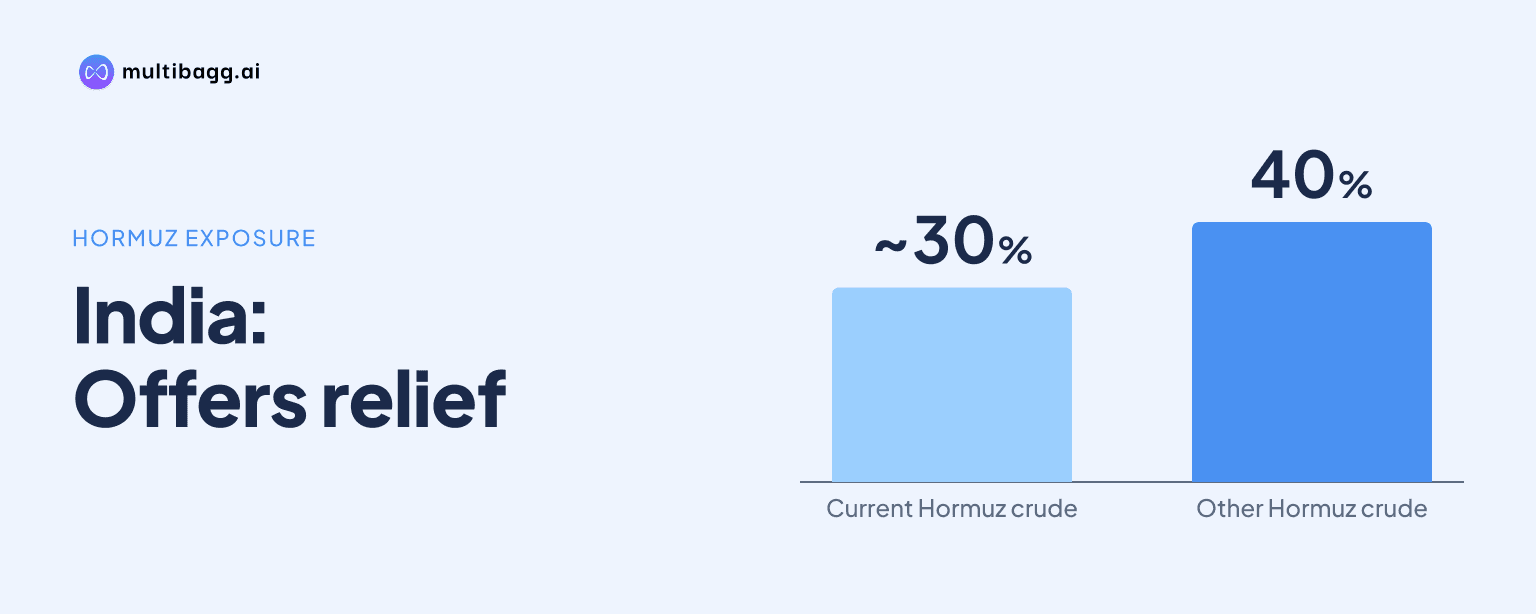
India has reportedly been exempted from wider Strait of Hormuz transit restrictions, offering relief for a route that currently carries about 30% of its crude oil imports, but no formal communication from Tehran has been confirmed and Indian vessels may still face transit fees. The development reduces immediate disruption concerns without removing shipping, insurance or energy-cost risks.
Has India been exempted from Strait of Hormuz restrictions?
India has reportedly been included with China, Iraq and Qatar in an Iranian exemption for merchant vessels from broader Strait of Hormuz restrictions. A senior Iranian lawmaker made the announcement, according to reports, and said vessels from these countries could pass through the waterway without the wider curbs.
The status remains uncertain from India’s perspective. Sources said New Delhi had received no formal communication from Tehran, and procedures for Indian vessels transiting the route had not changed. The reported statement also does not settle whether an exemption has been operationalised, whether it covers every Indian-flagged vessel and cargo, or how it would be applied in practice.
Why does the Strait of Hormuz matter to India’s energy imports?
The Strait of Hormuz matters because India imports nearly 90% of its crude oil needs and a substantial share of those supplies travels through the waterway. The passage links the Persian Gulf with the Gulf of Oman and the Arabian Sea, carrying oil and gas from producers including Saudi Arabia, Iraq, Kuwait, the United Arab Emirates and Qatar.
Estimates in the available reports vary by period and measurement. They put India’s current crude imports moving through Hormuz at around 30%, while other estimates put the share at around 40%; before the West Asia conflict, the route was reported to account for about 70% of India’s crude imports. India has diversified purchases through Russia, the United States, West Africa and Fujairah in the UAE, reducing reliance on the strait but not eliminating it.
The exposure is particularly significant for gas. About 90% of India’s LPG imports transit Hormuz, with Qatar and the UAE identified as major suppliers. The International Energy Agency was cited as estimating that nearly two-thirds of India’s LNG imports came through the route in 2025, largely from those two countries. Fertiliser supplies also depend on the passage.
Will Indian ships still have to pay transit fees?
Indian ships may still have to pay transit fees despite the reported exemption from broader restrictions. Reports state that Indian and Chinese vessels would be required to pay for passage, meaning the arrangement is not equivalent to fully unrestricted and cost-free transit.
The eventual financial effect cannot yet be quantified from the information available. It will depend on how fees are implemented, how long they remain in force and whether shipowners, charterers or buyers absorb the additional cost. The absence of a confirmed formal procedure for Indian vessels adds another layer of uncertainty for companies planning shipments.
An exemption for selected flags also does not fully normalise tanker movements. Much global tanker capacity uses third-country flags, including Panama, Liberia, the Marshall Islands and Greece, according to the discussion around the reported move. Those vessels could continue to face greater operational or insurance friction, keeping wider shipping conditions unsettled.
Got a follow-up? Ask IRIS
How could the Hormuz situation affect Indian markets and inflation?
The principal risk for India is higher imported inflation and a larger energy import bill rather than an immediate loss of access to Iranian crude. Higher crude prices, war-risk insurance and freight charges can raise costs for transport, manufacturing, logistics and supply chains even if Indian-linked cargoes retain passage.
The reported exemption may reduce part of the immediate risk premium attached to indiscriminate disruption in Hormuz. It could ease pressure at the margin on freight and war-risk costs for India-linked trades if it is respected in practice. Yet the route remains part of a conflict-affected maritime corridor, and risks could return quickly if there is a new attack, escalation or a change in how restrictions are enforced.
The broader market importance is substantial because the strait accounts for almost 25% of global seaborne oil supplies originating in West Asian countries. Reports also note that India imported 59.7 million tonnes of crude in April-June, compared with 73 million tonnes in the corresponding period a year earlier, while higher crude prices and a weaker rupee added to the import-cost challenge.
What should investors watch after the reported exemption?
Investors should watch for formal confirmation from Tehran or New Delhi, the operating rules for Indian vessels and the final structure of any transit fees. These details will determine whether the announcement delivers a practical reduction in shipping friction or remains a political statement with limited operational effect.
They should also track freight rates, war-risk insurance costs, crude prices and any incidents involving non-exempt shipping. India’s diversification of crude sources gives it more flexibility than when roughly 70% of crude imports moved through Hormuz, but its LPG and LNG exposure means disruption in the waterway can still affect energy costs and supply chains.
Conclusion
The reported Hormuz exemption offers India some near-term protection against broader transit restrictions on a strategically important energy route. It may reduce the chance of an abrupt disruption to part of India’s Gulf oil flows, but the lack of formal confirmation, possible transit fees and ongoing regional security concerns mean the relief is conditional rather than complete.
Next, markets will look for official communication on the exemption and clarity on its coverage and fee mechanism. The duration of the arrangement, shipping-company response, insurance costs and any further escalation in the region will determine whether the initial relief is sustained or gives way to renewed pressure on crude, freight and India’s import bill.