










Nifty Energy Stocks Split as Hormuz Risks Lift Oil Costs
Key highlights
- India imports about 85% of its crude oil requirement.
- Brent traded above $114 a barrel, while WTI crossed $100 during the cited week.
- JM Financial estimated that every $1 rise in crude adds about $2 billion to India’s annual import bill.
- Middle Eastern crude imports reached 2.8 million barrels per day in September, with a 54% share of total imports.
powered by IRIS
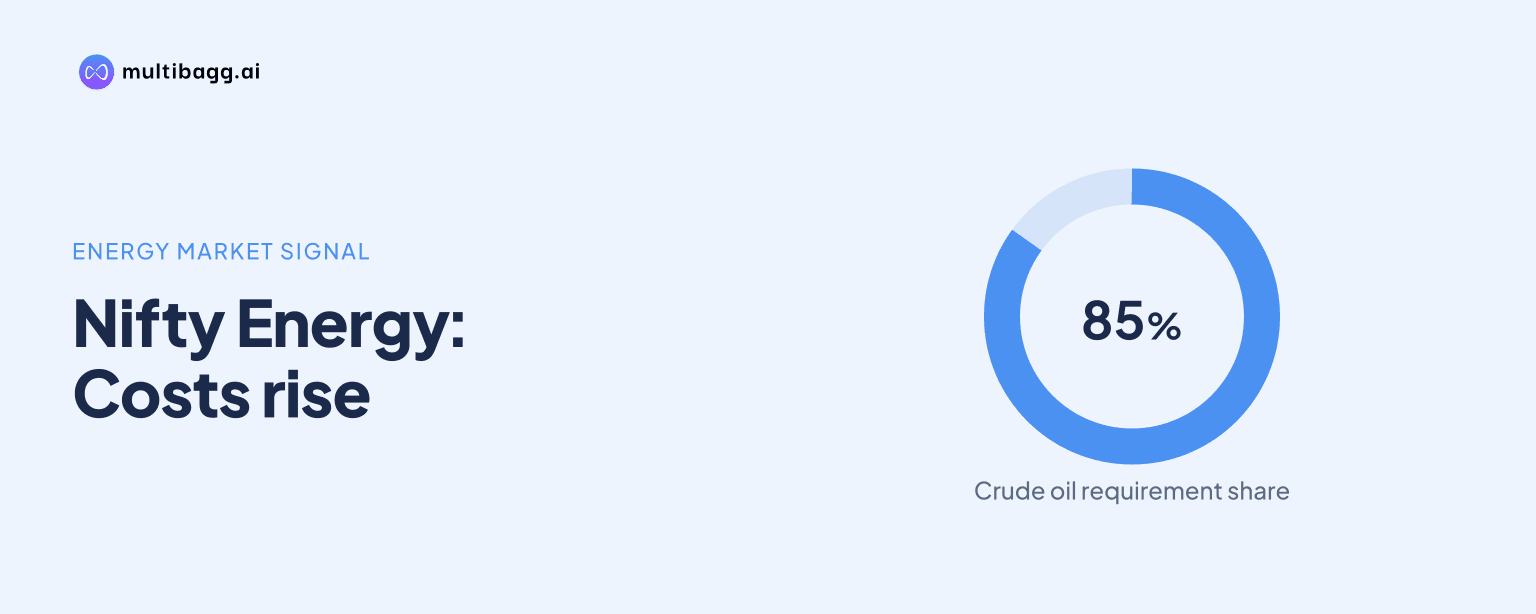
Nifty energy stocks face a split outlook as Brent traded above $114 a barrel, because higher crude can support upstream realisations while increasing cost and margin pressure on fuel marketing companies in an economy that imports about 85% of its crude requirement.
How do higher oil prices affect Nifty energy stocks?
Higher oil prices affect Nifty energy stocks differently because the sector includes companies with sharply different exposure to crude. Upstream producers can benefit from stronger realisations when international prices rise, although production costs and pricing arrangements also influence the final outcome.
For downstream companies, the same move can be a headwind. Indian Oil Corporation, Bharat Petroleum Corporation and Hindustan Petroleum Corporation can face margin pressure if crude remains elevated while domestic fuel prices stay relatively stable. Investors are therefore tracking crude, refining margins, fuel pricing and imported gas and LPG costs rather than treating the sector as one trade.
Does India’s reported Hormuz exemption remove supply risk?
India’s reported exemption from broader Strait of Hormuz transit restrictions may reduce the immediate risk of indiscriminate disruption, but it does not remove wider supply-chain or cost risks. The report said India was included alongside China, Iraq and Qatar, though no formal communication from Tehran had been confirmed.
Important operational questions remain unresolved. It is unclear whether the exemption has been put into practice, whether it applies to every Indian-flagged vessel and cargo, and how any fee mechanism would work. Indian ships may still have to pay transit fees, while war-risk insurance and freight can remain elevated even if passage is retained.
How exposed is India to a Strait of Hormuz disruption?
India has a meaningful but partly buffered exposure to a Strait of Hormuz disruption because 70% of its crude imports are currently routed outside the waterway. At the same time, estimates in the discussion put 40% to 50% of crude imports and 50% to 60% of LNG imports through Hormuz, showing why a prolonged interruption would still matter.
Recent trade flows underline the complexity. Middle Eastern crude imports climbed to 2.8 million barrels per day in September, taking the region’s share of total Indian imports to 54% from 32% in August. Russia remained the largest individual supplier, but Russian imports fell 14% month on month to 1.8 million barrels per day and its share fell to 33.5% from 46.6%.
Got a follow-up? Ask IRIS
Why do crude prices matter for India’s wider market?
Crude prices matter for the wider Indian market because each $1 increase in oil raises the annual import bill by about $2 billion, according to JM Financial. A persistent increase can pressure the rupee, widen import costs and complicate the inflation outlook.
The impact also extends beyond energy shares. Aviation, paints, chemicals, transport, manufacturing and logistics can face higher input costs when crude, freight and insurance rise. Recent market commentary linked oil above $114 a barrel to weaker sentiment, with the Sensex down 0.46% and the Nifty 50 down 0.5% on the cited day, while 12 of 16 sectors declined.
What could ease pressure on Indian energy shares?
A sustained fall in crude prices could ease pressure on Indian energy shares, especially oil marketing companies and fuel-intensive sectors. Indirect US-Iran talks in Qatar have raised hopes that tensions could ease and traffic through Hormuz could improve, potentially removing part of the geopolitical risk premium in oil.
However, a modest decline from elevated levels may provide only limited relief. Market participants are watching whether supply concerns recede meaningfully, as well as the direction of freight, insurance and retail fuel pricing. These variables will determine whether lower benchmark oil prices translate into a material improvement in downstream economics.
Conclusion
The reported Hormuz exemption offers India some near-term protection against broader transit restrictions, while diversified routing reduces the chance of an immediate direct supply shortfall. Yet high crude prices remain the larger market issue: they can aid upstream producers but squeeze oil marketing companies and raise economy-wide inflation and import-bill risks.
Investors will watch for official confirmation of the exemption, clarity on vessel coverage and transit fees, and any progress in US-Iran discussions. Brent’s direction, freight and war-risk insurance costs, and the ability of downstream companies to manage higher input costs will remain central to the outlook.