










United States Blockade of Iran Raises India's Oil Import Risks
Key highlights
- India's oil-and-gas import bill reportedly rose 53% in April from March.
- The Indian crude basket rose from about $70 to above $120 a barrel within four weeks.
- India reportedly routed roughly 70% of crude imports outside the Strait of Hormuz.
- Indian exports to Iran fell to $1.2 billion in FY2026 from $3.5 billion in FY2019.
powered by IRIS
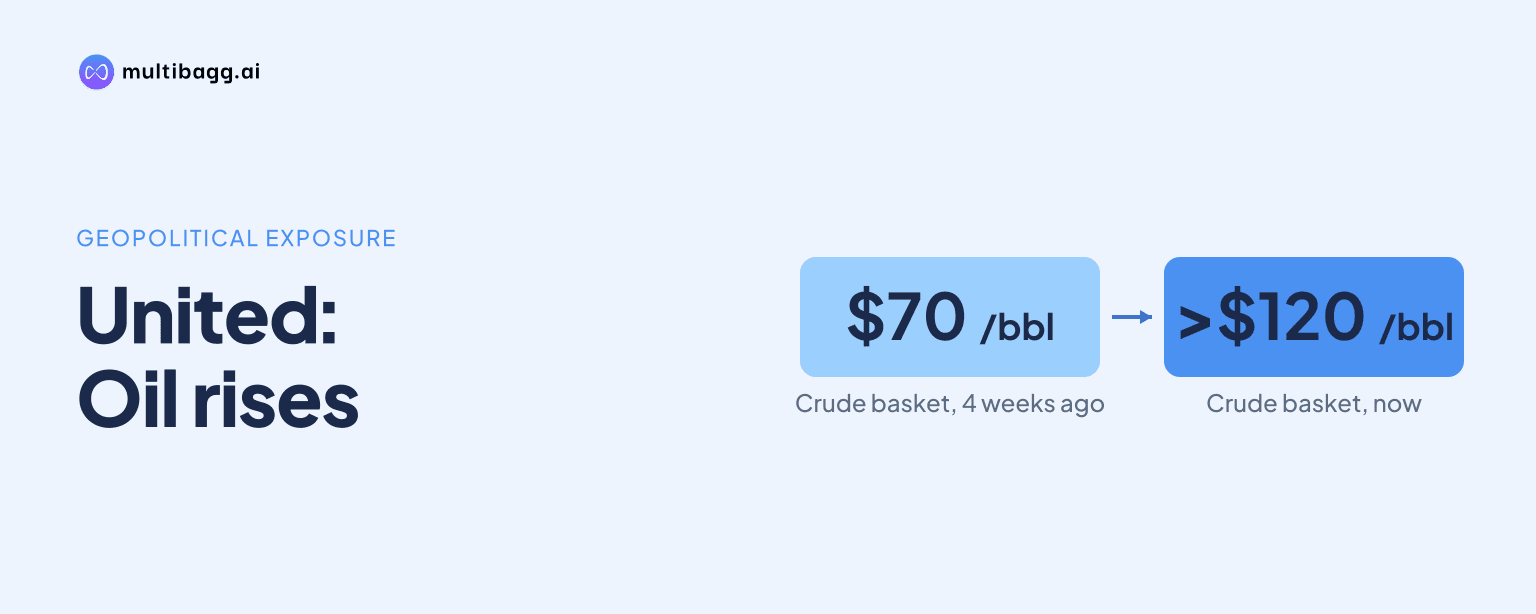
The United States blockade of Iran has raised India's energy-security risk, with the Indian crude basket climbing from about $70 to above $120 a barrel within four weeks after Strait of Hormuz traffic was disrupted. India has limited direct trade exposure to Iran, but its large dependence on imported oil leaves it vulnerable to higher fuel, freight and insurance costs.
How does the US blockade affect India's oil supply?
The US blockade affects India chiefly by tightening global oil availability and disrupting the Strait of Hormuz, rather than through the loss of Iranian crude bought directly by India. Reports cited in the discussion estimate that around two million barrels of Iranian oil a day could be shut out of global markets, while the strait normally carries roughly a fifth of global oil and gas transit.
India is described as the world's third-largest oil importer and consumer, importing about 90% of its oil in one estimate and around 85% of crude requirements in another. That reliance means a supply squeeze can raise the cost of alternative cargoes even where India does not buy Iranian oil. If major buyers of Iranian crude, particularly China, seek replacement barrels elsewhere, competition could increase for the supplies India uses.
The immediate market issue is therefore the durability of shipping access through Hormuz. A prolonged or complete blockage could constrain physical deliveries, raise freight charges and limit the effectiveness of drawing on Strategic Petroleum Reserves over time, according to the Nomura view cited in the context.
Why are inflation and the rupee under pressure?
Inflation and the rupee face pressure because costlier imported energy increases India's foreign-currency outgo while fuel and transport costs can spread through the economy. India's oil-and-gas import bill reportedly jumped 53% in April from March, prompting forecasts of a larger balance-of-payments deficit.
Higher crude prices are not the only channel. The discussion also points to freight rates, marine insurance and transaction costs rising during the conflict. Those costs can affect shipments even where goods may be eligible for humanitarian exemptions. In this setting, a rise in the import bill can add to demand for dollars, while higher domestic energy costs can feed into broader inflation.
The context identifies energy security as the principal channel through which the disruption affects India. Manufacturing, agriculture, civil aviation and power generation are among the sectors described as facing setbacks from higher petroleum and LPG costs. The scale and duration of the oil-price increase, along with the continuity of shipping, remain central to the domestic economic impact.
Got a follow-up? Ask IRIS
Can India avoid a Strait of Hormuz disruption?
India has reduced, but not removed, its exposure by diversifying crude sourcing and routing more supplies outside the Strait of Hormuz. The discussion says roughly 70% of crude imports were routed outside the strait, while the number of source countries increased from 27 to 41.
Newer suppliers named in the context include Libya, Gabon, Equatorial Guinea and Guyana, with higher volumes also coming from the United States and Russia. This broader supplier base gives Indian buyers more options than a concentrated sourcing model. It does not, however, insulate India from global benchmark prices or the cost of securing cargoes in a tighter market.
LPG remains a separate operational concern. Nomura noted that at least eight LPG tankers had crossed the strait safely over the preceding month, but warned that a complete Hormuz blockade could affect supplies. The note also said India had not paid tolls for LPG vessels that had sailed through the strait, leaving the future shipping situation unresolved.
Is India's direct trade with Iran large enough to matter?
India's direct trade with Iran is relatively small compared with the potential indirect energy shock. Indian exports to Iran fell from $3.5 billion in FY2019 to $1.2 billion in FY2026, while imports fell from $13.5 billion to less than $375 million over the same period after India largely stopped importing Iranian crude.
The export mix cited includes rice worth $810 million, tea and coffee worth $82 million, medicines worth $63 million, bananas worth $54 million, sugar worth $48 million and pulses worth $34 million. Planned US sanctions and the UAE's halt on Tehran trade could disrupt exports of rice, tea and pharmaceuticals that had been routed through Dubai, according to exporters cited in the discussion.
There was also a temporary US exemption under which India imported Iranian crude worth $430.5 million in April 2026 and $276.7 million in May. Still, the more material concern is not bilateral trade volumes but possible disruption to payments, shipping and insurance, as well as wider secondary-sanctions risks connected with energy trade.
What sanctions risk could Indian markets face?
The sanctions risk extends beyond Iran because the discussion cites potential US measures against major buyers of Russian energy. The Sanctioning Russia and Iran Act of 2026, passed by the US Senate on August 7 by an 86-11 vote, could authorise tariffs of up to 100% if enacted.
That possibility creates an additional uncertainty for India alongside the Gulf conflict. The potential consequences described include higher transaction costs, harder payment channels and increased market concern over trade restrictions. The available context does not establish that such tariffs have been imposed, but it identifies the legislation and its possible scope as a risk investors may monitor.
Conclusion
The United States blockade of Iran presents India with a predominantly indirect economic risk. Limited direct trade and diversified crude sourcing offer some protection, but they do not prevent a global supply shock from lifting oil prices, freight and insurance costs. The reported move in the Indian crude basket from about $70 to above $120 a barrel illustrates why energy security, inflation, the import bill and the rupee are closely linked in this episode.
The next developments to watch are the flow of oil and LPG through the Strait of Hormuz, the ability of Strategic Petroleum Reserves to offset lost supplies, and whether sanctions widen to affect payments or Russian-energy purchases. India's expanded supply network of 41 source countries and the reported routing of roughly 70% of crude imports outside Hormuz will be important buffers if the disruption persists.