










Indian stock market rises 5.6% as US vote boosts sentiment
Key highlights
- The Nifty gained 5.6% over five trading sessions through November 4.
- The Sensex opened 1,609.54 points, or 2.08%, higher at 78,910.94 on November 5.
- Foreign investors net bought Indian equities worth Rs 7,284.03 crore on Wednesday.
- Brent crude futures were down 0.95% at $93.72 a barrel in one reported update.
powered by IRIS
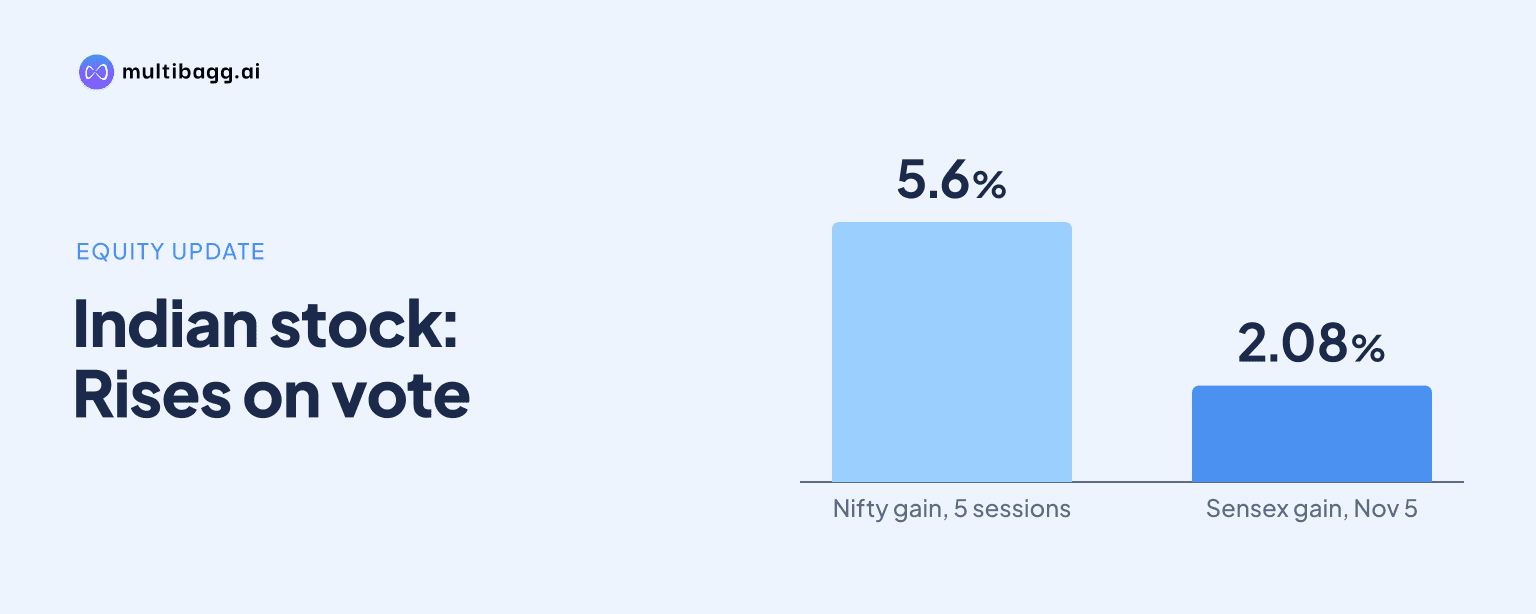
Following the US midterm election outcome, the Indian stock market rose 5.6% over five trading sessions through November 4, supported by falling crude oil prices, a Wall Street rally and renewed foreign investor buying. On November 5, the Sensex opened 1,609.54 points, or 2.08%, higher at 78,910.94.
Why is the Indian market rising after the US midterm elections?
The Indian market is rising because the Democratic victory in both chambers of the US Congress has reduced political uncertainty and improved global risk appetite. Investors expect the change in congressional control could create greater resistance to President Donald Trump's aggressive tariff policies, potentially easing trade uncertainty for emerging markets including India.
The immediate overseas cue was strong. The Dow Jones Industrial Average rose more than 3% overnight, its strongest post-midterm election performance in over four decades, while the S&P 500 and Nasdaq Composite gained more than 1.4% each. The move in US equities helped set the tone for Asian markets and triggered broad-based buying in India.
How did Indian benchmark indices perform in the rally?
The Indian market opened sharply higher on November 5, with the Nifty and Sensex both gaining close to 2%. The 30-share Sensex started at 78,910.94, up 1,609.54 points or 2.08%, while the Nifty opened at 24,378.05, a gain of 417.45 points.
During early trade, the Nifty rose 436.70 points, or 1.82%, to 24,397.30. The index had already gained 5.6% in the five trading sessions through November 4, while reports described the advance as the sixth consecutive session of gains. Realty and FMCG were among sectors that saw buying interest, alongside renewed attention on large-cap shares.
Got a follow-up? Ask IRIS
Why do lower crude prices matter for the Indian market?
Lower crude prices matter because India imports a large share of its oil requirements, so a decline can reduce the import bill and ease inflation and business-cost pressures. Expectations that tensions involving the US-Iran conflict could ease after the election outcome pushed energy prices lower and strengthened this part of the market case.
Brent crude futures were down 0.95% at $93.72 a barrel, while US West Texas Intermediate fell 1.48% to $86.82 a barrel in one reported trading update. Other market reports said Brent had fallen nearly 10% and settled below $100 a barrel. Airlines are among the businesses that could benefit from lower fuel expenses, while softer energy costs can also support the wider inflation outlook.
Are foreign investors returning to the Indian market?
Foreign investors showed signs of returning, with provisional data showing net purchases of Indian equities worth Rs 7,284.03 crore on Wednesday. This was reported as the highest single-day buying since October 28, 2025, and is equivalent to Rs 72.84 billion in another market update.
The buying coincided with a weaker US dollar and improved demand for riskier assets globally. Foreign flows can be important for large-cap Indian shares, but the durability of this trend will depend on global conditions, crude prices and how expectations around trade policy and interest rates develop.
Conclusion
The Indian market's advance reflects a combined shift in global sentiment after the US midterm result, lower crude prices and fresh foreign investor buying. The 5.6% Nifty gain through November 4 and the November 5 opening jump in both benchmarks show that investors have quickly priced in a more favourable near-term external backdrop.
Investors will now watch whether crude remains lower, whether foreign buying continues after the Rs 7,284.03 crore inflow, and whether hopes of reduced geopolitical and trade tensions are sustained. A sharp slowdown in US AI investment remains a risk for technology-linked sentiment and semiconductor supply chains, although a moderate slowdown could ease US inflation and interest-rate pressures.