










Indian Equity Markets Outperform Asia-Pacific by 7 Points
Key highlights
- Indian markets outperformed Asia-Pacific excluding Japan by 7 percentage points in October 2026.
- The Nifty recovered more than 1,200 points, or about 5.5%, from its October 26 intraday low in six sessions.
- The Nifty gained 2% in the week ended October 30, compared with a 1% rise in MXAPJ.
- MSCI India traded at 18.4 times forward earnings, a 92% premium to broader Asia-Pacific markets.
powered by IRIS
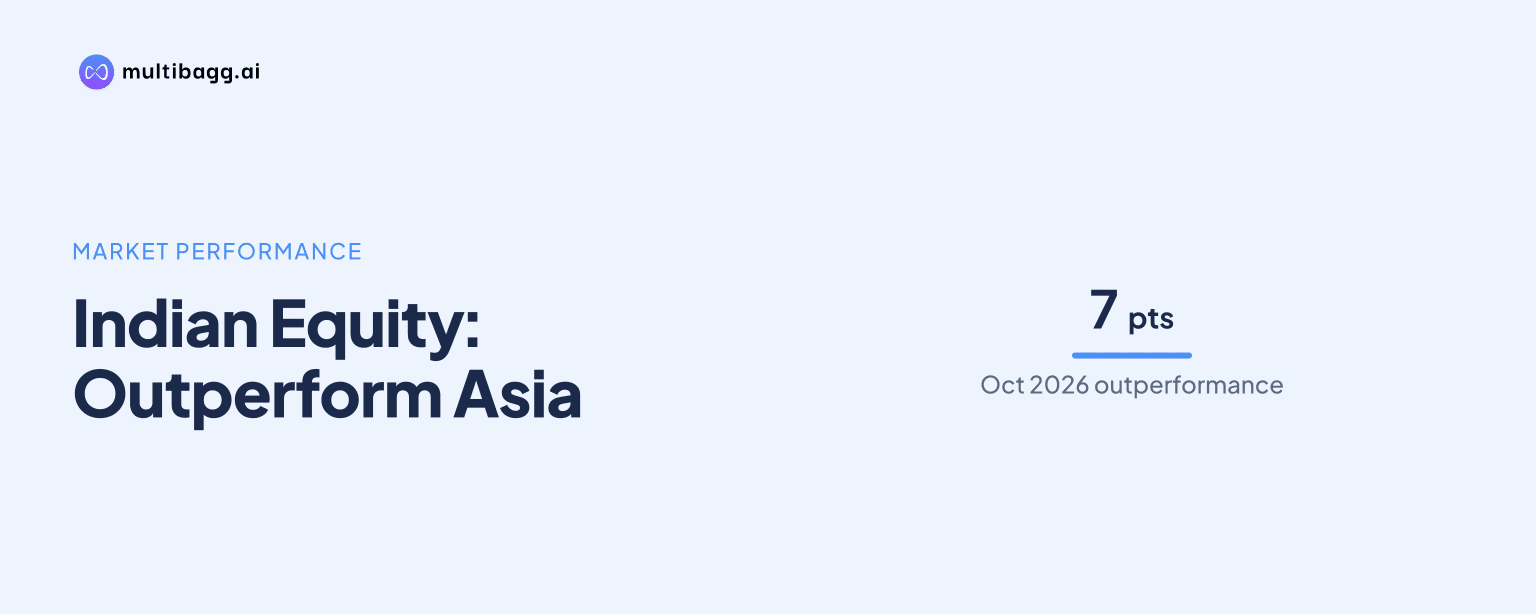
Indian equity markets outperformed the Asia-Pacific region excluding Japan by 7 percentage points in October 2026, as investors rotated away from AI-sensitive North Asian shares; the Nifty also rose 2% in the week ended October 30, against a 1% gain in the regional benchmark.
Why did Indian markets outperform Asia-Pacific peers?
Indian markets benefited from a global rotation away from North Asian markets that have greater exposure to artificial intelligence and semiconductor stocks. Goldman Sachs Research said the shift helped India outperform the broader Asia-Pacific region excluding Japan, or MXAPJ, by 7 percentage points in October, reversing India’s relative underperformance during the first nine months of 2026.
The rotation came as investors reassessed technology-stock valuations after a prolonged rally in AI-linked shares. The context indicates that even strong revenue and earnings growth in these companies may not be enough to sustain elevated valuations if investment requirements continue to rise. This created room for allocations to move towards markets with a different sectoral mix, including India.
How large was the Indian market recovery?
Indian markets recovered sharply from late-October lows, with the Nifty climbing from an intraday low of 22,387 on October 26 to around 23,600 on November 3. That move amounted to more than 1,200 points, or about 5.5%, in six trading sessions, placing the 23,700 level within reach at that point.
The momentum extended into early November. Market discussions cited a near-8% gain for the Nifty and Sensex across six sessions, while one November 5 market snapshot showed the Nifty 50 at 24,380.25, up 419.65 points or 1.75%, and the BSE Sensex at 78,755.30, up 1,453.90 points or 1.88%.
Which global markets lagged Indian markets?
Indian markets outperformed several major global indices over the past month as overseas technology-heavy markets fell. The Nifty gained 4.97% during that period, while South Korea’s KOSPI declined 19.35%, Taiwan’s TAIEX fell 12.90%, Japan’s Nikkei 225 lost 9.56%, the Nasdaq Composite dropped 7.45%, and Hong Kong’s Hang Seng declined 2.09%.
The contrast reflects different index compositions. South Korea and Taiwan have substantial semiconductor exposure, whereas Indian markets have greater representation from domestic consumption, banking, automobiles, infrastructure and other sectors linked primarily to the Indian economy. This composition helped the domestic benchmarks during the shift away from AI-sensitive shares.
Got a follow-up? Ask IRIS
What supported the latest rise in Indian markets?
Easing crude oil prices, positive corporate earnings updates and institutional buying supported the recent advance in Indian markets. Social-media market commentary also pointed to declining volatility and a rise in heavyweight stocks as factors behind the recovery, which took the benchmarks close to two-month highs.
Sector performance was uneven but constructive in the reported period. IT was described as the strongest weekly performer with an 11.7% gain, supported by corporate earnings and foreign institutional interest, while auto stocks rose about 3.7% on domestic-demand expectations and trade optimism. Pharmaceuticals rose 7% in the cited October discussion, while financials gained 1% and were among the weaker sectors.
What valuation issue remains for Indian markets?
Indian markets still trade at a sizeable valuation premium to regional peers despite the October recovery. MSCI India’s forward price-to-earnings multiple stood at 18.4 times, representing a 92% premium to the broader Asia-Pacific region, according to the cited Goldman Sachs Research assessment.
That premium means the relative-performance recovery does not remove valuation risk. The recent improvement was linked to a rotation in global positioning, improved earnings sentiment and renewed foreign investor interest, but continued gains would need to be viewed against the higher starting valuation compared with the regional market.
Conclusion
Indian markets have regained relative strength as global investors reduced exposure to AI-sensitive North Asian technology markets and shifted towards other regions and sectors. The 7-percentage-point October lead over MXAPJ, alongside the Nifty’s rapid recovery from its October 26 low, shows how quickly this rotation changed market leadership.
The next focus is whether institutional buying, corporate earnings momentum and easing crude oil prices continue to support the move. Investors will also watch whether the valuation premium, with MSCI India at 18.4 times forward earnings and 92% above the broader Asia-Pacific region, limits further relative outperformance.