










India Shelter AUM grew 39% CAGR; FY26 PAT topped Rs 500 crore
Key highlights
- India Shelter grew gross AUM from Rs 1,520 crore in FY20 to Rs 11,044 crore in FY26, a reported 39% CAGR.
- FY26 PAT reached Rs 503.1 crore, compared with Rs 47 crore in FY20.
- India Shelter expanded from 86 branches in FY20 to 312 branches across 15 states in Q2FY27.
- Q2FY27 gross AUM was Rs 11,997 crore and quarterly PAT was Rs 145.6 crore.
powered by IRIS
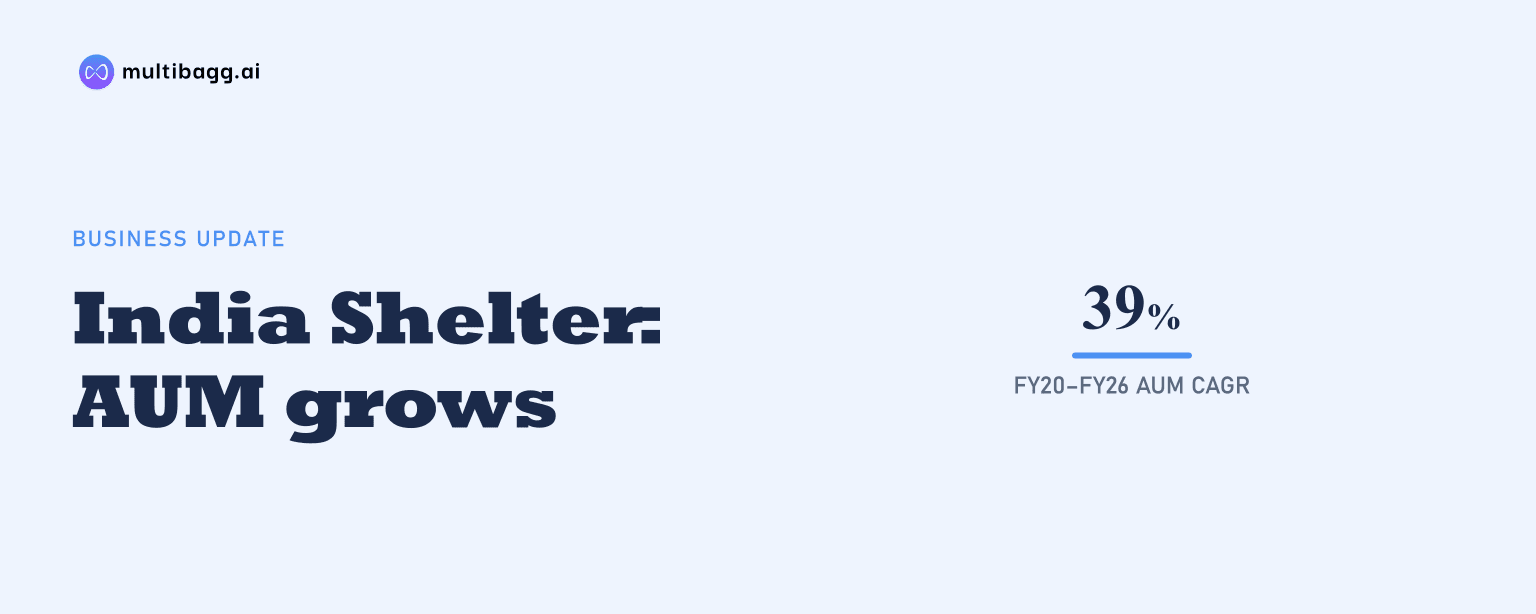
India Shelter Finance Corporation Limited grew gross assets under management (AUM) at a reported 39% compound annual growth rate (CAGR) from FY20 to FY26, ending FY26 with AUM of Rs 11,044 crore and profit after tax (PAT) of Rs 503.1 crore. Its branch network expanded from 86 to 307 over the same period.
Know India Shelter Finance Corporation inside out
Results, valuation, peers and who's buying, in one view.
How fast did India Shelter expand its loan book?
India Shelter expanded gross AUM from Rs 1,520 crore in FY20 to Rs 11,044 crore in FY26, which it reports as a 39% CAGR. The loan book passed Rs 3,073 crore in FY22, Rs 6,227 crore in FY24 and Rs 8,535 crore in FY25 before crossing Rs 10,000 crore in FY26.
Annual disbursements rose from Rs 551 crore in FY20 to Rs 3,834 crore in FY26. Active live accounts increased from 27,602 to 138,571, while employee count rose from 1,219 to 4,800, alongside the increase in gross AUM.
How did India Shelter’s profitability change as it scaled?
India Shelter’s PAT rose from Rs 47 crore in FY20 to Rs 503.1 crore in FY26, taking annual profit beyond Rs 500 crore after it first exceeded Rs 100 crore in FY22. Profit before tax rose from Rs 64 crore to Rs 653.3 crore, while net total income increased from Rs 156 crore to Rs 1,084.8 crore.
Cost to income declined to 36.1% in FY26 from 51.5% in FY20. Return on assets (ROA) increased to 5.8% from 3.0%, while return on equity (ROE) rose to 17.0% from 5.7%; operating expenses increased to Rs 391.2 crore from Rs 80 crore over the same period.
The reported funding spread was 6.6% in FY26, compared with 6.2% in FY25. Yield was 14.8% in FY26 versus 14.9% in FY25, while cost of borrowings fell to 8.2% from 8.7%.
What did India Shelter report in Q2FY27?
India Shelter reported gross AUM of Rs 11,997 crore in Q2FY27, 23% higher year on year, and quarterly PAT of Rs 145.6 crore, 19% higher year on year. Disbursements were Rs 1,126 crore, up 21% from Rs 931 crore in Q2FY26.
The company said AUM growth was affected by a one-time change in disbursement booking at realisation implemented in Q1FY27. Gross AUM rose 6% sequentially from Rs 11,284 crore in Q1FY27, while PAT increased 2% from Rs 143.0 crore; the reported 8% quarter-on-quarter disbursement growth uses Rs 1,046 crore of disbursements at clearance in Q1FY27.
For H1FY27, PAT was Rs 288.6 crore, compared with Rs 241.5 crore in H1FY26, an increase of 20%. Net total income rose 23% to Rs 633.8 crore, while operating expenses increased 27% to Rs 230.3 crore and credit cost rose 50% to Rs 29.7 crore.
Got a follow-up? Ask IRIS
How broad is India Shelter’s distribution and customer base?
India Shelter operated 312 branches across 15 states in Q2FY27, compared with 86 branches across 12 states in FY20. The network crossed 100 branches in FY21, 200 branches in FY24 and 300 branches in FY26, while the Q2FY27 account count was 147,950.
Branch maturity differed across the network in September 2026. The 202 branches operating for more than three years held Rs 9,827 crore of gross AUM, or Rs 49 crore per branch, compared with Rs 141 crore, or Rs 10 crore per branch, at 14 branches open for less than one year.
Loans below Rs 15 lakh accounted for 88% of loans by number in September 2026. Tier 3 cities represented 58% of the portfolio, Tier 2 cities 33% and Tier 1 cities 9%, while home loans represented 56% of AUM and loans against property accounted for 44%.
What credit and funding measures accompanied India Shelter’s growth?
India Shelter reported that 100% of its book was secured and that its sanctioned loan-to-value ratio was 52% in Q2FY27. Gross Stage 3 assets were 1.5% of the portfolio, compared with 1.2% in Q2FY26, while net Stage 3 assets were 1.2% versus 0.9%.
Collection efficiency was 98% in Q2FY27, compared with 99% a year earlier, and loans overdue by 30 days or more were 5.2%, versus 4.6%. The company’s in-house business rule engine assesses more than 100 customer and collateral fields during underwriting.
India Shelter’s expected credit loss provision was Rs 97.4 crore in September 2026, equal to 1.0% of the portfolio, compared with Rs 72.8 crore and 0.9% in September 2025. Term loans from banks and financial institutions accounted for 45% of funding in Q2FY27, while direct assignment accounted for 22% and National Housing Bank funding for 14%.
Conclusion
India Shelter’s FY20-to-FY26 record combines expansion in the loan book, profit and reported return measures: gross AUM rose from Rs 1,520 crore to Rs 11,044 crore, PAT increased from Rs 47 crore to Rs 503.1 crore, and ROE moved from 5.7% to 17.0%. Branches, active accounts and employees also increased during the period.
The next disclosures to watch are India Shelter’s stated plans to deepen branch penetration in adjacent markets, improve branch productivity, optimise borrowing costs and scale co-lending opportunities. Changes in gross Stage 3 assets of 1.5%, loans overdue by 30 days or more of 5.2%, and credit cost of 0.6% will also show how credit metrics develop as distribution expands.