










India Shelter booking shift reduced AUM by Rs 350-400 crore
Key highlights
- India Shelter said its Q1FY27 booking transition reduced reported Gross AUM by Rs 350 crore to Rs 400 crore.
- India Shelter reported Q2FY27 disbursements of Rs 1,126 crore, up 21% year on year and 8% quarter on quarter.
- India Shelter retained FY27 Gross AUM growth guidance of around 25% to 30%.
- India Shelter's collection efficiency improved to 98% in Q2FY27 from 97% in Q1FY27.
powered by IRIS
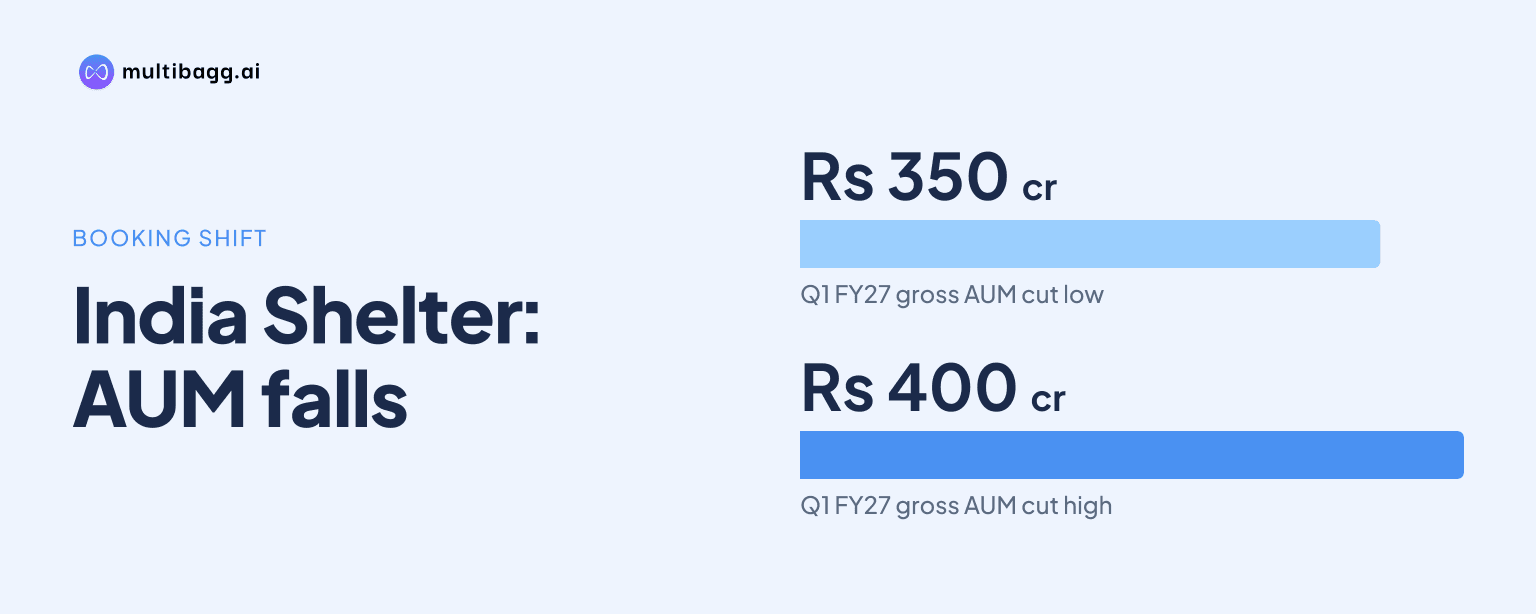
For Q2FY27, India Shelter Finance Corporation Limited said its Q1FY27 shift to booking disbursements at clearance had reduced reported Gross Assets Under Management by Rs 350 crore to Rs 400 crore, while management retained FY27 Gross AUM growth guidance of around 25% to 30% after disbursements increased 21% year on year to Rs 1,126 crore.
Know India Shelter Finance Corporation inside out
Results, valuation, peers and who's buying, in one view.
Why did India Shelter's reported AUM reduce after the booking change?
India Shelter said the Q1FY27 transition to recording disbursements at clearance reversed about Rs 350 crore to Rs 400 crore of previously booked disbursements, reducing reported Gross AUM. Chief Financial Officer Ashish Gupta said the transition also made the denominator used for credit-cost calculations smaller, making the Q2FY27 credit-cost ratio appear somewhat higher.
The company described the effect as a change in the timing of disbursement recognition rather than a change in portfolio performance. Gross managed assets were Rs 11,997 crore at September 2026. Management cited two adjusted growth figures during the call: Rupinder Singh referred to normalized Gross AUM growth of 26% year on year, while Gupta referred to 27% growth after adjusting for the transition.
An analyst noted that H1FY27 disbursement growth appeared flat to down about 2%, despite the policy change beginning in Q1FY27. Singh responded that normalization should be visible by FY27-end, while describing Q2FY27 disbursements of Rs 1,126 crore as the company’s highest quarterly level.
Is India Shelter maintaining its FY27 AUM growth target?
India Shelter is maintaining guidance for Gross AUM growth of around 25% to 30% in FY27. Singh reiterated that range after the half year ended September 30, 2026, despite the Rs 350 crore to Rs 400 crore effect of the booking transition on the reported asset base.
Management later indicated an expectation of 25% to 27% Gross AUM growth as FY27 progresses, which remains within the formal 25% to 30% range. It also said full-year disbursement growth should be around 20% or more, compared with 21% year-on-year disbursement growth in Q2FY27.
The guidance is supported by a stronger second-quarter run rate, according to management. Q2FY27 disbursements rose 8% sequentially to Rs 1,126 crore, and Singh said the quarterly level was higher than the January-to-March period had typically been in earlier years. India Shelter’s longer-term Gross AUM target remains Rs 30,000 crore by FY30.
India Shelter reported net worth of Rs 3,401 crore and said return on equity had exceeded 17% for six consecutive quarters on sequential measures. Quarterly return on equity was 17.3%, up 30 basis points year on year, at leverage of 3.1 times.
What does the booking shift mean for India Shelter's credit cost?
India Shelter said the reduced Gross AUM denominator contributed to optically higher Q2FY27 credit cost, but management retained FY27 credit-cost guidance of 40 to 50 basis points. Singh said the company now expected the annual outcome to be 50 basis points, with one basis point equal to one-hundredth of a percentage point.
Gupta said H1FY27 credit cost was about 60 basis points and that credit costs are generally higher in the first half than the second half. Management expects recoveries to improve in H2FY27 and said this should allow India Shelter to remain within its full-year guidance.
A scheduled write-off of about Rs 6 crore in Q2FY27 also affected the first-half credit-cost figure. Gupta said India Shelter writes off accounts overdue for more than two years under company policy and characterized the Q2FY27 write-off as timing-related.
Collection efficiency rose to 98% in Q2FY27 from 97% in Q1FY27. The 30-plus overdue ratio remained 5.2% and gross non-performing assets were stable at 1.5% quarter on quarter, while provision coverage for Stage 3 loans was 25%.
Got a follow-up? Ask IRIS
Which operating metrics support India Shelter's growth outlook?
India Shelter’s principal operating support for its FY27 outlook is Q2FY27 disbursement growth of 21% year on year and 8% quarter on quarter to Rs 1,126 crore. Management said affordable-housing demand remained healthy and that productivity had improved during the quarter.
Portfolio yield was unchanged sequentially at 14.8%, while finance cost was also stable at 8.2%. Net interest margin remained above 9%, and management said absolute net interest margin increased 27% on Gross AUM growth and a 20-basis-point year-on-year improvement in spread.
Operating expenditure as a share of AUM was stable at 4% in Q2FY27, while the cost-to-income ratio was about 36%. India Shelter reported profit after tax of Rs 146 crore, up 19% year on year; excluding the direct-assignment transition, management said quarterly profit after tax increased 25%.
Digital sourcing accounted for 7% of Q2FY27 disbursements, up from 4% in Q2FY26. India Shelter said it plans to increase that share in coming quarters, alongside its FY27 target of adding 40 to 45 branches.
How is India Shelter managing funding and portfolio risks?
India Shelter said it aims to maintain a medium-term spread above 6% while managing potential funding-cost changes. Its H1FY27 marginal borrowing cost was 8.1%, below the 8.2% blended finance cost, and management said recent borrowings were being raised at roughly 8.2%.
The lender had more than 30 funding counterparties, with National Housing Bank funding accounting for 14% of borrowings. Average borrowing tenure exceeded eight years, liquidity was more than Rs 700 crore, and undrawn sanctions exceeded Rs 1,400 crore; management said asset-liability management was positive across all maturity buckets.
India Shelter said 53% of its portfolio was in variable or semi-variable-rate loans, comprising 15% variable-rate and 38% semi-variable-rate products. The semi-variable pool has a three-year fixed-rate period and will gradually move into the variable-rate bucket from Q4FY27, at an estimated 4% to 5% of the portfolio each quarter.
On weather-related portfolio monitoring, management said self-employed borrowers account for 75% to 80% of the portfolio and that agricultural income is not considered in fixed-obligation-to-income underwriting. India Shelter identified about 750 pin codes out of roughly 8,000 for revised underwriting models and added cautionary measures.
Conclusion
The booking transition is important because it reduced India Shelter’s reported Gross AUM by Rs 350 crore to Rs 400 crore and affected the credit-cost denominator, while management continued to report Q2FY27 disbursement growth of 21% and adjusted Gross AUM growth of 26% to 27%. Its FY27 Gross AUM guidance of 25% to 30% therefore relies on normalization in the second half as well as continued disbursement momentum.
The next measures to watch are management’s target of around 20% or higher FY27 disbursement growth, its expectation of 25% to 27% Gross AUM growth as the year advances, and its stated 50-basis-point credit-cost expectation. India Shelter also plans 40 to 45 branch additions in FY27 and intends to expand digital sourcing beyond its 7% share of Q2FY27 disbursements.