










India Shelter Stage 3 ratio rises to 1.5% in September
Key highlights
- India Shelter’s gross Stage 3 ratio was 1.5% in September 2026, compared with 1.2% in September 2025.
- India Shelter’s gross Stage 2 loans were Rs 371.9 crore, or 3.9% of the portfolio, in September 2026.
- India Shelter’s 30+ DPD ratio was 5.2% in Q2FY27, versus 4.6% in Q2FY26.
- India Shelter’s Q2FY27 credit cost rose 72% year on year to Rs 16.3 crore.
powered by IRIS
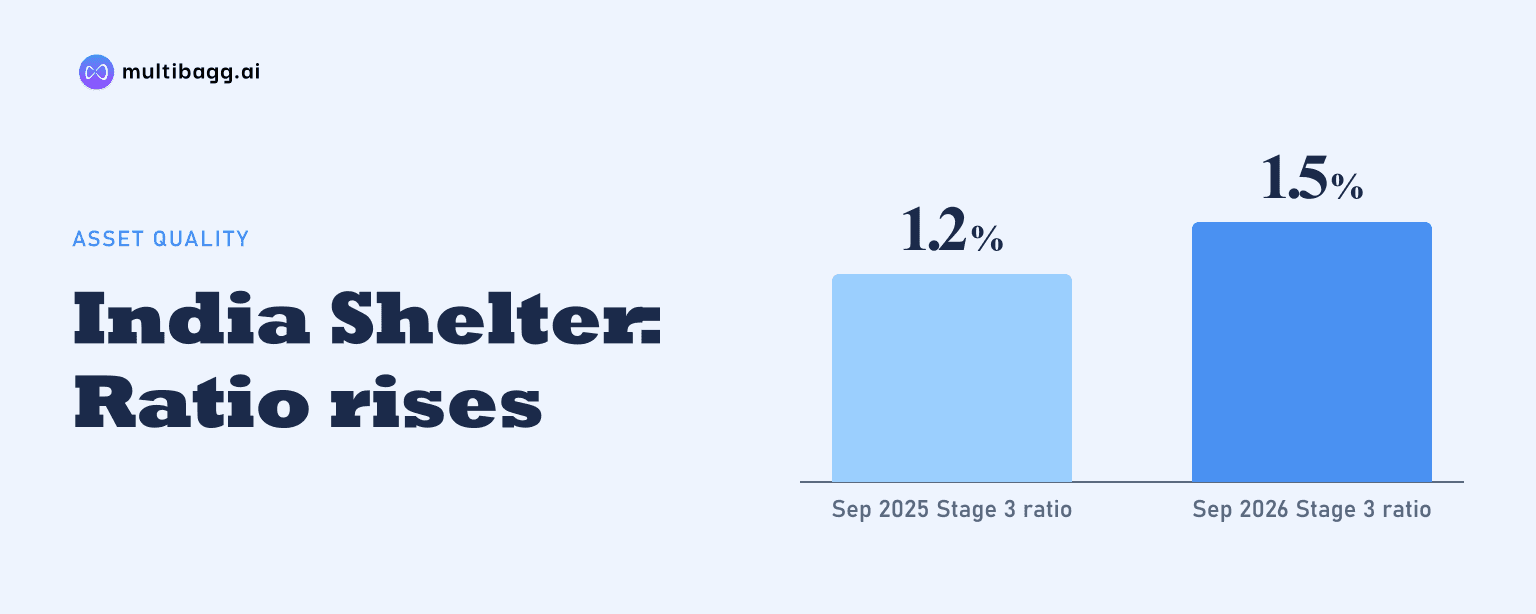
India Shelter Finance Corporation Limited reported a 1.5% gross Stage 3 ratio in September 2026, compared with 1.2% a year earlier, as gross Stage 3 loans increased to Rs 147.1 crore from Rs 97.8 crore. India Shelter also reported a 3.9% Stage 2 ratio and a 5.2% 30-plus-days-past-due ratio in Q2FY27.
Know India Shelter Finance Corporation inside out
Results, valuation, peers and who's buying, in one view.
Why did India Shelter’s Stage 3 ratio rise to 1.5%?
India Shelter’s gross Stage 3 ratio rose by 30 basis points year on year to 1.5% in Q2FY27, while gross Stage 3 loans rose by Rs 49.3 crore to Rs 147.1 crore. The presentation labels Stage 3 as gross non-performing assets, or GNPA. The gross Stage 3 ratio was 1.2% in Q2FY26, 1.5% in Q3FY26, 1.2% in Q4FY26 and 1.5% in Q1FY27.
Net Stage 3 was 1.2% in Q2FY27, versus 0.9% in Q2FY26 and unchanged from Q1FY27. Net Stage 3 loans were Rs 109.6 crore in September 2026, after expected credit loss, or ECL, provisions of Rs 37.5 crore, compared with Rs 73.8 crore net loans and Rs 24.0 crore provisions a year earlier. The Stage 3 provision coverage ratio, or PCR, was 25%, unchanged year on year and below 26% in June 2026.
What does India Shelter’s Stage 2 exposure show?
India Shelter reported gross Stage 2 loans of Rs 371.9 crore, equal to 3.9% of its portfolio, in September 2026. This was higher than Rs 296.6 crore, or 3.8%, in September 2025, but lower than Rs 363.0 crore, or 4.1%, in June 2026. The Stage 2 ratio therefore declined 20 basis points sequentially while remaining 10 basis points above the year-earlier level.
ECL provisions against Stage 2 loans were Rs 19.2 crore in September 2026, compared with Rs 10.1 crore in September 2025 and Rs 18.9 crore in June 2026. Stage 2 PCR was 5.2%, up from 3.4% a year earlier and unchanged sequentially. Net Stage 2 loans reached Rs 352.6 crore, against Rs 286.5 crore in September 2025 and Rs 344.2 crore in June 2026.
Stage 1 remained the largest category at Rs 8,992.6 crore, or 94.5% of gross Stage 1, 2 and 3 loans, at September 2026. Its share was 95.0% a year earlier and 94.4% in June 2026. Gross Stage 1, 2 and 3 loans totalled Rs 9,511.6 crore, while total ECL provisions were Rs 97.4 crore, or 1.0% of the portfolio, compared with Rs 72.8 crore, or 0.9%, in September 2025.
How are collections and early delinquencies changing at India Shelter?
India Shelter’s 30-plus-days-past-due, or 30+ DPD, ratio was 5.2% in Q2FY27, compared with 4.6% in Q2FY26. The ratio was unchanged from Q1FY27 after falling to 4.0% in Q4FY26. This measure covers loans at least 30 days overdue, providing a wider measure of repayment delays than Stage 3 alone.
Collection efficiency was 98% in Q2FY27, up from 97% in Q1FY27 but below 99% in Q2FY26. It was 100% in Q4FY26 and 98% in Q3FY26. The sequential improvement in collection efficiency occurred while the 30+ DPD ratio remained at 5.2% and the gross Stage 3 ratio remained at 1.5% between June and September 2026.
Got a follow-up? Ask IRIS
Which portfolio characteristics are relevant to India Shelter’s asset quality?
India Shelter’s September 2026 portfolio was 78% self-employed, compared with 75% in September 2025, while the salaried share declined to 22% from 25%. Tier 3 cities accounted for 58% of the portfolio, up from 56%, and Tier 2 cities accounted for 33%, down from 35%. These figures describe the borrower and geographic mix accompanying the reported 1.5% Stage 3 ratio.
Home loans represented 56% of assets under management, or AUM, in September 2026, compared with 57% a year earlier, while loan against property represented 44%, up from 43%. Loans below Rs 15 lakh made up 88% of loan count, versus 89% in September 2025. Loans above Rs 25 lakh remained 2% of loan count in both periods.
India Shelter reported a 52% loan-to-value ratio and a 49% fixed-obligation-to-income ratio in its credit framework. Its in-house business rule engine assesses more than 100 customer and collateral fields, while the process includes credit-bureau checks, household visits, bank-statement analysis, property geo-tagging, title checks and legal vetting. The presentation also states that every applicant and co-applicant must visit a branch.
How did credit cost and profit change in Q2FY27?
India Shelter’s credit cost rose to Rs 16.3 crore in Q2FY27 from Rs 9.5 crore in Q2FY26 and Rs 13.4 crore in Q1FY27. Credit cost as a share of average total assets was 0.6%, compared with 0.5% in both comparison quarters. The quarterly increase coincided with gross Stage 3 loans of Rs 147.1 crore and total ECL provisions of Rs 97.4 crore at September 2026.
Profit after tax was Rs 145.6 crore in Q2FY27, compared with Rs 122.0 crore in Q2FY26 and Rs 143.0 crore in Q1FY27. Total income increased 22% year on year to Rs 450.5 crore, net total income rose 24% to Rs 322.3 crore, and operating expenses increased 27% to Rs 117.4 crore. Pre-provisioning operating profit rose 22% to Rs 204.9 crore.
Gross AUM was Rs 11,997 crore in Q2FY27, up 23% from Rs 9,728 crore in Q2FY26 and 6% from Rs 11,284 crore in Q1FY27. Loan assets on the balance sheet were Rs 9,270.6 crore in September 2026, compared with Rs 7,634.0 crore a year earlier. India Shelter said AUM growth was affected by a one-time change in disbursement booking at realisation implemented in Q1FY27.
Conclusion
India Shelter’s September 2026 data show higher year-on-year Stage 3 and Stage 2 balances, with the gross Stage 3 ratio at 1.5% versus 1.2% a year earlier. Sequentially, Stage 3 was unchanged, while the Stage 2 ratio reduced to 3.9% from 4.1%. Collection efficiency improved to 98% from 97% in Q1FY27, but 30+ DPD remained at 5.2%.
The next disclosures will show whether the September reduction in Stage 2 exposure continues and whether 30+ DPD moves from 5.2%. India Shelter’s stated strategy includes using internal data models to identify default risk, deepening branch penetration in adjacent markets, improving branch productivity and increasing concentration in Tier II and Tier III cities.