










India Shelter says 53% of loans can reprice as costs rise
Key highlights
- India Shelter said 53% of its Q2 FY27 portfolio was variable or semi-variable rate.
- The portfolio contained 15% variable-rate loans and 38% semi-variable loans.
- India Shelter reported a 14.8% portfolio yield and 8.2% finance cost in Q2 FY27.
- Management reiterated a medium-term spread target of more than 6%.
powered by IRIS
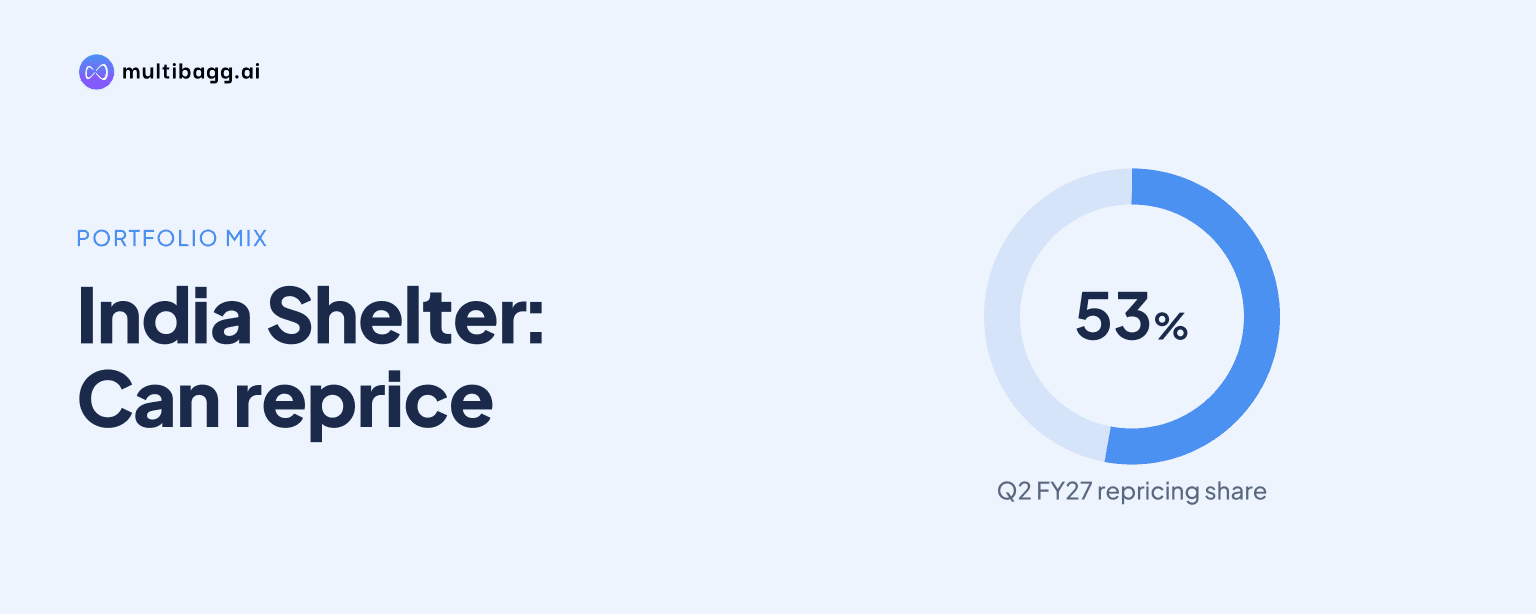
India Shelter said in Q2 FY27 that 53% of its loan portfolio was variable or semi-variable, providing a route to pass through part of any higher funding cost over time, while management reiterated a medium-term spread target of more than 6%.
Know India Shelter Finance Corporation inside out
Results, valuation, peers and who's buying, in one view.
How much of India Shelter's loan book can be repriced?
India Shelter said 53% of its total portfolio was in variable or semi-variable products in Q2 FY27, consisting of 15% variable-rate loans and 38% semi-variable loans. Management identified this mix as one lever to limit the effect on margins if repo-rate changes raise the company's borrowing costs.
The 15% variable-rate share is already subject to rate resets, while the 38% semi-variable share is fixed for three years before becoming variable. Therefore, the disclosed 53% is not an immediate repricing pool for the whole portfolio: it combines loans that are already variable with loans that will enter the variable bucket gradually.
Management said the 38% semi-variable portfolio can be considered over a three-year transition period. It estimated that about 4% to 5% of the total portfolio could move into the variable-rate bucket in each quarter, beginning from Q4 FY27 as loans complete their fixed-rate periods.
When will India Shelter's semi-variable loans reprice?
India Shelter said semi-variable loans will start becoming variable from Q4 FY27, but the conversion will occur gradually rather than through a one-time reset. The company described the product as carrying a three-year fixed rate, after which it moves into the variable-rate category.
Management said it did not expect immediate repricing either in funding costs or in the loan portfolio. It indicated that, once borrowing costs begin to rise, passing some of that impact to customers would likely occur with about a one-quarter lag.
New lending is a separate pricing lever. India Shelter said new disbursements typically represent 30% to 35% of gross assets under management, or Gross AUM, and can be priced at prevailing market conditions. Q2 FY27 disbursements were Rs 1,126 crore, up 21% year on year and 8% quarter on quarter.
How exposed is India Shelter to rising borrowing costs?
India Shelter said repo-rate changes have historically resulted in about 40% transmission to its cost of funds, rather than a full pass-through. Its marginal cost on recent borrowings was around 8.2% in Q2 FY27, close to its reported blended finance cost of 8.2%, while H1 FY27 marginal cost was 8.1%.
The borrowing mix limits the speed of transmission, according to management. About 20% of total borrowings were fixed rate, around 25% to 30% were linked to market benchmarks such as the repo rate or Treasury bills, and roughly 50% were linked to the marginal cost of funds-based lending rate, or MCLR.
Management said a significant part of the MCLR-linked funding was tied to one-year MCLR or the National Housing Bank's prime lending rate, where rate transmission can be limited. India Shelter also said 35% to 36% of Q2 FY27 borrowings were raised at fixed rates as it had anticipated the rate cycle.
Got a follow-up? Ask IRIS
Can India Shelter keep spreads above 6%?
India Shelter said it expects to remain well above its medium-term spread guidance of more than 6%, using loan repricing, new-disbursement pricing and a possible rating upgrade to offset part of any funding-cost increase. This is management's stated expectation rather than a reported future outcome.
Portfolio yield was 14.8% in Q2 FY27, unchanged quarter on quarter, while finance cost was also stable at 8.2%. Net interest margin, or NIM, remained above 9%, and management said quarterly NIM in absolute terms increased 27% as Gross AUM expanded, while spread improved 20 basis points year on year.
Management said a rating upgrade was scheduled in another couple of quarters and could reduce borrowing costs by about 15 to 20 basis points from current levels. It also said incremental funding-cost changes could be reflected in rates on new affordable-housing disbursements, although it gave no specific plan for a lending-rate increase.
What do India Shelter's Q2 FY27 operating figures show?
India Shelter reported Gross AUM of Rs 11,997 crore at September 2026 and described normalized year-on-year growth as 26%. The company also cited 27% growth after adjusting for its Q1 FY27 shift to booking disbursements at clearance, which reversed about Rs 350 crore to Rs 400 crore of disbursements and reduced reported Gross AUM.
Quarterly profit after tax was Rs 146 crore, up 19% year on year, while management said growth would have been 25% excluding the direct-assignment transition. Return on equity was 17.3%, up 30 basis points year on year, and collection efficiency improved to 98% from 97% in the preceding quarter.
Asset-quality indicators were unchanged quarter on quarter, with 30-plus overdue loans at 5.2% and gross non-performing assets at 1.5%. Management said H1 FY27 credit cost was about 60 basis points, including a scheduled Rs 6 crore write-off in Q2, and it expects full-year credit cost to be at 50 basis points within its 40-to-50-basis-point guidance range.
India Shelter maintained FY27 guidance for Gross AUM growth of around 25% to 30% and 40 to 45 branch additions. Management also expects operating expenditure to Gross AUM to improve by about 15 basis points year on year, despite investments in digital systems, technology initiatives and collections.
Conclusion
India Shelter's 53% variable and semi-variable portfolio gives it several mechanisms to address a potential rise in funding costs. The immediately variable portion is 15%, while the 38% semi-variable balance expands the repricing channel gradually after three-year fixed periods, alongside pricing on Rs 1,126 crore of Q2 FY27 disbursements.
The next items to watch are the Q4 FY27 start of semi-variable loan conversions, any change in the 8.2% finance cost, and management's planned rating upgrade in another couple of quarters. Progress toward FY27 Gross AUM growth of 25% to 30% and the stated 40-to-45 branch-addition target will also show whether growth supports the more-than-6% spread objective.