










India Shelter uses 100+ fields in underwriting controls
Key highlights
- India Shelter’s in-house Business Rule Engine assesses more than 100 customer and collateral fields.
- India Shelter disclosed a 52% loan-to-value ratio and 49% FOIR on its underwriting slide.
- Loans below Rs 15 lakh represented 88% of India Shelter’s loans by number in September 2026.
- India Shelter’s digital sourcing was 7% in Q2FY27, compared with 4% in Q2FY26.
powered by IRIS
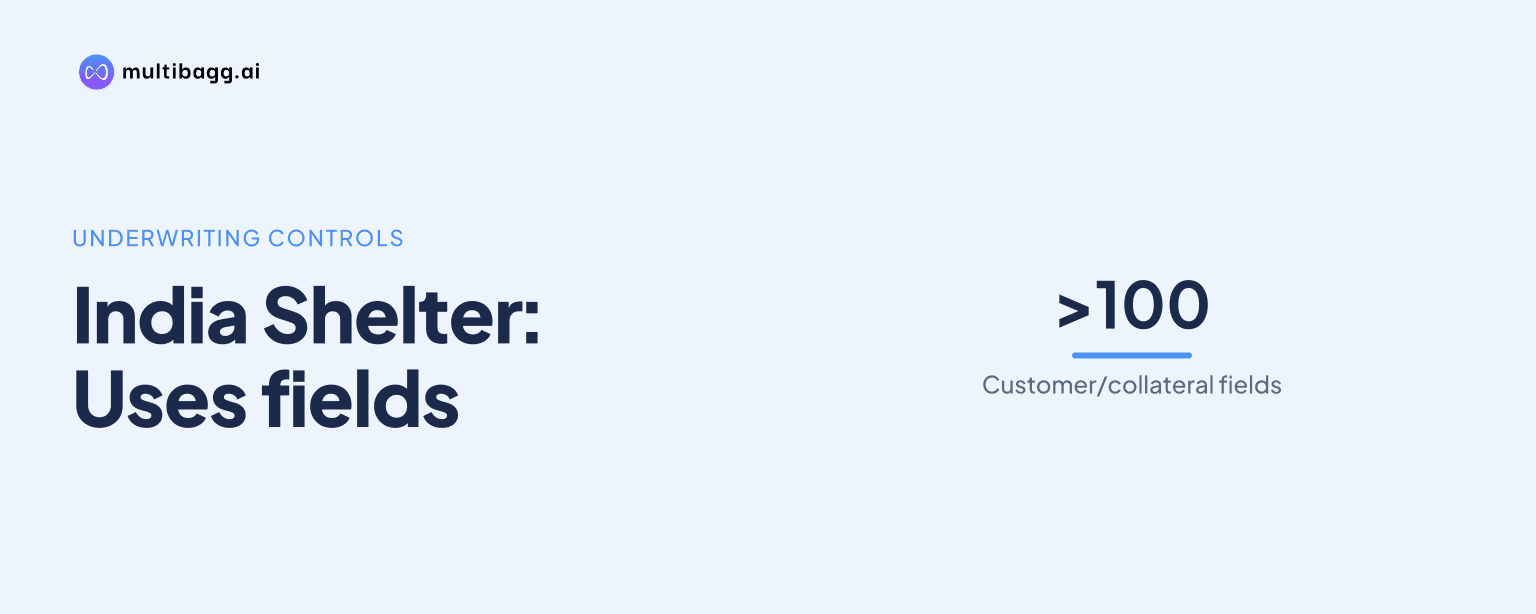
In its Q2FY27 investor presentation, India Shelter Finance Corporation Limited said its in-house Business Rule Engine assesses more than 100 customer and collateral fields, supported by field visits, property geotagging and central controls; the presentation also disclosed 52% loan-to-value and 49% FOIR metrics.
Know India Shelter Finance Corporation inside out
Results, valuation, peers and who's buying, in one view.
How does India Shelter assess loan applicants?
India Shelter assesses applicants through background and business-vintage checks, neighbour and reference checks, credit-bureau information and lifestyle indicators. Its control framework also requires every applicant and co-applicant to visit a branch and lists face-liveliness detection among its processes. The in-house Business Rule Engine, or BRE, evaluates more than 100 customer and collateral fields.
India Shelter’s cash-flow assessment includes a business discussion at the customer’s premises, household visits, bank-statement analysis and a discussion of the loan’s end-use. Household visits are used to triangulate income, expenses and savings. This process is relevant to the September 2026 borrower profile, in which self-employed customers accounted for 78%, up from 75% in September 2025.
Smaller loans remained the main part of the portfolio by number of loans. Loans below Rs 15 lakh represented 88% in September 2026, compared with 89% a year earlier, while the Rs 15 lakh to Rs 25 lakh band rose to 10% from 9%. Loans above Rs 25 lakh were unchanged at 2%, and India Shelter reported that 97% of loans were SORP.
What collateral checks does India Shelter perform?
India Shelter separates collateral work into valuation and legal evaluation. Valuation covers property identification and occupancy, geo-tagging, radial variances, local bylaws and marketability. Legal evaluation includes a title check supported by a legal opinion, an encumbrance title search and legal vetting of document authenticity.
India Shelter says all properties are geo-tagged during technical evaluation. Its cloud-based, paperless platform maintains a database of more than 100 data points on customer and collateral profiles, while Salesforce is integrated with upstream and downstream applications, including mobile applications. The company says the BRE enables real-time compliance with credit policy and prompt loan approvals.
The presentation disclosed a 52% loan-to-value ratio and 49% FOIR alongside these underwriting controls. It did not provide comparative-period figures, a calculation basis or a reporting date for those two metrics on the underwriting slide. The same slide identified loans below Rs 15 lakh as 88% of loan count, linking the control description to the September 2026 ticket-size mix.
How are India Shelter’s sales, credit and collections separated?
India Shelter states that customer acquisition, credit and collections operate through independent hierarchies. At branch level, loan officers and branch managers are shown under customer acquisition, credit managers under credit, and collection managers under collection. The chart also separately identifies branch service and technical manager roles.
The split continues through area, regional and head-office roles. India Shelter lists separate area and regional managers for sales, credit, operations and customer service, legal, technical, and collection or recovery, while the head-office chart includes a field underwriting head and heads for operations, legal, technical and collections. It also lists a Centralized Risk Containment Unit, a Centralized Credit and Hindsight Control Unit, maker-checker controls and a Hindsight & Fraud Control Unit.
Got a follow-up? Ask IRIS
What changed in India Shelter’s digital adoption?
India Shelter’s digital sourcing was 7% in Q2FY27, up from 4% in Q2FY26 and unchanged from Q1FY27. Account Aggregator penetration reached 95% in Q2FY27, versus 92% a year earlier and 95% in Q1FY27. India Shelter specifies that Account Aggregator penetration is measured on the sanctioned-loan base.
Customer registration on the app increased to 85% in Q2FY27 from 82% in Q2FY26 and 84% in Q1FY27. In contrast, service requests raised on the app fell to 69% from 71% a year earlier and 70% in the preceding quarter. India Shelter also reported 94% digital collection without comparative periods on the slide.
Digital processing operates alongside physical assessment rather than replacing it. India Shelter lists digital loan approval, a customer 360 view, data capture, third-party integrations, artificial intelligence and mobility solutions, while still requiring business-premise discussions and household visits. Its September 2026 customer mix was 58% in Tier 3 cities, 33% in Tier 2 cities and 9% in Tier 1 cities.
How does India Shelter’s portfolio mix frame underwriting?
India Shelter’s September 2026 product mix was 56% home loans and 44% loan against property, compared with 57% and 43%, respectively, in September 2025. On-book home loans represented 69% of product mix by assets under management, or AUM, up from 68%. The shift was one percentage point toward loan against property.
India Shelter had 312 branches across 15 states and gross AUM of Rs 11,997 crore in September 2026. Its 202 branches operating for more than three years held Rs 9,827 crore of gross AUM, or Rs 49 crore per branch. That compared with Rs 10 crore per branch across 14 branches operating for up to one year.
The state mix shows changes since March 2021. Rajasthan accounted for 31% of gross AUM in September 2026, down from 33%, Maharashtra was 15%, down from 19%, and Madhya Pradesh was 9%, down from 17%. Tamil Nadu rose to 7% from 1%, while India Shelter describes its branch expansion as geographically diversified and contiguous.
Conclusion
India Shelter’s disclosed underwriting architecture combines a BRE covering more than 100 fields with cash-flow verification, property valuation, legal checks, geo-tagging and separate functional lines for sales, credit and collections. The 52% loan-to-value and 49% FOIR disclosures sit alongside a portfolio where 88% of loans by number were below Rs 15 lakh in September 2026.
The next disclosures to watch are additional detail on the BRE’s field-level rules and the calculation basis and period for the 52% loan-to-value and 49% FOIR figures, which the presentation does not provide. Digital sourcing, which was 7% in both Q1FY27 and Q2FY27, and app registration, which reached 85% in Q2FY27, are also reported measures of the operating workflow.