










India Shelter restores lending spread to 6.6% as funding costs fall
Key highlights
- India Shelter’s FY26 spread returned to 6.6%, matching the FY22 level.
- India Shelter’s FY26 cost of funds fell to 8.2% from 8.7% in FY25, while yield was 14.8%.
- India Shelter reported a 14.9% incremental lending yield and an 8.1% incremental cost of funds.
- India Shelter’s Q2FY27 gross AUM was Rs 11,997 crore, up 23% year on year.
powered by IRIS
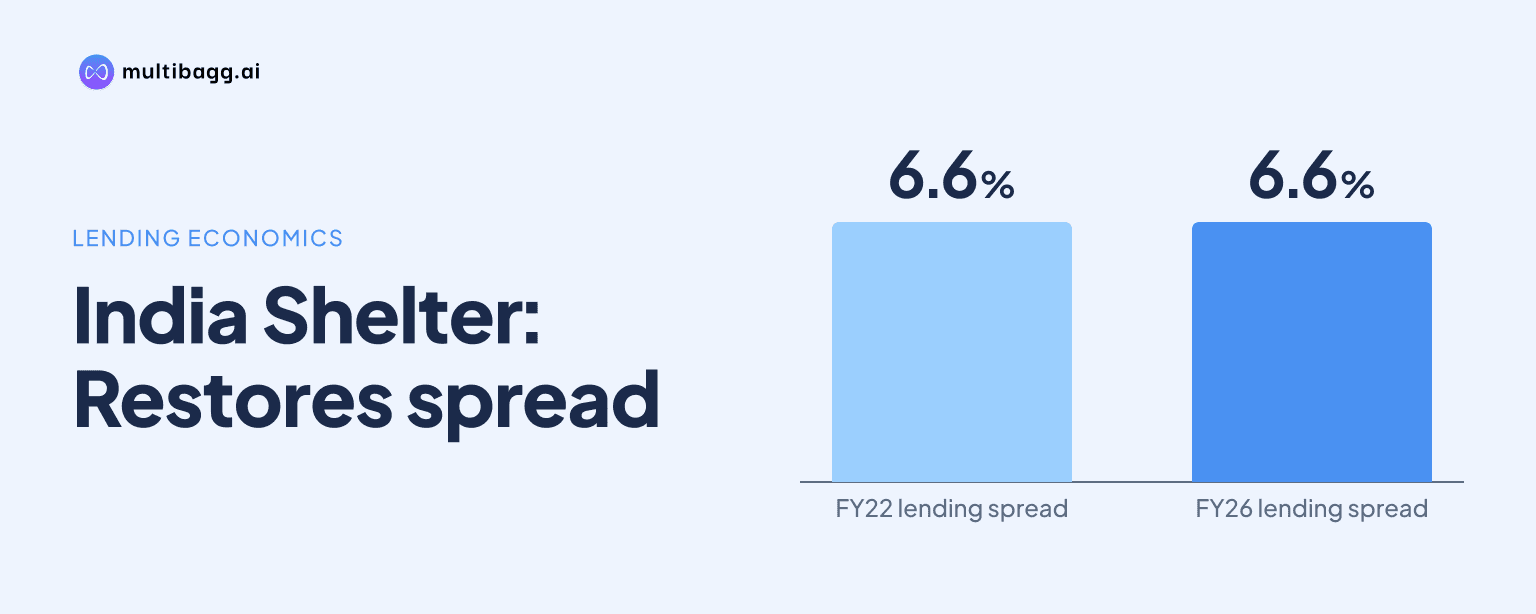
India Shelter Finance Corporation Limited restored its lending spread to 6.6% in FY26, matching FY22, as its cost of funds fell to 8.2% from 8.7% in FY25 while yield declined only to 14.8% from 14.9%. India Shelter maintained the 6.6% spread in Q2FY27, with incremental cost of funds at 8.1%.
Know India Shelter Finance Corporation inside out
Results, valuation, peers and who's buying, in one view.
How did India Shelter restore its 6.6% lending spread?
India Shelter restored its 6.6% spread primarily through lower funding costs rather than higher lending yield. FY26 yield was 14.8%, 10 basis points below FY25, while cost of funds fell 50 basis points to 8.2% from 8.7%. One basis point equals one-hundredth of a percentage point, and the movements increased spread by 40 basis points from 6.2% in FY25.
The FY26 result matched the 6.6% spread reported in FY22, although the components differed. India Shelter’s FY22 yield was 15.0% and its cost of funds was 8.4%, compared with 14.8% and 8.2%, respectively, in FY26. Across FY23 to FY25, yield stayed within a 14.7% to 14.9% range, whereas cost of funds rose as high as 8.8% in FY24 before declining in FY26.
What do India Shelter’s Q2FY27 funding metrics show?
India Shelter reported a 6.6% spread in Q2FY27, unchanged from Q1FY27 and 20 basis points above Q2FY26. Yield was 14.8% in both Q1FY27 and Q2FY27, versus 14.9% in Q2FY26. Cost of funds was 8.2% in both recent quarters, down from 8.5% a year earlier.
The quarterly data show that India Shelter maintained the FY26 spread despite no rise in reported yield. It disclosed an incremental lending yield of 14.9% and an incremental cost of funds of 8.1%, a difference of 6.8 percentage points. The presentation defines these incremental figures as year-to-date positions, not standalone Q2FY27 measures.
Why did cost of funds drive the FY26 change?
Cost of funds drove the FY26 spread change because its 50-basis-point decline was larger than the 10-basis-point reduction in yield. India Shelter’s spread therefore rose to 6.6% from 6.2% in FY25 even though the reported yield moved down to 14.8% from 14.9%.
India Shelter states that yield and cost of funds are positions at the end of the relevant period and exclude amortised upfront income or expense under Indian Accounting Standards, or IND AS. Its 8.1% incremental cost of funds was 10 basis points below the 8.2% Q2FY27 reported figure, while incremental lending yield of 14.9% was 10 basis points above the reported quarterly yield.
FY24 was the lowest-spread year in the five-year series, at 6.1%. In that year, India Shelter’s cost of funds reached 8.8%, the highest disclosed level, while yield was 14.9%. By FY26, cost of funds had fallen 60 basis points from FY24, while yield was 10 basis points lower.
Got a follow-up? Ask IRIS
How did India Shelter’s loan book and profit change in Q2FY27?
India Shelter’s gross assets under management, or AUM, reached Rs 11,997 crore in Q2FY27, up 23% from Rs 9,728 crore in Q2FY26 and 6% from Rs 11,284 crore in Q1FY27. The company said the year-on-year AUM comparison was affected by a one-time change in booking disbursements at realisation that it implemented in Q1FY27.
Q2FY27 disbursements were Rs 1,126 crore, compared with Rs 931 crore in Q2FY26 and Rs 641 crore in Q1FY27. India Shelter reported 21% year-on-year disbursement growth and 8% quarter-on-quarter growth using Rs 1,046 crore of Q1FY27 disbursements on a clearance basis. The presentation therefore provides a different Q1FY27 base for its stated sequential growth rate.
Profit after tax was Rs 146 crore in Q2FY27, up 19% from Rs 122 crore in Q2FY26 and 2% from Rs 143 crore in Q1FY27. India Shelter’s 312 branches held the Rs 11,997 crore AUM in September 2026, with 202 branches older than three years accounting for Rs 9,827 crore, or Rs 49 crore per branch. The presentation does not attribute the change in profit to a single operating factor.
What asset-quality measures accompanied the 6.6% spread?
India Shelter reported a Stage 3, or gross non-performing asset, ratio of 1.5% in Q2FY27, unchanged from Q1FY27 and up from 1.2% in Q2FY26. Its net Stage 3 ratio was 1.2%, also unchanged sequentially and above the 0.9% reported a year earlier.
The 30-plus days past due ratio was 5.2% in Q2FY27, unchanged from Q1FY27 and above 4.6% in Q2FY26. Collection efficiency improved to 98% from 97% in Q1FY27 but remained below 99% in Q2FY26. These figures show that the lower funding cost was reported alongside stable sequential delinquency measures, rather than a sequential improvement in them.
India Shelter’s September 2026 AUM mix was 56% home loans and 44% loans against property, while 78% of customers were self-employed. Tier-3 cities accounted for 58% of the portfolio, and 88% of loans by number had an average ticket size below Rs 15 lakh. The presentation does not provide yield, funding-cost or asset-quality splits by product, customer type or city tier.
Conclusion
India Shelter’s return to a 6.6% spread in FY26 resulted from the decline in cost of funds to 8.2%, while yield remained close to its recent range at 14.8%. The same spread held in Q2FY27 as gross AUM reached Rs 11,997 crore and profit after tax was Rs 146 crore.
The unresolved issue is whether India Shelter can sustain the 8.2% reported cost of funds and 8.1% incremental cost of funds while maintaining a 14.9% incremental lending yield. Subsequent disclosures will also show whether the 5.2% 30-plus days past due ratio and 1.5% Stage 3 ratio change as AUM expands beyond the Q2FY27 level.