










Indo-MIM revenue rises 11.8% despite electronics decline
Key highlights
- Indo-MIM revenue increased 11.8% to Rs 2,490.6 crore in H1 FY27.
- Machining revenue rose 55.4% to Rs 188.2 crore in H1 FY27.
- Consumer Product Group revenue increased 46.2% to Rs 389.5 crore in H1 FY27.
- Electronics Component Manufacturing revenue fell 40.5% to Rs 268.1 crore in H1 FY27.
powered by IRIS
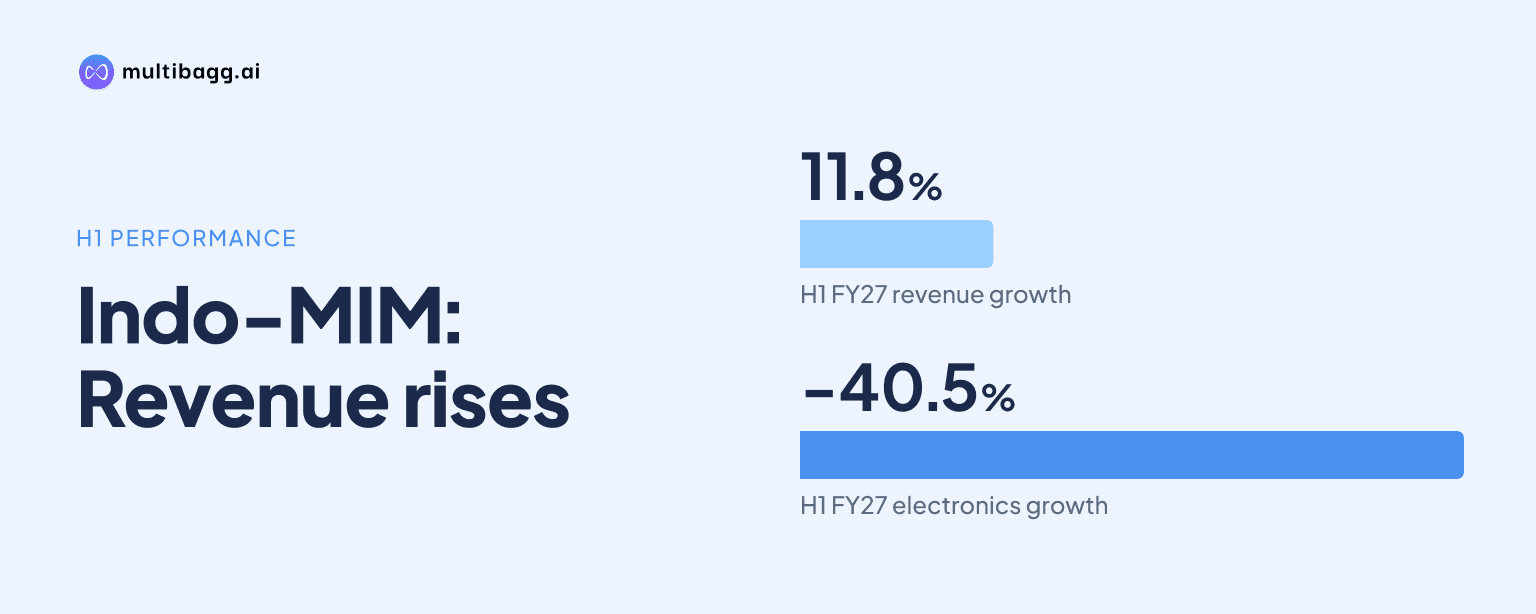
Indo-MIM Limited increased H1 FY27 consolidated revenue by 11.8% to Rs 2,490.6 crore, as growth in metal injection moulding, investment casting, machining and consumer products outweighed a 40.5% fall in electronics revenue to Rs 268.1 crore. Machining delivered the fastest operating-segment growth, rising 55.4% to Rs 188.2 crore.
Know Indo-MIM inside out
Results, valuation, peers and who's buying, in one view.
How did Indo-MIM's operating segments change in H1 FY27?
Indo-MIM's three largest engineering operating segments expanded in H1 FY27, while the Others segment contracted. Metal injection moulding, or MIM, remained the largest segment, rising 19.8% to Rs 1,500.1 crore from Rs 1,252.3 crore in H1 FY26 and accounting for 60% of total revenue. Investment casting, or IC, increased 36.0% to Rs 477.2 crore, representing 19% of revenue.
Machining rose 55.4% to Rs 188.2 crore from Rs 121.1 crore, making it the fastest-growing reported operating segment. By contrast, Others fell 39.0% to Rs 281.0 crore from Rs 460.9 crore, while Medical Devices declined 7.1% to Rs 23.2 crore. Powders increased 25.1% to Rs 20.8 crore, but represented 1% of the H1 FY27 revenue mix.
Which product groups drove Indo-MIM's H1 FY27 growth?
Indo-MIM's Consumer Product Group, or CPG, recorded the fastest growth among the major product groups, increasing 46.2% to Rs 389.5 crore from Rs 266.5 crore. CPG accounted for 16% of H1 FY27 revenue. Aerospace Product Group revenue rose 31.5% to Rs 223.9 crore, while Medical Product Group revenue increased 22.7% to Rs 475.3 crore.
Automotive Product Group, or APG, remained the largest product group at Rs 615.6 crore, or 25% of total revenue, after growing 19.4%. Defence Product Group revenue increased 19.3% to Rs 493.8 crore and represented 20% of revenue. Powder, tools and traded revenue grew 11.2% to Rs 24.4 crore, leaving each of the six non-electronics product groups above its H1 FY26 revenue level.
How much did electronics change Indo-MIM's revenue mix?
Indo-MIM's Electronics Component Manufacturing, or ECM, revenue fell Rs 182.8 crore to Rs 268.1 crore in H1 FY27 from Rs 450.9 crore a year earlier. The 40.5% decline reduced ECM's share of consolidated revenue to 11%. The presentation reports the revenue movement but does not identify a cause for the electronics decline.
The product-group ranking changed materially over the year. ECM was Indo-MIM's second-largest disclosed product group in H1 FY26, behind APG revenue of Rs 515.6 crore. In H1 FY27, ECM was below APG, defence, medical and consumer revenue, although it remained above aerospace and powder, tools and traded revenue.
The six non-electronics product groups generated Rs 2,222.5 crore in H1 FY27, up Rs 446.6 crore from Rs 1,775.9 crore in H1 FY26. That increase exceeded the Rs 182.8 crore fall in ECM and supported the Rs 263.8 crore increase in total revenue. The figures show that revenue growth came from several end markets rather than electronics.
Got a follow-up? Ask IRIS
How much H1 FY27 revenue came from Indo-MIM subsidiaries?
Indo-MIM's standalone business generated Rs 2,073.1 crore in H1 FY27, approximately 83% of consolidated revenue of Rs 2,490.6 crore. This was lower than the approximately 87% standalone share indicated for H1 FY26, when standalone revenue was Rs 1,927.7 crore and consolidated revenue was Rs 2,226.8 crore.
Gross subsidiary revenue before eliminations rose to Rs 456.3 crore from Rs 335.4 crore. Indo-MIM Inc., USA contributed Rs 254.9 crore and Triax Industries, USA contributed Rs 154.9 crore, together making up 90% of gross subsidiary revenue. In H1 FY26, their respective contributions were Rs 193.5 crore and Rs 100.4 crore.
Eliminations and other items reduced consolidated revenue by Rs 38.8 crore in H1 FY27, compared with Rs 36.3 crore in H1 FY26. Conway Marsh Garrett, UK contributed Rs 23.2 crore and Phoenix DeVentures II, USA contributed Rs 23.3 crore, while Indo-MIM Arms Components, India recorded nil revenue in H1 FY27.
What is Indo-MIM's plan for growth after H1 FY27?
Indo-MIM management's priorities for FY27 and beyond include converting new-part launches into production, raising productivity and capacity utilisation, and continuing its focus on quality and operating efficiency. These plans apply across a business model that includes MIM, IC, precision machining, electronic components and additive manufacturing.
Management also identifies selective investment in capacity, automation, advanced materials, tooling and additive manufacturing. It says it intends to deepen customer engagement in higher-value, technology-intensive applications and pursue profitable growth rather than growth at any cost. The presentation does not disclose a numerical revenue target, capacity target or timetable for these priorities.
Subsequent reporting will show whether those actions affect the segments that expanded in H1 FY27, including MIM at Rs 1,500.1 crore, IC at Rs 477.2 crore and machining at Rs 188.2 crore. It will also show whether ECM, which represented Rs 268.1 crore of revenue, stabilises or continues to alter the revenue mix.
Conclusion
Indo-MIM's H1 FY27 revenue growth was broader than the reported decline in electronics. MIM remained the largest operating segment at Rs 1,500.1 crore, while IC and machining rose 36.0% and 55.4%, respectively. Across product groups, automotive, defence, medical, consumer and aerospace all grew, enabling total revenue to rise 11.8% despite the ECM contraction.
The next development to watch is execution of management's FY27 and beyond plan to convert new parts into production, lift productivity and utilisation, and invest selectively in capacity, automation, materials, tooling and additive manufacturing. The presentation provides no quantified revenue or capacity target, so future segment and product-group disclosures will be the available measure of progress.