










INDO-MIM sees Triax near break-even by FY27 end on IGT ramp
Key highlights
- INDO-MIM expects Triax to approach net-net break-even by the end of FY27.
- INDO-MIM reported Rs 2,490 crore of consolidated revenue for the half year ended September 30, 2026.
- INDO-MIM Inc. contributed Rs 200 crore of revenue and Rs 52 crore of PAT in the half year.
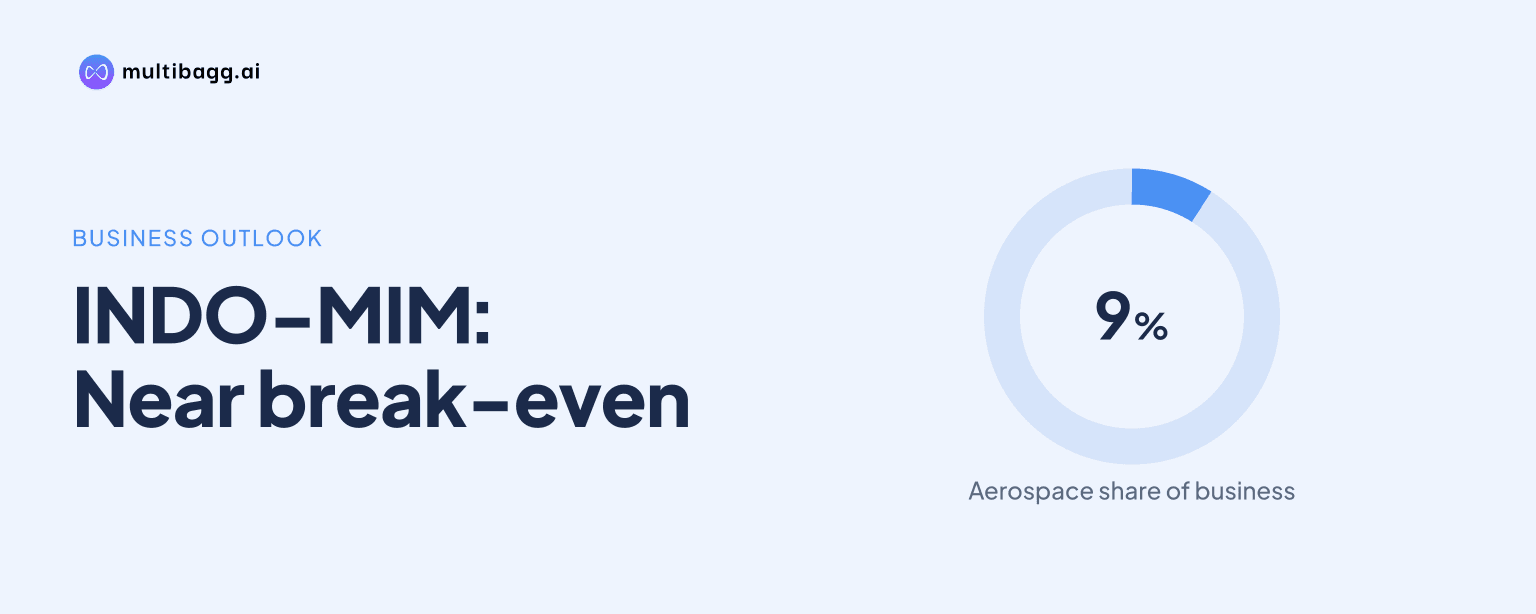
- Aerospace represented 9% of business and grew 31.5% year on year.
powered by IRIS
In FY27, INDO-MIM Limited expects its loss-making Triax unit to approach net-net zero profitability by year-end as industrial gas turbine programmes developed over the past three years enter production, while group consolidated revenue reached Rs 2,490 crore in the half year ended September 30, 2026.
Know Indo-MIM inside out
Results, valuation, peers and who's buying, in one view.
The expectation matters because subsidiaries other than INDO-MIM Inc. were still marginally loss-making in the half year ended September 30, 2026. INDO-MIM reported consolidated revenue of Rs 2,490 crore for that period, while management said Triax should reach near-zero profitability by year-end and turn the corner from the following year.
Why does INDO-MIM expect Triax to reach break-even by FY27 end?
INDO-MIM expects Triax to reach near net-net zero profitability by the end of FY27 because programmes that had been in development are moving into production. Chief Financial Officer P. Balasubramanian said other subsidiaries were marginally loss-making, but management expected Triax's losses not to be present by year-end. He said the unit should turn the corner from the following year.
The company did not disclose Triax's separate revenue, loss or margin for the half year ended September 30, 2026. That leaves the timing and scale of the earnings improvement dependent on management's operational assessment rather than a quantified subsidiary forecast. Management's stated condition is that the Triax operation must continue improving throughput and efficiency as production volumes rise.
What does industrial gas turbine production change for Triax?
Industrial gas turbine, or IGT, programmes are the main production catalyst cited for Triax. Chief Executive Officer Krishna Chivukula Jr. said both Triax and INDO-MIM's Tirupati casting facility have substantial exposure to IGT and aerospace-engine applications, and both have seen a large number of IGT programmes over the past three years.
Management said the Triax programmes are coming out of development and into production, which should support profitability if factory throughput and efficiency progress. This differs from the Indian opportunity, where management said significant product development and programmes won over the past 18 months will take time to translate to production. The call did not provide programme-level production dates, contract values or expected Triax revenue.
How large is INDO-MIM's subsidiary earnings drag currently?
The disclosed group figures show a modest gap between standalone and consolidated profit after tax, or PAT, but they do not isolate Triax's loss. Standalone revenue was Rs 2,073 crore in the half year ended September 30, 2026, compared with Rs 2,490 crore on a consolidated basis. INDO-MIM Inc., the metal injection moulding subsidiary, contributed Rs 200 crore of revenue and Rs 52 crore of PAT.
Maya Industries contributed Rs 150 crore of revenue, while management grouped the remaining subsidiaries as marginally loss-making. Consolidated PAT was Rs 455 crore, only Rs 12 crore above standalone PAT despite the Rs 417 crore difference in revenue. These figures show that subsidiaries beyond INDO-MIM Inc. were not adding proportionately to group profit, although they cannot be used to calculate Triax's standalone loss.
Got a follow-up? Ask IRIS
What does INDO-MIM's wider FY27 performance indicate about Triax?
INDO-MIM reported Rs 2,490 crore of revenue in the first half of FY27, up about Rs 263 crore from the corresponding FY26 half year. Management reported earnings before interest, tax, depreciation and amortisation, or EBITDA, margin of 32%, about 6.3 percentage points higher year on year, while PAT rose by about Rs 160 crore to Rs 455 crore, including exceptional items.
The group also reported differing momentum across end markets. Aerospace accounted for 9% of business and was up 31.5%, while automotive represented 25% and rose 19.4%. Consumer business made up 16% and rose 46.5%, whereas electronic component manufacturing, representing 11%, was down about 40%; management nevertheless expected that segment to meet its roughly Rs 500 crore FY27 budget after achieving Rs 268 crore so far.
What must happen for Triax to become profitable after FY27?
Triax must convert IGT and aerospace work from development to repeatable production while improving operating efficiency. Management said INDO-MIM has seen heavy IGT demand, alongside demand related to humanoid and satellite applications. However, it did not attach a revenue forecast or profit target to any of those applications, so the pathway remains execution-led rather than contract-value-led.
INDO-MIM's planned capital spending is also directed chiefly at secondary operations such as machining to finish parts, rather than major investment in primary metal injection moulding or casting processes. Management said significant programmes under development would require investment during FY27, with most capital expenditure intended to support programmes ramping through the second and fourth quarters. That approach could support Triax and related aerospace work, but management did not specify how much capital would be allocated to Triax.
How does INDO-MIM's FY27 target frame the Triax turnaround?
INDO-MIM's FY27 revenue target is Rs 5,000 crore and its bottom-line target is Rs 850 crore. Management said it was close to the revenue objective and believed the bottom line could be slightly ahead of its earlier indication, but it would provide a firmer estimate in the next quarter. Removal of Triax's losses would support that group objective, although management did not quantify the contribution.
Management also described component mix as a major determinant of margins because the company makes about 6,000 to 6,500 stock-keeping units annually and 1,000 to 1,200 different components each month. That means Triax's profitability will depend not only on IGT volumes but also on the parts entering production, their material content and the efficiency of their manufacturing process.
Conclusion
The Triax turnaround is a management expectation tied to a specific operational shift: three years of IGT programme development moving into production. INDO-MIM's half-year consolidated revenue of Rs 2,490 crore and PAT of Rs 455 crore show that the wider group is growing, but the disclosed figures also show that non-INDO-MIM Inc. subsidiaries remain a drag on consolidated earnings.
The next item to watch is management's next-quarter estimate for FY27 bottom-line performance and whether it confirms that Triax has reached near-zero profitability by year-end. Investors will also need evidence that IGT and aerospace programmes are converting into output, while throughput and efficiency improve enough to deliver the profitability management expects.