










INDO-MIM plans 3,000-tonne iron-powder plant, no profit assumed
Key highlights
- INDO-MIM plans about 3,000 tonnes of annual iron-powder capacity.
- INDO-MIM expects captive iron-powder demand of about 1,500 to 2,000 tonnes annually.
- The proposed plant could leave 1,000 to 1,500 tonnes available for external sales.
- Management expects operating leverage only at roughly 70% to 80% utilisation, or about 2,100 to 2,400 tonnes.
powered by IRIS
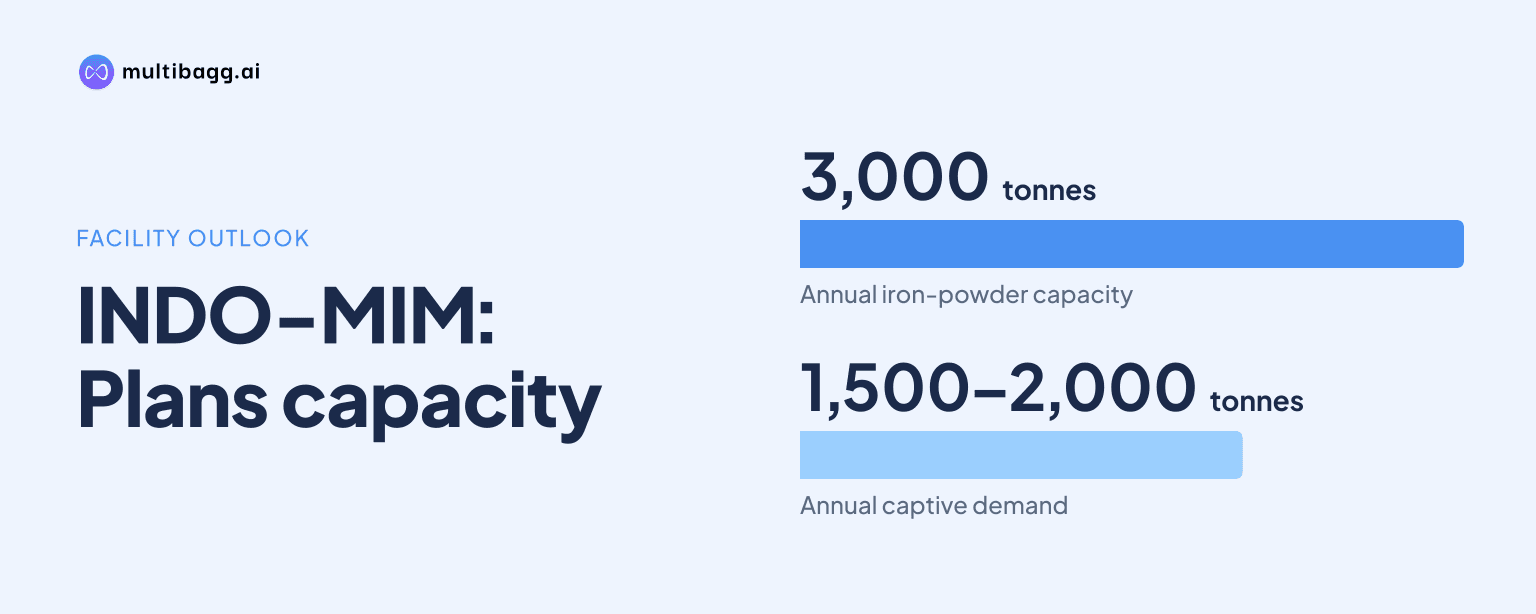
INDO-MIM plans an iron-powder plant producing about 3,000 tonnes a year, with 1,000 to 1,500 tonnes potentially available for external sales after captive use. Management said it is not assuming a profitability benefit from the capacity until utilisation reaches roughly 70% to 80%, making supply-chain security the immediate purpose of the project.
Know Indo-MIM inside out
Results, valuation, peers and who's buying, in one view.
What iron-powder capacity is INDO-MIM planning?
INDO-MIM is planning an iron-powder manufacturing facility with annual capacity of roughly 3,000 tonnes. Management said the investment is primarily intended to secure powder supply for expanded internal requirements, rather than to provide an immediate earnings contribution.
The planned capacity is split between captive demand of about 1,500 to 2,000 tonnes and potential outside sales of 1,000 to 1,500 tonnes. The range means internal consumption could account for half to about two-thirds of the proposed 3,000-tonne output, depending on how quickly INDO-MIM's expanded requirements develop.
The 1,000- to 1,500-tonne external range is not a sales commitment. Management did not disclose customer names, contracts, prices, commissioning timing, capital expenditure or expected revenue for the iron-powder facility, citing confidentiality around the applications being discussed.
Why is INDO-MIM making iron powder internally?
INDO-MIM is making iron powder internally first for supply-chain security. Management said capacity additions are typically built to protect material availability, with additional business opportunities arising after the facility is established and its output is available for emerging demand.
The company pointed to its stainless-steel powder operation as the precedent. INDO-MIM said it had already completed the stainless-steel backward integration required for its own use, initially to secure supply, before additive-manufacturing powders and other applications created further opportunities.
A large customer is seeking additional stainless-steel powders from INDO-MIM, and management said it is evaluating facility requirements for that demand. However, it did not disclose the potential capacity, timing, customer identity or financial contribution, so the stainless-steel discussion does not establish a forecast for the new iron-powder plant.
For iron powder, management said it was in talks with customers and potential customers about applications that could offer higher value addition than purchasing powder externally. That assessment remains management's view: the transcript contains no disclosed selling price, production cost, margin estimate or volume commitment for the planned 3,000-tonne capacity.
How much iron powder could INDO-MIM sell externally?
INDO-MIM could sell 1,000 to 1,500 tonnes of iron powder externally each year, based on management's stated allocation. At the lower end of captive use, 1,500 tonnes of the 3,000-tonne capacity would remain for outside customers; at the higher end, the balance would fall to 1,000 tonnes.
This makes the external opportunity dependent on two factors: the pace of INDO-MIM's 1,500- to 2,000-tonne captive requirement and demand from the undisclosed customer applications. Management did not say whether external sales would be under long-term orders, spot arrangements or a mix of both.
The proposed split also shows that the plant has a dual operating purpose. Captive powder can reduce reliance on outside suppliers for INDO-MIM's expanded production needs, while spare capacity could support a separate powder-sales line if customers absorb the 1,000 to 1,500 tonnes available.
Management compared this possibility with the stainless-steel powder experience, where a supply-security investment later served additive-manufacturing demand. But it did not state that the iron-powder applications would be additive manufacturing, nor did it identify any end market, leaving the commercial mix unresolved.
Got a follow-up? Ask IRIS
When will INDO-MIM see a profit benefit from the plant?
INDO-MIM is not assuming a margin advantage from the new iron-powder capacity in its profitability calculations. Management said full use of the facility will take time, and lower costs and operating leverage will be realised only when utilisation reaches about 70% to 80%.
Applied to the planned 3,000-tonne annual capacity, 70% utilisation equals about 2,100 tonnes and 80% equals about 2,400 tonnes. Management did not give a target date for reaching that range, so the transcript does not indicate when a cost benefit or external-sales contribution may be reflected in results.
At 2,100 tonnes of production, output would cover the lower end of the stated 1,500- to 2,000-tonne captive need, with limited surplus depending on internal use. At 2,400 tonnes, the facility would have more room for external volumes, though customer demand would still determine whether the additional output is sold.
Management said the effect of powder initiatives should eventually be visible in both top line and bottom line, but it gave no financial estimate or reporting period. The current position is more limited: the 3,000-tonne project is being assessed as a supply-chain measure until utilisation becomes reasonably high.
How does the project compare with INDO-MIM's existing powder activity?
INDO-MIM's iron-powder plan differs from its existing stainless-steel powder activity because the new facility has a disclosed 3,000-tonne annual capacity and a stated external-sales range of 1,000 to 1,500 tonnes. The stainless-steel facility is already in place for internal use, while its possible expansion for a large customer remains under evaluation.
Both powder initiatives share the same mechanism of backward integration: INDO-MIM first seeks control over supply for its own operations and then considers additional demand. In the iron-powder case, the company has specified a 1,500- to 2,000-tonne expanded captive requirement, which provides the basis for estimating potential surplus.
The comparison does not establish the future scale of a powder business. INDO-MIM has not disclosed iron-powder customers, contracts, applications, production costs or sales realisation, and management explicitly excludes a margin benefit before 70% to 80% utilisation is reached.
Conclusion
INDO-MIM's planned 3,000-tonne iron-powder facility is designed first to support an expanded captive requirement of 1,500 to 2,000 tonnes annually. The remaining 1,000 to 1,500 tonnes could create an external-sales opportunity, but the company has not disclosed customers, commercial terms, revenue or a margin forecast for that output.
The next issue to watch is progress towards the roughly 70% to 80% utilisation level, or about 2,100 to 2,400 tonnes of annual production, at which management expects cost and operating-leverage benefits. Management is also evaluating added stainless-steel powder capacity for a large customer, without yet providing facility or financial details.