










Captive and commercial mines take 20.2% coal share
Key highlights
- Captive and commercial mines’ share of India’s coal output rose from 10.9% in Fiscal 2022 to 20.2% in Fiscal 2026.
- Coal India Limited supplied nearly three-fourths of India’s coal production in Fiscal 2026.
- India had auctioned 147 coal blocks with about 378 MTPA of aggregate capacity by August 2026.
- Opencast mines are estimated to account for 97.0% of India’s coal output in Fiscal 2026.
powered by IRIS
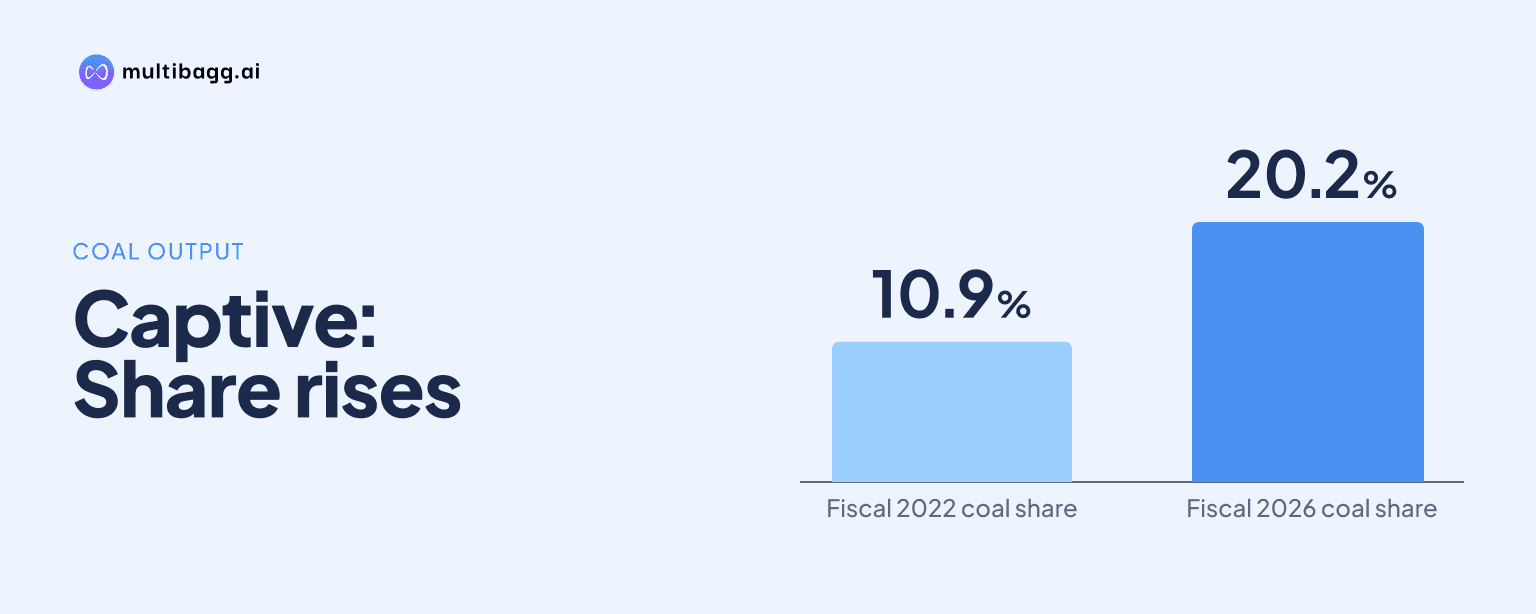
Captive and commercial coal mines accounted for 20.2% of India’s coal production in Fiscal 2026, up from 10.9% in Fiscal 2022, as auction-led liberalisation expanded participation beyond traditional state producers. Coal India Limited still supplied nearly three-fourths of national output, leaving the market predominantly public-sector led despite the shift.
How did captive and commercial mines take 20.2% of coal output?
Captive and commercial mines took a 20.2% share of national coal output in Fiscal 2026 because reforms progressively expanded the pool of companies able to operate blocks and market coal. Their share rose by 9.3 percentage points from 10.9% in Fiscal 2022, while Coal India Limited, or CIL, remained responsible for nearly three-fourths of India’s production.
Captive mines are allocated for specified end-use industries, including power, steel and cement, whereas commercial mines can sell coal without an end-use restriction. A 2021 liberalisation allowed captive mine operators to sell up to 50% of annual output in the open market after meeting their own consumption needs, subject to an additional charge. That mechanism gave mines designed for internal use a limited route into wider coal supply.
The share gain also occurred during an expansion in overall national production. India’s coal output increased from around 610 million tonnes in Fiscal 2015 to approximately 1,048 million tonnes in Fiscal 2025. Captive and commercial mines therefore gained share in a larger production base rather than solely replacing established supply.
What policy changes expanded captive and commercial mines?
Auction-based allocation and the removal of sales restrictions expanded captive and commercial mines. The Coal Mines (Special Provisions) Act, 2015 created the process for reallocating mines after the Supreme Court cancelled 204 legacy coal blocks, replacing the earlier nomination-based framework with auctions and allotments administered by the Nominated Authority.
Commercial coal mining began on 18 June 2020 and enabled successful bidders to mine and market coal without end-use restrictions. The policy also allowed 100% foreign direct investment under the automatic route. By August 2026, 147 coal blocks had been successfully auctioned with aggregate production capacity of about 378 million tonnes per annum, or MTPA.
The Mines and Minerals (Development and Regulation) Act, 1957, as amended in 2021, reduced the distinction between captive and other miners for coal sales. Captive operators can sell up to 50% of annual production only after fulfilling their own consumption requirements. The expansion of freely marketable coal therefore depends on block development, statutory approvals, actual production and each operator’s captive demand.
How concentrated is coal supply after liberalisation?
India’s coal supply remains concentrated because CIL supplied nearly three-fourths of output in Fiscal 2026 even as captive and commercial mines reached 20.2%. Other public-sector producers include Singareni Collieries Company Limited, NLC India Limited, NTPC Limited’s mining business, Gujarat Mineral Development Corporation and Andhra Pradesh Mineral Development Corporation.
The gap between CIL’s nearly three-fourths share and the 20.2% combined share held by captive and commercial mines shows that policy liberalisation has widened supply channels without ending public-sector dominance. The supplied outlook expects public producers to retain a leading role over the medium term because of their reserve base, infrastructure and operating scale. Diversification depends on auctioned capacity becoming operational mine output.
Coal is sold through several channels with different pricing and eligibility conditions. Fuel supply agreements, or FSAs, provide contractual coal linkages, while linkage auctions serve non-regulated users and CIL’s single-window e-auction platform sells non-linkage coal. Commercial miners can choose their sales mechanism, but captive operators remain subject to the 50% ceiling after satisfying end-use needs.
Got a follow-up? Ask IRIS
Why does opencast mining matter for coal output?
Opencast mining matters because it is estimated to produce 1,010 million tonnes, or 97.0% of India’s coal output, in Fiscal 2026, compared with 31 million tonnes from underground mines. Opencast mining extracts coal after removing surface layers and is associated in the source with higher productivity, greater mechanisation, lower unit costs and higher recovery rates.
The production mix has shifted further towards surface operations since Fiscal 2015. Opencast mines produced 561 million tonnes and represented 92.0% of output in Fiscal 2015, while underground mines produced 49 million tonnes. By Fiscal 2025, opencast output had climbed to 1,016 million tonnes and underground output had declined to 32 million tonnes.
Captive and commercial mines seeking to increase output are consequently affected by access to suitable surface deposits, equipment, evacuation infrastructure and regulatory approvals. Non-coking coal, used mainly in thermal power and industrial applications, is graded partly by gross calorific value, or GCV, which measures heat released during combustion. Rail, ships and conveyor belts move coal to users, while the Integrated Coal Logistics Plan, 2030 aims to improve multimodal evacuation and first-mile connectivity.
What could sustain captive and commercial mines’ growth?
Captive and commercial mines can sustain their rising share if auctioned capacity becomes producing capacity and domestic demand continues to grow. India’s coal demand is projected at around 1.5 billion to 1.6 billion tonnes by 2030, while coal accounted for about 70% of electricity generation in Fiscal 2026. The power sector represented more than 70% of coal demand, linking mine utilisation closely to electricity consumption.
Mine development remains conditional on project execution. Coal projects require environmental, forest and wildlife clearances where applicable under the Environment (Protection) Act, 1986, Forest (Conservation) Act, 1980, Wildlife (Protection) Act, 1972 and Environmental Impact Assessment Notification, 2006. Land acquisition, rehabilitation, rail availability and evacuation facilities also affect the timing at which rated capacity becomes physical production.
Price formation differs across coal sales channels. CIL’s notified prices remain central to domestic non-coking coal, while e-auction prices, imported coal prices and the National Coal Index affect market-linked realisations. The National Coal Index tracks notified, auction and imported coal prices and is used to calculate revenue sharing and premium payments for commercial coal blocks.
Conclusion
The increase from a 10.9% share in Fiscal 2022 to 20.2% in Fiscal 2026 shows that captive and commercial mines have become a larger source of Indian coal under the auction-led regime. Yet CIL’s nearly three-fourths share of output and opencast mining’s estimated 97.0% share demonstrate that production remains concentrated by producer type and extraction method.
The next measure to watch is whether the 147 blocks auctioned by August 2026, with about 378 MTPA of aggregate capacity, enter sustained production. Coal demand projected at 1.5 billion to 1.6 billion tonnes by 2030, the Integrated Coal Logistics Plan, 2030 and the National Coal Gasification Mission’s 100 million-tonne target by 2030 will influence how quickly non-traditional supply grows.