










MCL Ib Valley Washery operated at 40.6% capacity in FY26
Key highlights
- MCL’s Ib Valley Washery processed 4.06 MT of raw coal in Fiscal 2026 against 10 MT of operable capacity.
- Ib Valley Washery utilisation declined to 40.60% in Fiscal 2026 from 55.78% in Fiscal 2025.
- Raw coal represented 207.31 MT, or 98.37%, of MCL’s 210.74 MT Fiscal 2026 dispatch.
- Washed-coal dispatch declined to 3.38 MT in Fiscal 2026 from 3.81 MT in Fiscal 2025.
powered by IRIS
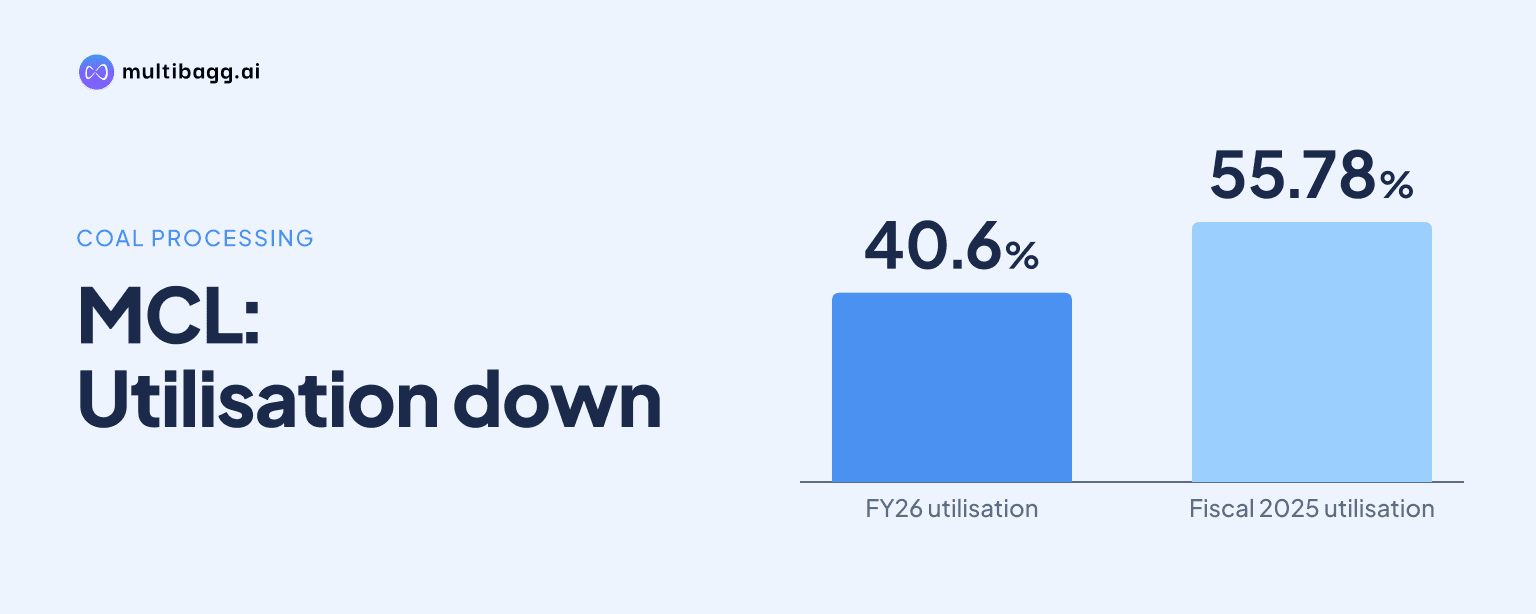
Mahanadi Coalfields Limited (MCL) operated its 10 million tonnes per annum (MTPA) Ib Valley Washery at 40.60% capacity in Fiscal 2026, feeding 4.06 million tonnes (MT) of raw coal into the plant. Utilisation fell from 55.78% in Fiscal 2025 as raw coal feed declined by 1.30 MT and operable capacity rose to 10 MT.
How much of MCL Ib Valley Washery capacity was used in FY26?
MCL used 40.60% of Ib Valley Washery’s 10 MT Fiscal 2026 operable capacity. The Lakhanpur Area facility received 4.06 MT of raw coal for washing, leaving 5.94 MT of the stated annual operable capacity unused under MCL’s reported capacity methodology.
The Fiscal 2026 utilisation rate was 15.18 percentage points below the 55.78% reported in Fiscal 2025. Raw coal feed fell to 4.06 MT from 5.36 MT, while operable capacity increased to 10 MT from 9.61 MT. Installed capacity was unchanged at 10 MTPA in both years, so the lower rate reflected both reduced feed and a larger operable base.
MCL defines installed capacity as the plant’s designed capacity at commissioning. Operable capacity is the maximum capacity at which the washery can operate at the start of the relevant fiscal, based on assumptions that include ageing of the washery, non-operation of any circuit and 5,000 effective working hours annually. The 40.60% measure therefore compares raw coal feed with estimated operable capacity, rather than measuring washed-coal output.
What does MCL Ib Valley Washery’s 40.6% capacity utilisation measure?
MCL calculates Ib Valley Washery capacity utilisation by dividing raw coal feed by operable capacity for the relevant fiscal. In Fiscal 2026, 4.06 MT of raw coal feed divided by 10 MT of operable capacity produced the reported 40.60% utilisation rate.
Raw coal feed means the quantity of coal sent to the washery for processing. It is not equivalent to washed-coal dispatch because beneficiation separates coal from impurities and produces other streams, including washery rejects and slurry. Product inventories, customer specifications and dispatch timing can also differ from the timing of raw coal feed.
Ib Valley Washery commenced operations on April 15, 2024 and was not operated in Fiscal 2024. It reported 5.36 MT of raw coal feed and 55.78% utilisation in Fiscal 2025 against 9.61 MT of operable capacity. Fiscal 2026 was the next reported full fiscal, with operable capacity reaching the 10 MT installed level.
How does MCL Ib Valley Washery process coal?
MCL uses Ib Valley Washery to remove impurities, including ash, from coal and produce washed coal designed at ash content of 33.5% plus or minus 0.5%. The 10 MTPA facility uses heavy media cyclone technology, which separates coal using a magnetite suspension and centrifugal force.
In this process, lower-specific-gravity clean coal overflows from the cyclone while high-ash rejects and middlings leave through the underflow. Raw coal enters the facility at below 100 millimetres, is held in 16,000 tonnes of raw-coal storage, crushed and washed. The process produces washed coal and rejects at below 50 millimetres, while washed-coal storage capacity is 20,000 tonnes.
MCL defines run-of-mine coal as coal extracted from a mine before washing, crushing or blending. The beneficiation process includes crushing, screening, dense-medium cyclones for intermediate-sized coal, froth flotation for fines, and dewatering systems that recover water through screens, thickeners and filtration equipment for reuse.
MCL states that its washed coal is primarily used by high-efficiency power stations and other industrial users. The Ministry of Coal policy allows washery rejects to be used for energy extraction through captive or thermal power plants, construction applications such as brick making and land reclamation, or disposal in mine voids and low-lying areas subject to safety and environmental requirements.
Got a follow-up? Ask IRIS
How does MCL Ib Valley Washery use relate to coal dispatch?
MCL’s Fiscal 2026 dispatch data show that raw coal remained its principal product, accounting for 207.31 MT, or 98.37%, of total dispatch of 210.74 MT. Washed coal accounted for 3.38 MT, or 1.60%, while washery rejects represented 0.05 MT, or 0.03%.
The washed-coal share declined from 1.81% in Fiscal 2025, when MCL dispatched 3.81 MT of washed coal from total dispatch of 210.46 MT. Raw-coal dispatch increased by 0.67 MT from 206.64 MT in Fiscal 2025, even as raw coal feed to Ib Valley Washery decreased by 1.30 MT. The reported figures show that the washery served a limited part of MCL’s overall coal dispatch.
The 4.06 MT of Fiscal 2026 washery feed should not be treated as a direct same-year conversion into 3.38 MT of washed-coal dispatch. Coal washing produces rejects as well as washed coal, and the source reports feed and dispatch as distinct measures. MCL also reported 0.05 MT of washery rejects dispatched in Fiscal 2026, compared with 0.01 MT in Fiscal 2025.
How large is MCL Ib Valley Washery relative to mining and logistics operations?
MCL’s sole 10 MTPA washery was small relative to Fiscal 2026 coal production of 218.31 MT and normative mine production capacity of 303.75 MT. The 4.06 MT sent to Ib Valley Washery equalled about 1.9% of total Fiscal 2026 production, indicating that most MCL coal was produced outside the washery feed stream.
MCL’s mines operated at 71.87% of normative capacity in Fiscal 2026, compared with Ib Valley Washery’s 40.60% of operable capacity. Opencast mines produced 217.99 MT at 72.30% capacity utilisation, while underground mines produced 0.32 MT at 14.22%. Mine capacity utilisation uses normative production capacity, whereas washery utilisation uses operable capacity, so the measures have different definitions.
MCL dispatched 210.74 MT of coal in Fiscal 2026 through a network in which rail carried 137.56 MT, or 65.28%, road carried 64.78 MT, or 30.74%, and merry-go-round rail carried 8.40 MT, or 3.98%. Ib Valley Washery receives raw coal through covered belt conveyors and a pipe conveyor, which MCL says eliminate transfer points and reduce pollution, spillage and maintenance costs.
Conclusion
MCL’s Ib Valley Washery operated at 40.60% capacity in Fiscal 2026, down from 55.78% in Fiscal 2025, because raw coal feed declined to 4.06 MT while the reported operable base increased to 10 MT. The washery’s scale also helps explain why raw coal accounted for 98.37% of MCL’s 210.74 MT Fiscal 2026 dispatch and washed coal accounted for 1.60%.
The next reported test will be whether raw coal feed moves closer to the 10 MT operable capacity under MCL’s assumptions on plant ageing, circuit operation and 5,000 effective annual working hours. Readers should also watch future washed-coal and reject dispatch disclosures after washed-coal dispatch fell from 3.81 MT in Fiscal 2025 to 3.38 MT in Fiscal 2026.