










Mahanadi Coalfields IPO Is Entirely a 661.8 Million-Share OFS
Key highlights
- Mahanadi Coalfields is offering up to 661,836,300 existing equity shares through a promoter offer for sale.
- Mahanadi Coalfields will issue no fresh equity and receive no IPO capital under the disclosed offer structure.
- Up to 33,091,815 shares are reserved for eligible employees and up to 66,183,630 shares for eligible shareholders.
- At least 35% of Mahanadi Coalfields’ Net Offer is available to retail individual bidders, subject to valid bids.
powered by IRIS
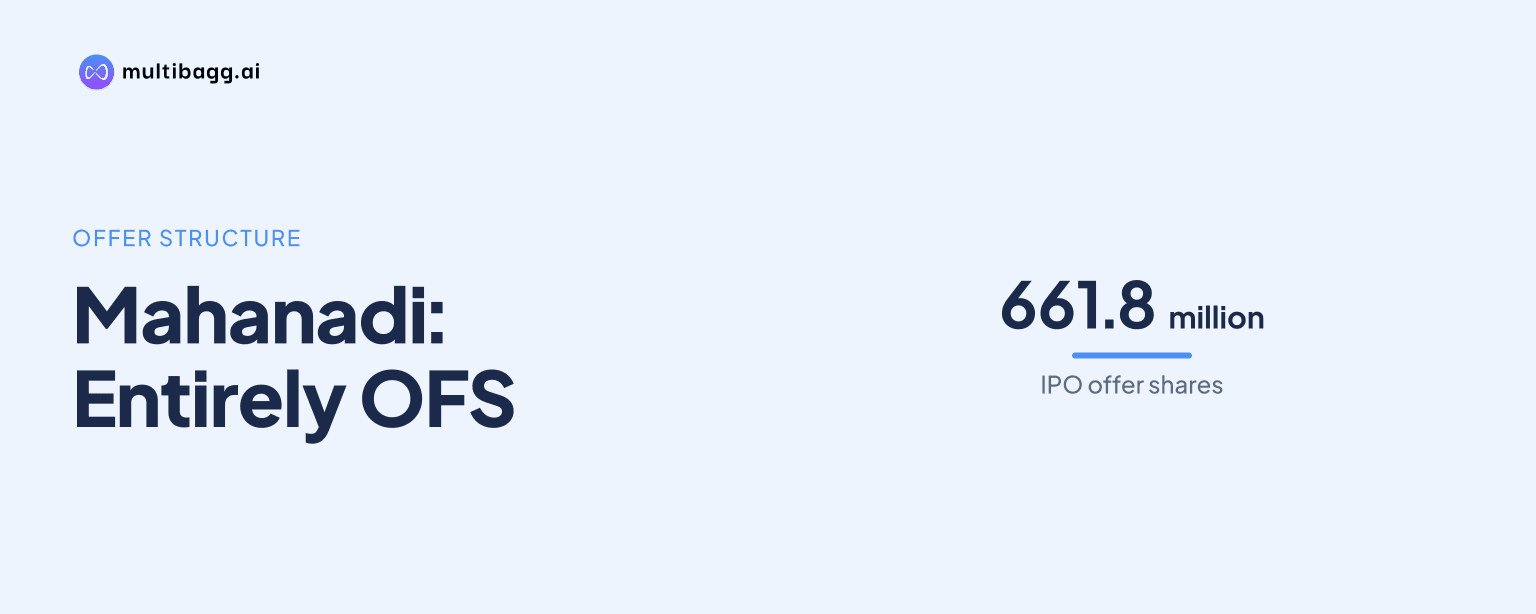
In the proposed initial public offering, Mahanadi Coalfields is offering up to 661,836,300 existing equity shares through a promoter offer for sale, meaning the company will issue no fresh equity and receive no IPO proceeds. The shares have a face value of Rs 2 each, while the offer price and aggregate transaction value remain undisclosed in the document.
What does Mahanadi Coalfields’ all-OFS IPO structure mean?
Mahanadi Coalfields’ IPO is entirely an offer for sale, or OFS, of up to 661,836,300 equity shares by the Promoter Selling Shareholder. An OFS transfers existing shares held by a selling shareholder to public investors, unlike a fresh issue, which creates new shares and brings capital into the issuer. The offer document identifies no fresh component alongside the 661,836,300-share OFS.
Mahanadi Coalfields will therefore not receive proceeds from the sale of these offered shares. The document separately states that Mahanadi Coalfields is not issuing any new financial instruments through the offer, confirming that the transaction is not a primary capital-raising exercise. The selling shareholder, rather than Mahanadi Coalfields, is the party disposing of the offered shares.
The structure also means the IPO itself does not expand Mahanadi Coalfields’ equity share capital through new issuance. The disclosed face value of Rs 2 per equity share is the nominal value of each share, not the eventual sale price. The document leaves the offer price, total cash consideration and the offer’s percentage of post-offer paid-up equity capital as blank fields, so it does not establish the final monetary size or post-offer promoter holding.
How are Mahanadi Coalfields’ 661.8 million offered shares allocated?
Mahanadi Coalfields has reserved up to 33,091,815 equity shares for eligible employees and up to 66,183,630 equity shares for eligible shareholders within the 661,836,300-share OFS. The employee reservation may not exceed 5% of the offer size, while the shareholder reservation may not exceed 10%. These are allocations from existing promoter-held shares, not separate fresh issues.
The offer after deducting the employee and shareholder reservations is called the Net Offer. This definition matters because the regulatory allocations for qualified institutional buyers, non-institutional bidders and retail individual bidders apply to the Net Offer rather than to the full 661,836,300 shares. Any allocation within these categories changes the distribution of the OFS, not the amount of capital received by Mahanadi Coalfields.
Mahanadi Coalfields’ employee reservation allows an eligible employee to bid up to Rs 5 lakh, net of any employee discount, although allocation is initially considered up to Rs 2 lakh. If that reservation is undersubscribed, employees who bid above Rs 2 lakh may receive proportionate allocation, provided total allotment to an eligible employee does not exceed Rs 5 lakh. This mechanism reallocates shares already included in the OFS.
Which investor-allocation rules apply to Mahanadi Coalfields’ Net Offer?
Mahanadi Coalfields’ Net Offer may allocate no more than 50% to qualified institutional buyers, or QIBs, while at least 15% is available to non-institutional bidders and at least 35% to retail individual bidders, or RIBs. These thresholds apply under the Securities and Exchange Board of India’s Issue of Capital and Disclosure Requirements Regulations, subject to valid bids at or above the offer price.
Within the QIB portion, 5% of the Net QIB portion is available on a proportionate basis to mutual funds. Mahanadi Coalfields may also allocate up to 60% of the QIB portion to anchor investors on a discretionary basis. Of the anchor investor portion, 40% is reserved for domestic mutual funds, life insurance companies and pension funds, including 33.33% for domestic mutual funds and 6.67% for life insurance companies and pension funds, subject to valid bids.
Under-subscription in the employee or shareholder reservations may be adjusted between the two reserved categories before any remaining shares are added to the Net Offer. Under-subscription in the retail or non-institutional portions may be met through spill-over from other categories at the company’s discretion with the book running lead managers and designated stock exchange. An undersubscribed QIB portion, however, cannot be filled through spill-over from other categories.
The document sets separate non-institutional sub-categories, but its tables contain differing application-value thresholds. One table describes one-third of the non-institutional portion for applications above Rs 20 lakh and up to Rs 1 crore, whereas the continued table describes one-third for applications above Rs 2 lakh and up to Rs 10 lakh. Both descriptions provide that an unsubscribed sub-category may be allocated to the other non-institutional sub-category.
Got a follow-up? Ask IRIS
How does book building affect Mahanadi Coalfields’ OFS?
Mahanadi Coalfields is conducting the OFS through the book-building process under Rule 19(2)(b) of the Securities Contracts (Regulation) Rules and Regulation 6(1) of the SEBI regulations. Book building collects investor bids within the stated price range to determine the final offer price and allocation. It establishes the sale value and investor mix, but does not convert the 661,836,300-share OFS into a fresh issue.
The document permits revision of the price range by up to 20% on either side of the floor price, with the cap price required to be at least 105% and no more than 120% of the floor price. A revision requires an extension of at least three additional working days, subject to a maximum bid period of 10 working days. Such a change could alter the value realised by the Promoter Selling Shareholder, while the maximum number of offered shares remains unchanged.
Applicants other than anchor investors use Applications Supported by Blocked Amount, or ASBA, under which bid funds are blocked in the bidder’s bank account. Eligible individual applicants using the Unified Payments Interface, or UPI, mechanism must provide a UPI identification detail where applicable. Anchor investors do not use ASBA and must pay the full bid amount when submitting their applications.
What conditions must Mahanadi Coalfields meet to complete the offer?
Mahanadi Coalfields does not face the usual 90% minimum-subscription requirement because the transaction is an OFS by the Promoter Selling Shareholder. It must nevertheless meet applicable subscription requirements under Rule 19(2)(b) of the Securities Contracts (Regulation) Rules, including any underwriting devolvement where applicable. If the required conditions are not met or listing permission is not obtained, the subscription amount must be refunded or unblocked in accordance with applicable law.
Mahanadi Coalfields must allot shares to at least 1,000 prospective allottees under Regulation 49(1) of the SEBI regulations. The company also needs final listing and trading approvals from the stock exchanges after allotment and final approval of the prospectus from the Registrar of Companies. Successful bidders receive shares only in dematerialised form, and the market lot is one equity share.
Conclusion
Mahanadi Coalfields’ proposed IPO is a 661,836,300-share transfer of existing promoter-held equity rather than a fundraising event for the company. The employee and shareholder reservations, as well as the institutional, non-institutional and retail allocations, determine who may receive those shares, but do not create fresh capital or new financial instruments for Mahanadi Coalfields.
The key disclosures to watch are the eventual offer price, aggregate OFS value and the percentage of post-offer paid-up equity capital represented by the sale, all of which remain unspecified. Investors should also watch for any revision to the price range, the resolution of the differing non-institutional application thresholds in the offer tables, and final listing and trading approvals from the stock exchanges.