










India’s coal supply projected to show 98 MT surplus in fiscal 2036
Key highlights
- India’s levelised coal balance is projected to change from a 195 MT deficit in fiscal 2025 to a 98 MT surplus in fiscal 2036.
- Total coal demand is forecast to rise from 1,176 MT in fiscal 2025 to 1,712 MT in fiscal 2036.
- Levelised G10-grade supply is projected to reach 1,810 MT in fiscal 2036, compared with 981 MT in fiscal 2025.
- Coal India Limited accounted for 73.81% of domestic coal production in fiscal 2026.
powered by IRIS
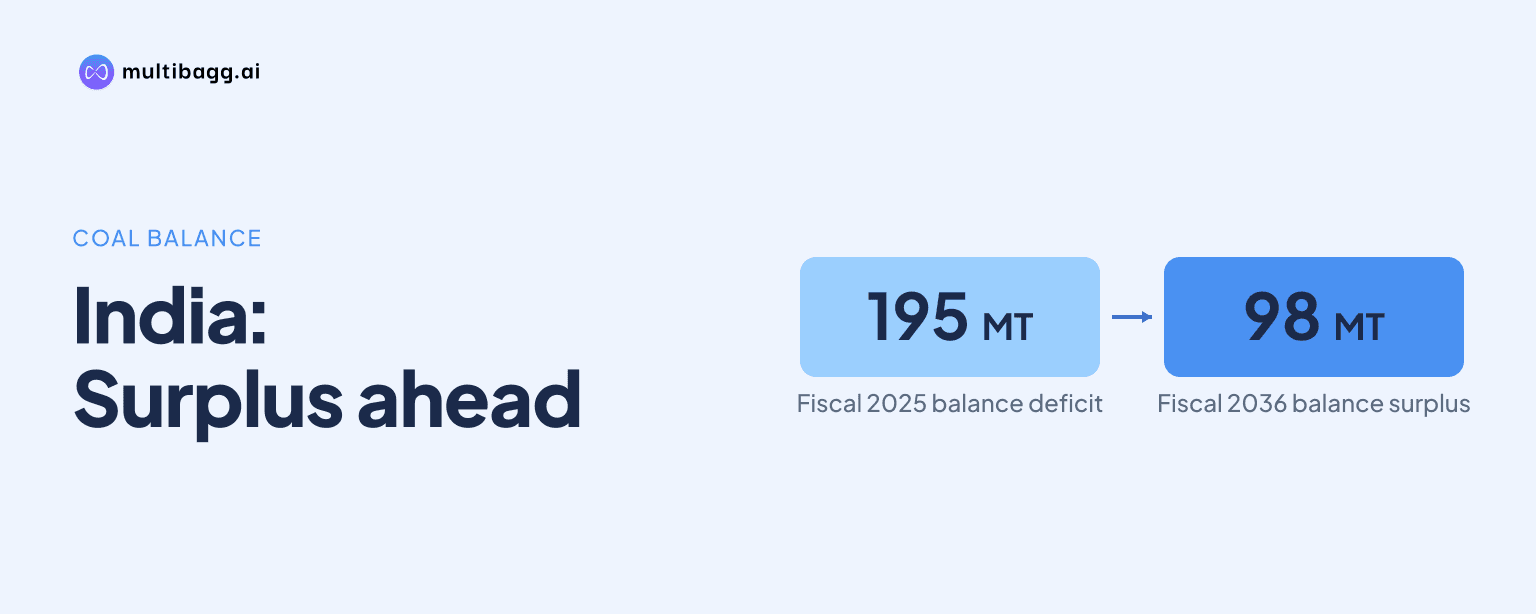
India is projected to move from a levelised coal deficit of 195 million tonnes (MT) in fiscal 2025 to a 98 MT supply surplus in fiscal 2036, as G10-grade supply reaches 1,810 MT against demand of 1,712 MT. The forecast depends on production growth from Coal India Limited, captive mines and commercial coal blocks.
Why is India’s coal supply projected to show a 98 MT surplus in fiscal 2036?
India’s coal supply is projected to exceed demand by 98 MT in fiscal 2036 because levelised supply at G10 grade is forecast at 1,810 MT, above total demand of 1,712 MT. A negative gap of 98 MT in the forecast denotes a surplus, reversing the 195 MT shortfall between 981 MT of supply and 1,176 MT of demand in fiscal 2025.
The projected crossover follows a narrowing deficit after fiscal 2026. The gap is forecast at 288 MT in fiscal 2026, then falls to 150 MT in fiscal 2028, 76 MT in fiscal 2030 and 62 MT in fiscal 2031. This is an aggregate supply outlook, rather than a finding that every coal consumer will cease importing, because coal quality, location and end-use requirements continue to affect procurement.
The comparison is on a G10-levelised basis, meaning coal is adjusted to a common grade for comparison. The source states that actual raw-coal demand can be higher because average Indian production was G11 and coal grades are expected to decline. The projected balance therefore depends on both mining volume and the calorific quality of delivered coal.
How fast are India’s coal demand and supply expected to grow?
India’s total coal demand is projected to rise from 1,176 MT in fiscal 2025 to 1,712 MT in fiscal 2036, a compound annual growth rate, or CAGR, of 3.5%. Raw coal production is projected to increase from 1,047 MT in fiscal 2025 to 2,043 MT in fiscal 2036, creating the faster supply path underlying the projected surplus.
Non-coking coal remains the larger part of projected demand, increasing from 1,112 MT in fiscal 2025 to 1,564 MT in fiscal 2036. Coking-coal demand is projected to rise from 64 MT to 148 MT over the same period. Non-coking coal is used in power generation, captive power plants, direct reduced iron, cement and other industrial processes, while coking coal is a metallurgical input in steelmaking.
Power utilities remain the largest demand source, even though their projected growth is lower than for captive power plants, or CPPs. Utility demand is forecast to increase from 698 MT in fiscal 2025 to 886 MT in fiscal 2036, while CPP demand rises from 143 MT to 292 MT. A CPP is an industrial facility that generates electricity primarily for its owner’s operations.
India’s power demand was 1,709 billion units in fiscal 2026 and is projected to reach 3,365 billion units by fiscal 2036. Coal’s generation share is also expected to face increasing renewable-energy competition, with the Government of India targeting 500 gigawatts of installed renewable capacity by 2030. The forecast therefore assumes coal demand continues to grow in absolute terms even as the generation mix changes.
Which producers are expected to provide India’s additional coal supply?
India’s projected supply growth comes from Coal India Limited, captive coal blocks, commercial coal blocks, Singareni Collieries Company Limited and other producers. Coal India Limited is projected to remain the largest contributor, with levelised G10 output of 1,265 MT in fiscal 2036, equivalent to about 70% of the projected 1,810 MT national total.
Commercial coal blocks are projected to provide 237 MT of levelised output in fiscal 2036, compared with 13 MT in fiscal 2025, while captive blocks are projected to supply 185 MT. The commercial-mining framework introduced in 2020 permits private entities to mine and sell coal in the open market. The source identifies operationalisation of auctioned mines and expansions at existing Coal India Limited and non-Coal India Limited mines as mechanisms that narrow the deficit.
Supply is concentrated geographically. Odisha produced 269 MT of raw coal in fiscal 2025, about 26% of India’s 1,047 MT total, while Jharkhand and Chhattisgarh each produced about 20%. Eastern-region levelised production is projected to reach 1,010 MT in fiscal 2036, or about 56% of national levelised supply, compared with 675 MT from the western region.
Coal India Limited’s current dominance makes execution at its subsidiaries material to the forecast. In fiscal 2026, Coal India Limited accounted for 73.81% of domestic production, while Mahanadi Coalfields Limited produced 218.31 MT and South Eastern Coalfields Limited produced 176.29 MT. The projected surplus requires both the established production base and newer commercial mines to deliver the forecast output.
Got a follow-up? Ask IRIS
Why could India still import coal despite a projected surplus?
India could still import coal in fiscal 2036 because a national surplus would not eliminate quality and logistics constraints. About 18,000 megawatts of coastal thermal-power capacity is technically designed for high-calorific, low-ash imported non-coking coal. Retrofitting these plants or transporting domestic coal from eastern mines to coastal plants can be capital-intensive or logistically uneconomic.
Coking coal is a separate constraint because domestic low-ash, high-fluidity coking-coal reserves are scarce. India imported 57.58 MT of coking coal in fiscal 2025, a 2.1% decline from the preceding year, indicating the steel sector’s continuing dependence on imported metallurgical coal for blast-furnace production.
Cement, aluminium and chemicals can also require higher-calorific coal with specified ash and sulphur characteristics that domestic coal, predominantly graded G11 to G17, cannot fully provide. Total coal imports declined 7.9% to 243.622 MT in fiscal 2025 from 264.531 MT in fiscal 2024 as domestic production increased, but this reduction does not remove the quality-based import requirement.
What could prevent India’s projected coal surplus from materialising?
India’s projected surplus could be delayed if mines, coal blocks or evacuation infrastructure do not start or expand as forecast. The source identifies surrender of high-premium commercial blocks, land-acquisition delays, railway-infrastructure delays for greenfield mines above 10 million tonnes per annum, and depletion of legacy mines as factors that could extend the deficit beyond fiscal 2031.
Coal quality is also material because the demand-supply forecast uses G10 levelisation. Lower grades require more raw coal to provide the same energy content, while greater washery recovery could reduce thermal by-products available to power plants. Mine development, washery commissioning and transport capacity must therefore convert mined output into usable delivered supply.
Rail logistics are another condition for the forecast. Rail carried 51% of domestic coal dispatch in fiscal 2025 and is projected to carry 59% by fiscal 2031. Coal India Limited plans to commission 92 first-mile connectivity projects with 994 million tonnes per annum of capacity by the end of fiscal 2029, using mechanised conveyors and rapid-loading systems to reduce road movement and expand mine evacuation.
Conclusion
India’s projected 98 MT coal surplus in fiscal 2036 marks a change in the aggregate G10-levelised balance, not the end of coal demand or imports. Demand is still forecast to increase by 536 MT from fiscal 2025 to fiscal 2036, supported by power utilities, captive generation and industry, but supply is projected to rise faster through Coal India Limited, commercial blocks and captive mines.
The next test is whether levelised supply reaches 1,433 MT by fiscal 2031, when the deficit is forecast to narrow to 62 MT. Key developments to watch are the operationalisation of auctioned commercial mines, Coal India Limited’s first-mile connectivity programme through fiscal 2029, mine clearances, rail evacuation capacity and continuing import demand from coastal power plants and steelmakers.