










MCL contractors supplied 71.96% of FY26 output as MDO grew
Key highlights
- Contractual or outsourcing arrangements produced 157.08 MT, or 71.96%, of MCL’s Fiscal 2026 coal output.
- MCL’s MDO production rose to 22.36 MT in Fiscal 2026 from 7.24 MT in Fiscal 2024.
- Departmental production contributed 38.87 MT, or 17.80%, of MCL’s Fiscal 2026 output.
- MCL produced 218.31 MT in Fiscal 2026 against normative capacity of 303.75 MT, equivalent to 71.87% utilisation.
powered by IRIS
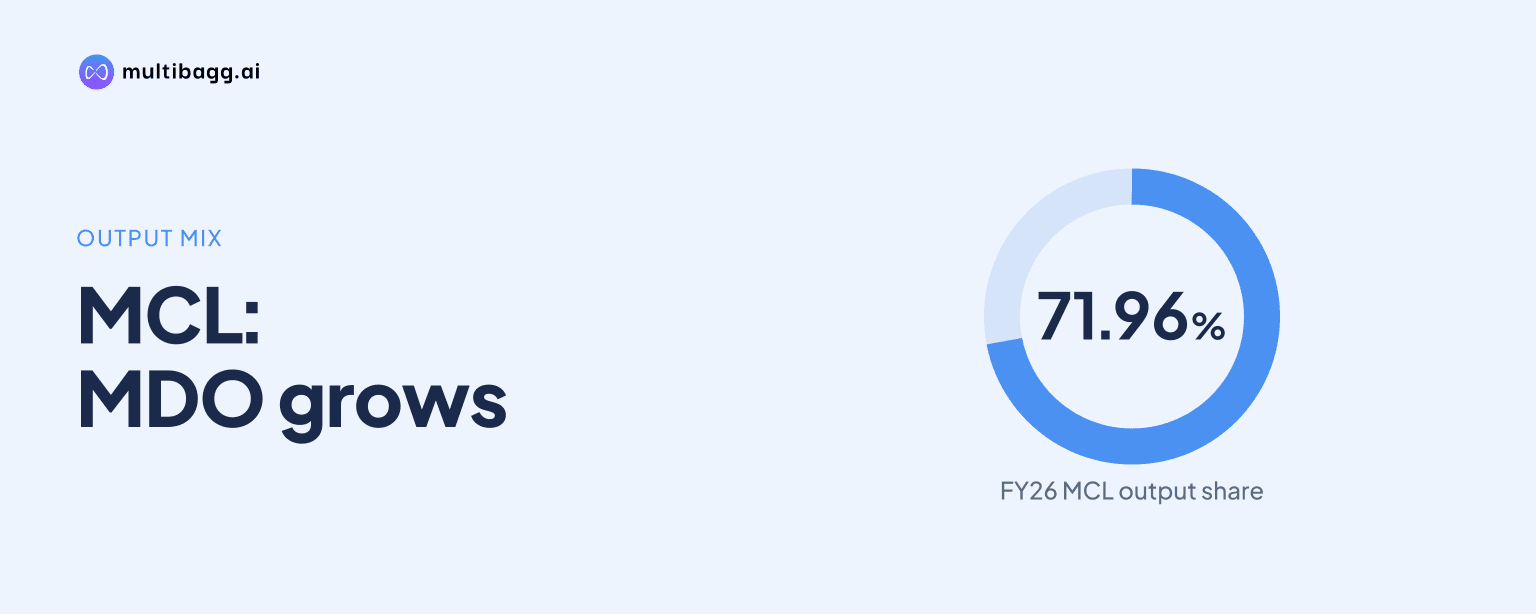
MCL produced 157.08 million tonnes (MT), or 71.96%, of its 218.31 MT Fiscal 2026 coal output through contractual or outsourcing arrangements, while the mine developer and operator (MDO) model produced 22.36 MT, or 10.24%. Together, the two third-party delivery models accounted for 82.20% of Fiscal 2026 production.
How much of MCL’s FY26 coal output came from contractors?
Contractual or outsourcing arrangements produced 157.08 MT, or 71.96%, of MCL’s Fiscal 2026 coal output of 218.31 MT. Departmental production, which MCL defines as mining through its own workforce, equipment and management systems, accounted for 38.87 MT or 17.80%. The MDO model supplied the remaining 22.36 MT, or 10.24%.
MCL’s contractual or outsourcing and MDO categories combined to deliver 179.44 MT in Fiscal 2026, equivalent to 82.20% of output. That was 5.11 MT below the Fiscal 2025 combined total of 184.55 MT: contractual or outsourcing production declined by 8.94 MT, while MDO production increased by 3.83 MT. Total output declined by 6.86 MT year on year and departmental production fell by 1.76 MT.
How did MCL’s MDO model grow in two years?
MCL’s MDO model increased its share of coal output to 10.24% in Fiscal 2026 from 3.51% in Fiscal 2024, while its volume rose by 15.12 MT to 22.36 MT. The model’s share was almost three times the Fiscal 2024 level, even as contractual or outsourcing’s share decreased from 78.53% to 71.96% over the same two-year period.
Under the MDO model, MCL states that selected mining partners assume full planning and operational responsibility under MCL’s supervision. MCL retains strategic oversight, production-target monitoring and compliance monitoring. The reported MDO volume therefore represents externally operated projects within a structure where MCL says it retains supervision over key decisions.
The movement also continued between Fiscal 2025 and Fiscal 2026. MDO output rose from 18.53 MT to 22.36 MT, lifting its production share by 2.01 percentage points. Contractual or outsourcing volume decreased from 166.02 MT to 157.08 MT, reducing its share by 1.77 percentage points, while departmental production’s share declined by 0.24 percentage points to 17.80%.
What coal-production work does MCL retain under its control?
MCL retains direct oversight of mine planning, blasting, quality assurance, safety protocols and logistics when it uses contractual or outsourcing arrangements. In that model, specialised equipment and operators are contracted for specified tasks in designated mine patches, while MCL states that its teams retain control of the listed critical functions.
MCL’s process includes mine planning and design with CMPDIL, government approvals, infrastructure development, coal extraction, conveying and processing. CMPDIL is engaged for exploration, geological assessments, mining-method selection, coal handling, environmental management and economic-viability evaluation. At mines where contractors undertake coal production or overburden removal, the contractors deploy the required heavy earth-moving machinery.
The distinction between the two external models is explicit in MCL’s description. Contractual or outsourcing uses third-party equipment and operators for defined tasks while MCL directly controls specified functions; the MDO model assigns full planning and operational responsibility to the partner for selected projects. Across departmental, contractual and MDO production, MCL says its core management maintains control of key decision-making processes.
Got a follow-up? Ask IRIS
What production and approvals affect MCL’s contractor reliance?
MCL’s Fiscal 2026 production was almost entirely opencast, with opencast mines producing 217.99 MT of the 218.31 MT total and underground mines producing 0.32 MT. Actual production represented 71.87% of normative capacity of 303.75 MT, where normative capacity is the standard annual quantity planned under an approved mining plan or project report. This compares with 72.46% in Fiscal 2025 and 71.40% in Fiscal 2024.
Mine-level production varied against normative capacity in Fiscal 2026. Ananta OCP Expansion produced 24.00 MT against normative capacity of 15.00 MT, equating to 160.00% capacity utilisation. Balaram OCP produced 3.92 MT against 15.00 MT, or 26.13% utilisation. These outcomes affect total production volumes regardless of whether extraction is undertaken departmentally, through contractual arrangements or by MDO partners.
MCL states that coal production depends on environmental clearances, forest clearances and other government approvals. Aggregate approved environmental-clearance capacity was 340.81 million tonnes per annum as at September 30, 2026, compared with 330.81 million tonnes per annum as at March 31, 2026. Forest clearances covered 5,136.12 hectares as at September 30, 2026, compared with 5,001.43 hectares as at March 31, 2026.
MCL’s Ib Valley coalfield is subject to an additional approvals consideration. The Central Pollution Control Board’s 2018 monitoring assigned the Ib Valley industrial cluster a Comprehensive Environmental Pollution Index score of 66.35 and classified it as severely polluted. MCL states that environmental clearances for mines in this cluster may face additional appraisal requirements and more stringent conditions, which may delay clearances or raise compliance costs.
Conclusion
MCL’s Fiscal 2026 production mix was dependent on external delivery models rather than wholly departmental mining. Contractual or outsourcing work supplied 157.08 MT and MDO partners supplied 22.36 MT, together accounting for 82.20% of 218.31 MT total output. The MDO model gained scale from 7.24 MT in Fiscal 2024, while contractual or outsourcing remained MCL’s largest production channel.
The next points to watch are MCL’s clearance and expansion progress, because planned production requires approvals alongside mining capacity and partner execution. MCL has environmental and forest-clearance proposals in progress for Balabhadra OCP Stage II at 10 million tonnes per annum, Balaram OCP Stage II at 15 million tonnes per annum, and Bharatpur OCP at 20 million tonnes per annum. MCL also states that integrated Kulda and Garjanbahal production is scheduled to begin in Fiscal 2028.