










Mahanadi Coalfields leaves most operating assets uninsured
Key highlights
- Mahanadi Coalfields disclosed no policy to insure all assets in fiscal 2024, fiscal 2025 and fiscal 2026.
- The recurring uninsured categories were PPE or fixed assets, stores and spares, and closing stock of coal.
- Fiscal 2026 identified road-plying HEMM and light vehicles as exceptions to the broad insurance gap.
- Mahanadi Coalfields disclosed no target date, premium estimate or asset value for its cost-benefit assessment.
powered by IRIS
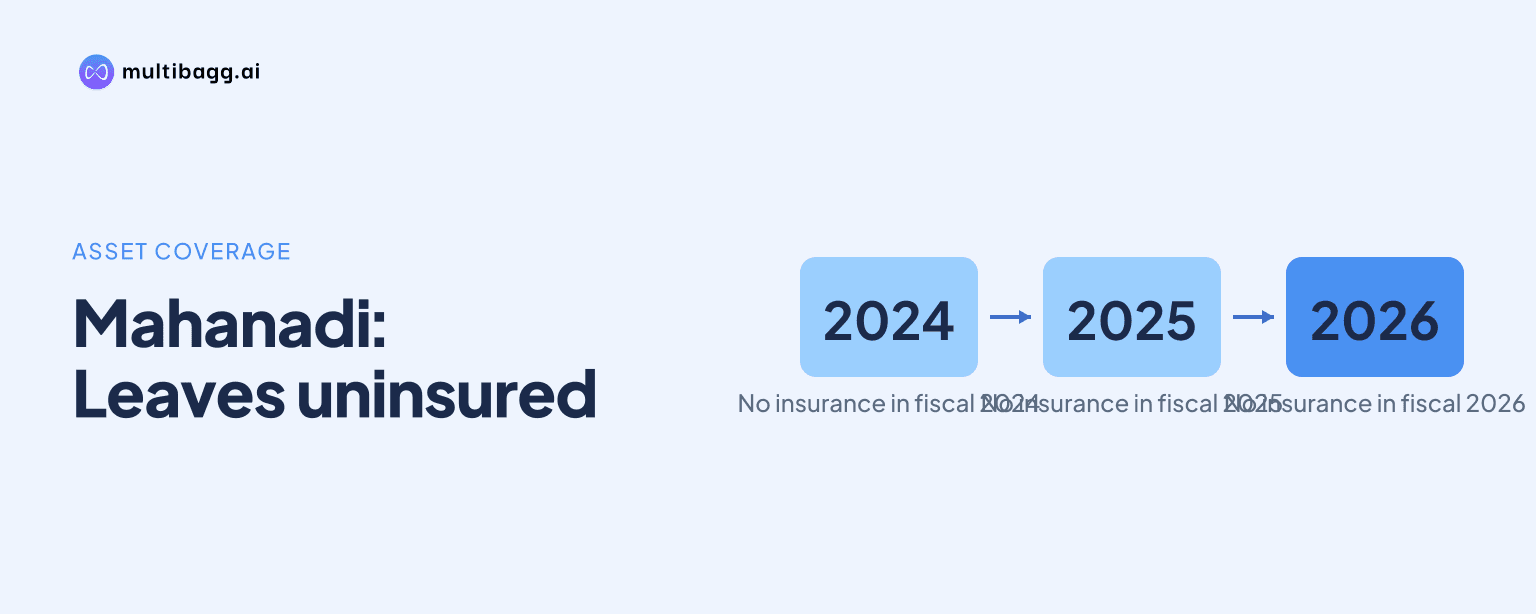
Mahanadi Coalfields Limited disclosed in fiscal 2024, fiscal 2025 and fiscal 2026 that most of its property, plant and equipment, coal closing stock, stores and spares lacked insurance against fire, burglary and allied risks. The recurring audit observation excluded only specified road-use machinery and vehicles, while Mahanadi Coalfields said it was assessing wider cover through a cost-benefit analysis.
Why does Mahanadi Coalfields leave most operating assets uninsured?
Mahanadi Coalfields says it has no policy for obtaining insurance for all its assets, and management is assessing insurance for other assets through a cost-benefit analysis. That was its response to the fiscal 2026 statutory-audit observation, which said the company had not insured its assets, property, plant and equipment, stores and spares, or coal closing stock against fire, burglary and allied activities, except road-plying heavy earth-moving machinery and light vehicles.
The fiscal 2026 response does not disclose the value of uninsured assets, the cost of premiums, the scope of policies under consideration or a date for completing the assessment. A cost-benefit analysis is therefore a stated review mechanism rather than a disclosed commitment to purchase cover. Wider insurance would depend on management completing that assessment and deciding that the cost and terms of coverage justify adoption.
Property, plant and equipment, or PPE, is the accounting category for long-lived operating assets. Heavy earth-moving machinery, or HEMM, refers to mining equipment; the fiscal 2026 audit wording identified only HEMM plying on roads and light vehicles as exceptions. The disclosure does not identify mine-site machinery, plant, structures or other individual PPE categories that may be insured, so the stated exceptions cannot be used to infer broader cover.
How long has the Mahanadi Coalfields insurance gap been reported?
Mahanadi Coalfields reported the insurance gap in audit disclosures for three consecutive fiscal years: fiscal 2024, fiscal 2025 and fiscal 2026. In fiscal 2024, the auditor said fixed assets, stores and spares, and closing coal stock had not been insured for fire, burglary and allied activities, except some HEMM and vehicles plying on roads.
The fiscal 2025 wording again identified PPE, stores and spares and closing coal stock as uninsured, with exceptions for some HEMM and road-plying vehicles. Mahanadi Coalfields repeated that it had no policy to insure all assets and was assessing the need for insurance of other assets using a cost-benefit analysis. The repetition between fiscal 2024 and fiscal 2025 shows that the disclosed policy position had not changed.
In fiscal 2026, the observation continued, but the exception was described as road-plying HEMM and light vehicles. Mahanadi Coalfields used the same response on the absence of a company-wide insurance policy and its ongoing assessment. The source does not state whether the narrower wording reflects a change in cover or only a change in how the auditor described the exceptions.
Which Mahanadi Coalfields assets are outside the stated cover?
Mahanadi Coalfields’ disclosed uninsured categories span long-lived assets, maintenance inventory and coal inventory awaiting sale or dispatch. The fiscal 2024 observation used “fixed assets,” while the fiscal 2025 and fiscal 2026 observations used PPE, but each year also named stores and spares and closing stock of coal. The three categories indicate that the audit matter was not confined to a single asset class.
The fiscal 2026 disclosure does not attach carrying values, replacement values, volumes of coal stock, or values of stores and spares to the insurance observation. It consequently does not allow calculation of the amount exposed to an uninsured fire, burglary or allied event. The absence of deductibles, policy limits and asset-level cover details also prevents a comparison between the limited road-use exceptions and the broader uninsured categories.
Mahanadi Coalfields’ fiscal 2026 financial disclosures separately recorded Rs 76.55 crore of unplanned depreciation in fiscal 2025-26 relating to fiscal 2023-24 and fiscal 2024-25, based on Comptroller and Auditor General observations. That item does not quantify the insurance gap or show an insurance-related loss, but it illustrates that the insurance observation appeared alongside other audit-report matters rather than as an isolated operational statement.
Got a follow-up? Ask IRIS
What could determine whether Mahanadi Coalfields buys wider insurance?
Mahanadi Coalfields has identified cost-benefit analysis as the mechanism that will determine insurance requirements for other assets. The fiscal 2024, fiscal 2025 and fiscal 2026 responses do not state a premium threshold, a targeted category of PPE, a board-approved insurance plan or a completion deadline. No future policy outcome can therefore be established from the three disclosed responses.
Any broader policy decision would need to specify whether coverage extends to fixed assets or PPE, stores and spares, and closing coal stock, the three categories repeatedly named from fiscal 2024 to fiscal 2026. It would also need to clarify whether road-plying HEMM and light vehicles remain separate exceptions or form part of a consolidated programme. None of those terms is set out in the fiscal 2026 response.
The source also does not report a fire, burglary, theft or allied loss arising from the stated absence of broad cover during the three reported fiscal years. It reports an exposure category rather than a realised loss amount. Whether the gap persists will therefore turn on the unresolved management assessment, not on a disclosed claims history or stated remediation timetable.
How was the insurance issue presented in Mahanadi Coalfields’ audit reports?
Mahanadi Coalfields’ insurance disclosure appeared under “other matters” in the supplied fiscal 2024, fiscal 2025 and fiscal 2026 audit-report disclosures. In fiscal 2026, it was not listed among the emphasis-of-matter items, which included the liquidation basis used for MJSJ Coal Limited, asset useful-life assumptions, a pending Odisha land-use appeal, an executive pay-scale provision and interest on an income-tax refund.
The “other matters” presentation records the auditor’s observation and Mahanadi Coalfields’ response; it does not provide an insurer’s assessment, quantify probable damage or determine that a loss will occur. The fiscal 2026 other-matters disclosures also included board-composition requirements and the implementation assessment for four labour codes, showing that the section grouped multiple matters with different mechanisms and financial effects.
Mahanadi Coalfields said director appointments were handled through the Ministry of Coal, while its insurance response identified management’s own cost-benefit analysis. The source does not say that Coal India Limited, the Ministry of Coal or an insurer must approve a future insurance policy. This distinction matters because only management’s assessment is disclosed as the next step for the insurance issue.
Conclusion
Mahanadi Coalfields disclosed an insurance gap for three successive fiscal years, covering most PPE or fixed assets, coal closing stock, stores and spares against fire, burglary and allied risks. The limited exceptions for road-plying HEMM and vehicles do not establish cover for the wider asset and inventory base. The disclosures identify continuing uninsured categories, but provide neither their value nor a loss estimate.
The next item to watch is the outcome of Mahanadi Coalfields’ stated cost-benefit analysis for other assets. A subsequent disclosure could show whether a policy is adopted, which fiscal-year asset categories are included, and whether the company provides premiums, limits, insured values or an implementation date. As of the fiscal 2026 response, each of those points remains unresolved.