










Mahanadi Coalfields contests Rs 1,504.391 crore order
Key highlights
- The Claims Commission assessed Rs 2,565.785 crore for compensation in Jhupruranga and Tumulia villages.
- Mahanadi Coalfields had deposited Rs 1,061.393 crore and was directed to deposit a further Rs 1,504.391 crore.
- Mahanadi Coalfields challenges the use of August 28, 2015 instead of September 2010 for market-value determination.
- The Rs 1,504.391 crore direction is about 3.54 times the Rs 425.12 crore litigation materiality threshold adopted in August 2026.
powered by IRIS
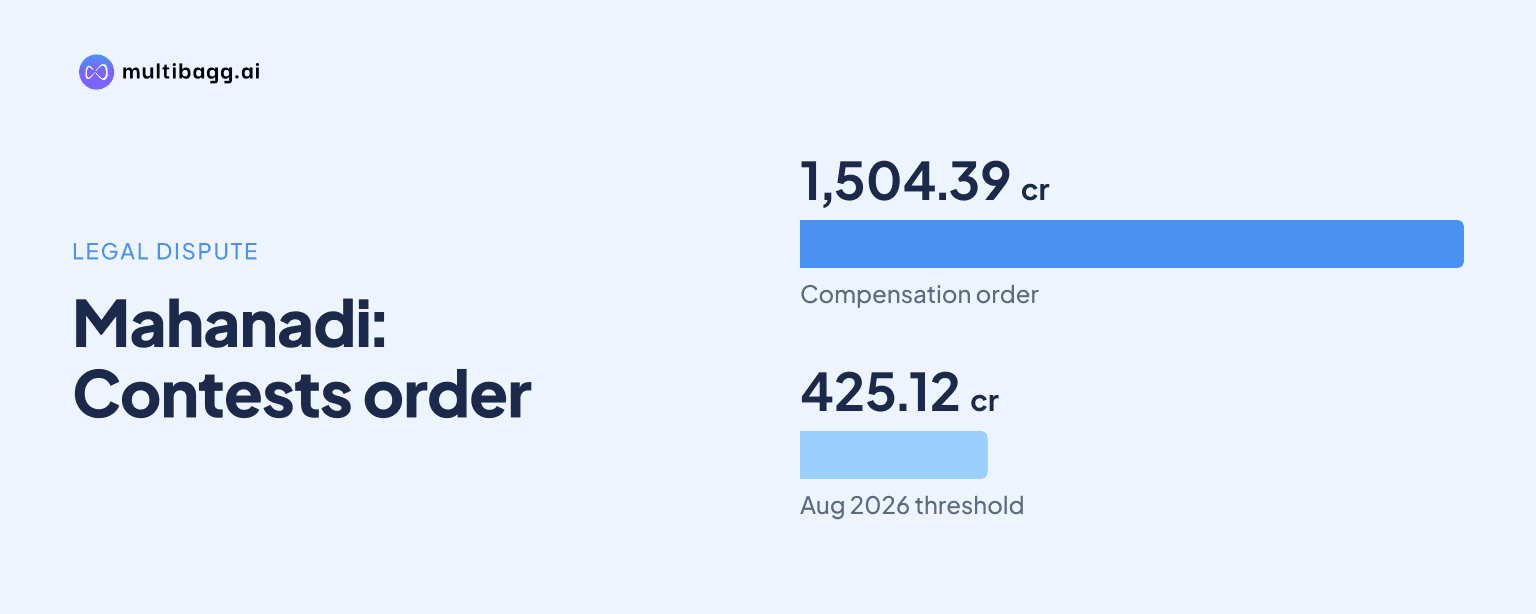
Mahanadi Coalfields is contesting a Rs 1,504.391 crore additional-compensation direction after the Claims Commission’s March 28, 2026 order assessed Rs 2,565.785 crore for Jhupruranga and Tumulia in Odisha, against Rs 1,061.393 crore already deposited. Its pending High Court petition disputes the market-value date and the treatment of solatium and interest.
Why is Mahanadi Coalfields contesting the Rs 1,504.391 crore order?
Mahanadi Coalfields is challenging the order because it says the Claims Commission misinterpreted the Supreme Court’s November 3, 2022 direction when setting the methodology for land compensation. The company filed a writ petition in the High Court of Orissa at Cuttack on October 10, 2023, seeking to uphold its proposed methodology and set aside the Claims Commission order.
Mahanadi Coalfields says September 2010, rather than August 28, 2015, should be the cut-off date for establishing market value for acquisitions in the villages. It also contends that the commission applied a double component of solatium and interest. Solatium is the statutory addition to compensation above a land’s assessed market value, while interest is an additional amount calculated under the applicable compensation framework.
The Claims Commission did not adopt Mahanadi Coalfields’ proposed approach in its March 28, 2026 order. The filing states that the commission used the market value as of August 28, 2015 under Section 26(1) and serial number 1 of the First Schedule to the Right to Fair Compensation and Transparency in Land Acquisition, Rehabilitation and Resettlement Act, 2013, or RFCTLARR Act. The dispute is therefore over calculation inputs and statutory additions, not over whether a compensation redetermination was required.
How did the Supreme Court-directed compensation process begin?
The Supreme Court constituted the Claims Commission on November 3, 2022 to resolve compensation, rehabilitation, beneficiary-identification and possession issues linked to government acquisition of land under the Coal Bearing Areas (Acquisition and Development) Act, 1957. The court directed the commission to redetermine compensation for Jhupurunga, Tumulia, Ratansara and Kriparsi under the RFCTLARR Act, while additionally considering September 2010 as the cut-off date.
Mahanadi Coalfields set out its proposed calculation in a January 1, 2025 letter to the Claims Commission and in a civil petition dated January 1, 2023. The company requested that September 2010 govern market-value determination, that the RFCTLARR Act’s First Schedule apply to all acquisitions, and that solatium follow a June 22, 2018 letter issued by Odisha’s Revenue and Disaster Management Department.
The disclosure records a special leave petition dated April 19, 2023 and Supreme Court orders dated May 12, 2023 and October 10, 2023, as well as the Claims Commission order dated March 28, 2026. It states that the two Supreme Court orders required Mahanadi Coalfields to place the differential compensation in an interest-bearing deposit account and permitted parties to approach the High Court for further grievances. The filing does not explain the apparent sequence between these dates.
What compensation did the Claims Commission calculate for the two villages?
The Claims Commission calculated Rs 2,565.785 crore of compensation for Jhupruranga and Tumulia and directed Mahanadi Coalfields to deposit a Rs 1,504.391 crore balance after recognising Rs 1,061.393 crore already deposited. The quantified order is expressly limited in the disclosure to Jhupruranga and Tumulia, although the November 2022 Supreme Court direction named four villages.
The directed balance equals about 58.6% of the Rs 2,565.785 crore assessment, while the recorded prior deposit equals about 41.4%. Those percentages describe the composition of the commission’s stated figures and do not determine the ultimate liability, because the writ petition remains pending before the High Court of Orissa.
Mahanadi Coalfields’ board adopted its litigation materiality policy on August 22, 2026, setting a Rs 425.12 crore threshold based on 2% of net worth at March 31, 2026. The Rs 1,504.391 crore differential direction is about 3.54 times that disclosure threshold. The threshold identifies material litigation for disclosure purposes and does not establish whether the commission’s compensation methodology is legally correct.
Got a follow-up? Ask IRIS
Which laws and calculation questions are before the High Court?
Mahanadi Coalfields’ case concerns the interaction between the Coal Bearing Areas Act, under which the acquisitions arose, and the RFCTLARR Act, under which the Supreme Court directed compensation to be redetermined on November 3, 2022. The company’s challenge asks how the Supreme Court direction should govern the date used for market value, application of the First Schedule, solatium and interest.
Section 26(1) and the First Schedule are central because the Claims Commission used them with an August 28, 2015 market-value date, according to the filing. Mahanadi Coalfields says September 2010 should apply instead. A different market-value date can change the base value of acquired land, while the treatment of solatium and interest can change the resulting compensation amount.
The Claims Commission at Bhubaneswar filed a counter affidavit on February 21, 2024 opposing Mahanadi Coalfields’ writ petition and seeking its dismissal. The filing does not disclose the counter affidavit’s detailed reasoning, a High Court hearing date or a decision. It therefore provides no basis to determine which calculation method the court will accept.
What does the interest-bearing deposit requirement mean for Mahanadi Coalfields?
The Supreme Court orders dated May 12, 2023 and October 10, 2023 required Mahanadi Coalfields to deposit the differential compensation in an interest-bearing deposit account, according to the disclosure. That arrangement places the disputed amount in an account while the challenge proceeds; it does not resolve the final entitlement of the company or claimants.
The filing does not disclose an interest rate, deposit date or accounting treatment for the Rs 1,504.391 crore amount. It also does not quantify compensation under Mahanadi Coalfields’ proposed September 2010 methodology. The financial difference between the current direction and the company’s preferred calculation therefore cannot be measured from the disclosed information.
The compensation dispute is separately identifiable within Mahanadi Coalfields’ disclosed litigation because five Motor Accidents Claims Tribunal matters total Rs 6.129 crore, compared with the Rs 1,504.391 crore compensation balance. The legal subjects are different and should not be treated as equivalent claims, but the figures show the scale of the compensation direction relative to that separately quantified group.
Conclusion
Mahanadi Coalfields is challenging the methodology behind a Supreme Court-directed land-compensation process, rather than the existence of the process itself. The Claims Commission’s use of an August 28, 2015 market-value date and its treatment of statutory additions produced a Rs 2,565.785 crore assessment for two villages and a Rs 1,504.391 crore further deposit direction after prior deposits.
The next disclosed issue is the High Court of Orissa’s consideration of the October 10, 2023 writ petition and the Claims Commission’s February 21, 2024 counter affidavit. Mahanadi Coalfields’ September 2010 cut-off argument, and its objections to solatium and interest, will determine whether the present methodology and deposit direction are retained or reconsidered; the filing provides no hearing schedule or target date.