










Mahanadi Coalfields FY24 audit finds coal sold below cost
Key highlights
- Orient Area Office recorded a Rs 347.92 crore loss in FY24, while Talcher recorded a Rs 321.75 crore loss.
- HB Mine’s FY24 selling price was Rs 1,432.29 per tonne against a weighted average production cost of Rs 5,905.89 per tonne.
- Mahanadi Coalfields said it was exploring an MDO model and manpower redeployment to reduce costs at the affected mines.
- FY23 FSA-related invoices totalling Rs 258.97 crore were issued five to six months after the stated due date.
powered by IRIS
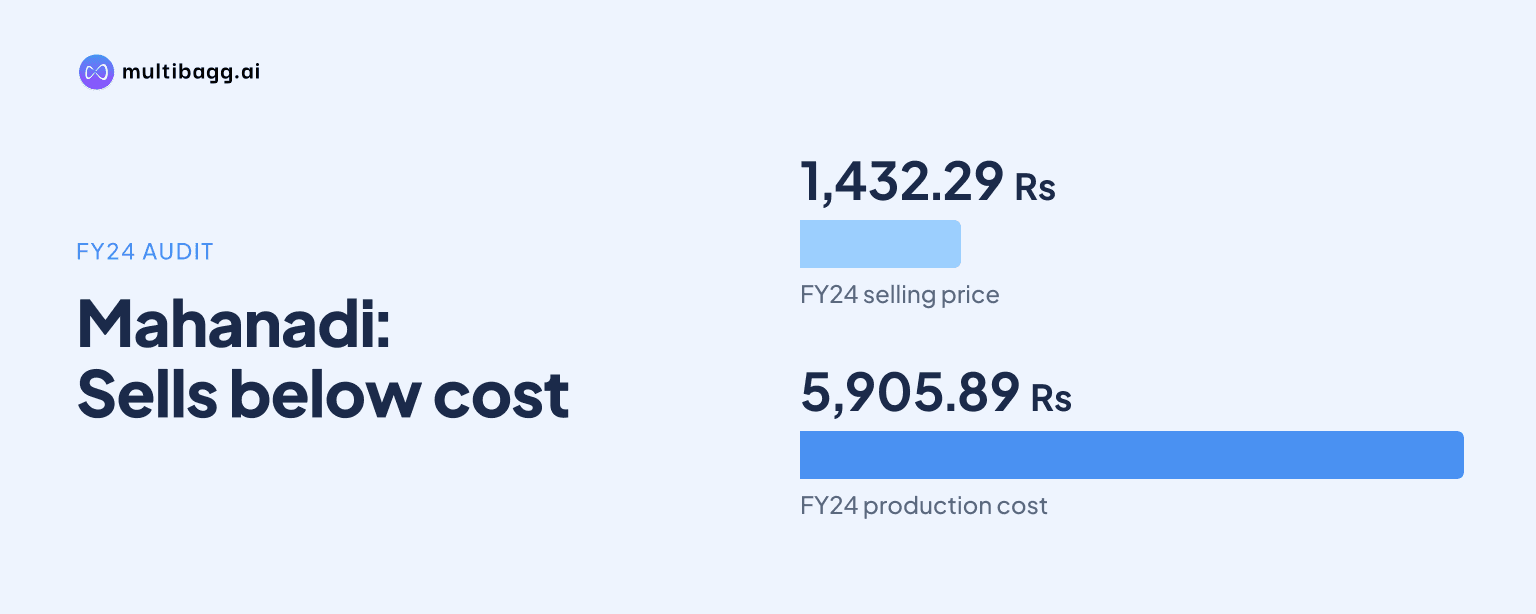
Mahanadi Coalfields Limited recorded FY24 losses of Rs 347.92 crore in its Orient Area Office and Rs 321.75 crore in Talcher after coal selling prices remained below production costs; at HB Mine, the price was Rs 1,432.29 per tonne against a weighted average cost of Rs 5,905.89 per tonne.
What did the FY24 audit observation say about Mahanadi Coalfields coal costs?
Mahanadi Coalfields’ FY24 audit observation said the Orient Area Office incurred a Rs 347.92 crore loss because coal was sold substantially below production cost at HB Mine and M2. The observation reported a weighted average cost of Rs 5,905.89 per tonne and an average selling price of Rs 1,432.29 per tonne at HB Mine; at M2, it reported a cost of Rs 5,386.28 per tonne and a selling price of Rs 1,531.94 per tonne.
The disclosed unit-price gaps were Rs 4,473.60 per tonne at HB Mine and Rs 3,854.34 per tonne at M2. On these measures, revenue per tonne did not cover the respective cost of production, which explains the auditor’s observation that the position would negatively contribute to the organisation’s reserves.
The disclosure identifies an area-level loss of Rs 347.92 crore for Orient, rather than separate losses for HB Mine and M2. It also does not provide tonnes sold by either Orient mine or Talcher, so the disclosed figures do not permit calculation of each mine’s contribution to the Orient loss.
Why was the Orient loss higher than Talcher’s in FY24?
Orient’s FY24 loss of Rs 347.92 crore was Rs 26.17 crore higher than Talcher’s Rs 321.75 crore loss, while the disclosed price-cost shortfalls at both Orient mines were wider. HB Mine’s Rs 4,473.60 per-tonne gap was Rs 3,373.92 per tonne larger than Talcher’s Rs 1,099.68 gap, and M2’s shortfall was Rs 2,754.66 per tonne larger.
Talcher remained loss-making in the audit observation because its selling price of Rs 2,088.52 per tonne was below its production cost of Rs 3,188.20 per tonne. Talcher’s price was higher than the prices reported for HB Mine and M2, but its cost was also lower than both Orient mines, showing that the reported area losses reflect both unit gaps and sales or production volumes that were not disclosed.
For the disclosed cost-price position to change, realised selling prices would have to rise, production costs would have to decline, or both would need to occur. This is an analytical implication of the FY24 price and cost figures, not a company forecast: Mahanadi Coalfields disclosed no price target, cost-reduction target, volume target or deadline for returning Orient or Talcher to profitability.
Got a follow-up? Ask IRIS
How does Mahanadi Coalfields plan to address the coal cost gap?
Mahanadi Coalfields said it was exploring operation of the affected mines through a mine developer and operator, or MDO, model, which could decrease costs. An MDO is a third-party arrangement under which a contractor develops and operates mining activities; Mahanadi Coalfields also said it was exploring transfers of some manpower from these mines to productive mines to reduce manpower costs.
The company presented the MDO model and manpower movement as options under exploration, not as a completed FY24 programme. Mahanadi Coalfields did not identify mines proposed for MDO operation, name an operator, estimate the cost saving per tonne, disclose the number of workers to be redeployed, or give an implementation date, leaving the outcome dependent on subsequent execution.
The FY24 accounts contained a separate policy revision for stripping activity expenses and adjustments, which are costs associated with removing overburden to access coal. The revision increased FY24 profit before tax by Rs 655.71 crore, restated the prior year’s net profit downward by Rs 5.05 crore, and resulted in a stripping-activity asset of Rs 841.54 crore as at April 1, 2022 being considered in the current-year income-tax calculation.
What other FY24 audit matters could affect Mahanadi Coalfields revenue and cash?
Mahanadi Coalfields’ FY24 audit observation also identified delayed invoicing of performance incentives and compensation cess under fuel supply agreements, or FSAs. Under the disclosed FSA terms, a performance incentive applies when a buyer lifts more than 90% of annual contracted quantity, or ACQ, while compensation cess applies when lifting is below 75% of ACQ; the auditor said invoices should be raised by year-end based on quantities lifted.
Invoices for FY23 performance incentive and compensation cess totalling Rs 258.97 crore were issued in August and September 2023, five to six months after the stated due date. The observation said delayed invoices could create lost bank-interest opportunity, revenue risk if a buyer discontinued operations, and possible interest at 18% under Section 50 of the Central Goods and Services Tax Act; Mahanadi Coalfields responded that it was expediting billing of this income.
The observation also recorded Rs 3,392 crore of income-tax refunds pending for assessment years 2019-20 to 2023-24. Mahanadi Coalfields said that during the next fiscal year it filed grievances, obtained refunds for those periods and filed rectification appeals in the cited cases; separately, it disputed Indian Railways demurrage demands of Rs 21.33 crore for FY20 through FY24 and disclosed them as contingent liabilities rather than making a provision.
Conclusion
The FY24 audit observation identifies a specific operational profitability issue at Mahanadi Coalfields’ Orient and Talcher operations: each disclosed cost-price comparison showed selling prices below production costs, while the two area offices reported combined losses of Rs 669.67 crore. Orient had the larger area loss and substantially wider disclosed unit gaps, while delayed FSA billing and pending tax refunds were additional matters relevant to cash collection and financial reporting.
The next disclosure to watch is whether Mahanadi Coalfields turns its exploratory MDO and manpower-redeployment proposals into an operating plan naming mines, timelines and expected cost reductions. Updates on the recovery of FY24-related tax refunds, the Rs 21.33 crore railway demurrage demands, and the accounting effects of the stripping-activity policy revision will also determine how these audit matters develop.