










Mahanadi Coalfields Limited stripping policy misses Ind AS 37
Key highlights
- Mahanadi Coalfields said its stripping-provision reversal policy is not as required by Ind AS 37.
- The reversal equalled 1.09% of profit before tax for the six months ended September 30, 2026, versus 3.75% a year earlier.
- Fiscal 2025 had the highest disclosed reversal share, at 4.01% of profit before tax.
- Mahanadi Coalfields said Ind AS 37 would have required a full reversal of the March 31, 2023 provision in Fiscal 2023.
powered by IRIS
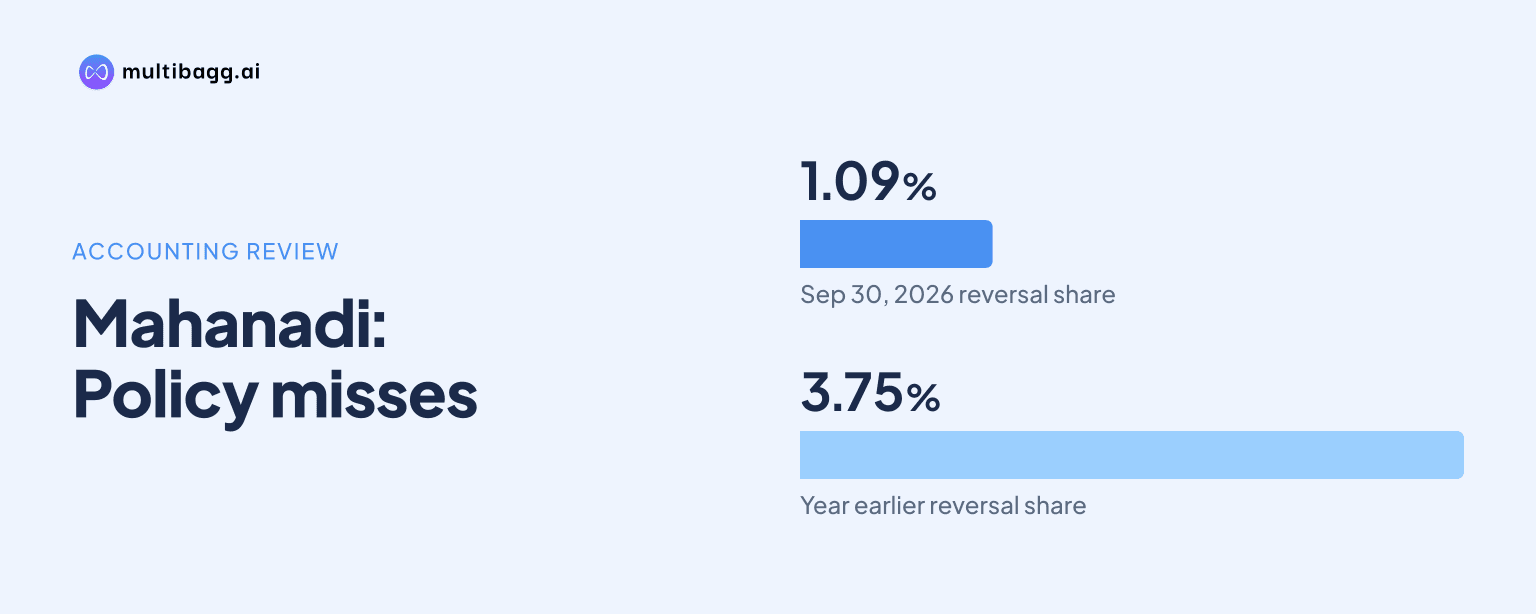
Mahanadi Coalfields says its systematic stripping-activity provision reversal policy does not meet Ind AS 37, and the reversal equalled 1.09% of profit before tax for the six months ended September 30, 2026. The company also says that, had Ind AS 37 been applied, no reversals would have been recorded in the reported periods from Fiscal 2024 through September 2026.
What compliance gap did Mahanadi Coalfields disclose under Ind AS 37?
Mahanadi Coalfields disclosed that its policy for the systematic reversal of stripping-activity provisions is not in accordance with Ind AS 37, the Indian Accounting Standard covering provisions, contingent liabilities and contingent assets. The disclosure appears in the company’s risk factors and identifies a policy-level mismatch, rather than stating that only a single reporting-period entry was outside the standard.
Mahanadi Coalfields said the accounting policy for stripping-activity provisions was revised during Fiscal 2024. The company’s disclosure nevertheless says the revised policy does not satisfy Ind AS 37, making the timing and method of reversals relevant to the interpretation of profit before tax in Fiscal 2024, Fiscal 2025, Fiscal 2026 and the six months ended September 30, 2026.
The provision concerns stripping activity at a mine where the volume of overburden, the material removed in mining, exceeds the expected volume of overburden. Mahanadi Coalfields describes a systematic reversal mechanism for such provisions, but its risk disclosure does not provide the rupee amount of the provision balance or the rupee value reversed in each of the five reported periods.
The distinction matters because a provision reversal is recognised in profit before tax, or PBT, in the period of reversal. Mahanadi Coalfields therefore gives the reversal as a percentage of PBT for each period, but it does not disclose enough information in this risk factor to calculate an adjusted PBT figure from the percentage alone.
How much did stripping-provision reversal contribute to Mahanadi Coalfields profit before tax?
Mahanadi Coalfields said stripping-activity provision reversals represented 1.09% of PBT in the six months ended September 30, 2026, compared with 3.75% in the six months ended September 30, 2025. The stated proportion declined by 2.66 percentage points year on year for the comparable six-month periods, although the company did not disclose the underlying rupee reversal amounts in this section.
For the full-year periods, Mahanadi Coalfields reported reversals equal to 3.41% of PBT in Fiscal 2026, 4.01% in Fiscal 2025 and 2.56% in Fiscal 2024. Fiscal 2025 was the highest of the three full years on this measure, at 0.60 percentage points above Fiscal 2026 and 1.45 percentage points above Fiscal 2024.
The percentages establish that the reversal affected reported PBT in every period shown, but they do not establish the absolute size of the accounting effect. A percentage of PBT can change because the reversal changes, because PBT changes, or because both change; Mahanadi Coalfields provides no period-by-period rupee reconciliation of those components in the supplied disclosure.
Got a follow-up? Ask IRIS
What would have changed if Mahanadi Coalfields had applied Ind AS 37?
Mahanadi Coalfields says that applying Ind AS 37 would have required the total stripping-activity provision outstanding at March 31, 2023 to be reversed in Fiscal 2023. Under the company’s stated counterfactual, the accounting impact would therefore have been recognised before Fiscal 2024 rather than being systematically reversed across later reporting periods.
Mahanadi Coalfields further says there would have been no stripping-activity provision reversals in Fiscal 2024, Fiscal 2025, Fiscal 2026, the six months ended September 30, 2025, or the six months ended September 30, 2026 if Ind AS 37 had been applied. That statement directly links the reported reversal percentages of 2.56% to 4.01% in the three fiscal years, and 3.75% and 1.09% in the two interim periods, to the policy the company says is not compliant.
The disclosed alternative does not mean that every item in PBT would change. It means the timing of this specific stripping-provision reversal would differ: the opening provision at March 31, 2023 would have been reversed in Fiscal 2023, with no subsequent reversals in the listed periods. Mahanadi Coalfields does not quantify the Fiscal 2023 reversal or specify the resulting Fiscal 2023 PBT effect in rupees.
This creates a comparability issue across periods because reported PBT after March 31, 2023 includes the effect of reversals that the company says would not have occurred under Ind AS 37. Any assessment of changes in PBT between Fiscal 2024 and Fiscal 2026 must therefore distinguish operational and other accounting movements from the disclosed stripping-provision reversal effect.
Why does the Fiscal 2024 policy revision matter for comparing earnings?
Mahanadi Coalfields revised its stripping-activity provision policy during Fiscal 2024, yet says the systematic reversal policy remains outside Ind AS 37 requirements. The Fiscal 2024 revision is therefore an important reporting-date marker: it changed the policy during the first full fiscal year in which the company reports a reversal equal to 2.56% of PBT.
Mahanadi Coalfields reports a higher reversal share of PBT in Fiscal 2025 at 4.01%, followed by 3.41% in Fiscal 2026 and 1.09% in the six months ended September 30, 2026. These movements show that the reported influence of the reversal on PBT was not constant, so a comparison of headline PBT across these periods requires attention to both the policy and the relative percentage disclosed for each period.
The company’s disclosure does not say that the stated percentages are an error correction, a restatement, or a cash-flow item. It characterises the issue as a policy that is not as required by Ind AS 37 and explains the different outcome under that standard, namely a full reversal in Fiscal 2023 and nil reversals in the subsequent periods listed.
Mahanadi Coalfields also does not provide an updated timetable for further policy action in the supplied risk factor. The disclosed facts consequently allow readers to identify the reported PBT exposure by period and the company’s Ind AS 37 counterfactual, but not to determine whether future financial statements will contain a correction, a restatement, or another change in accounting treatment.
Conclusion
Mahanadi Coalfields has explicitly said that its systematic stripping-activity provision reversal policy does not comply with Ind AS 37. The reversals equalled between 1.09% and 4.01% of PBT across the five periods disclosed, meaning reported PBT in Fiscal 2024 through the six months ended September 30, 2026 included an accounting effect that the company says would not arise if Ind AS 37 had been applied.
The unresolved matter is whether Mahanadi Coalfields will provide a rupee reconciliation of the opening provision at March 31, 2023 and the later reversals, or change its accounting treatment. The supplied disclosure sets out no timetable for a correction or restatement, while specifying that an Ind AS 37 outcome would have placed the full reversal in Fiscal 2023.